
Nathaniel Stern scans artwork into being
Mary Louise Schumacher for the Milwaukee Journal Sentinel

It’s a quirk of human nature to want to see the world through facsimiles of it. That instinct — to look at pictures — is as old as humankind. It defines us, really.
So what happens when the world itself seems to be a terrain of copies, when our days are filled with more images of people and places than actual ones, for instance.
This is the territory of Milwaukee artist Nathaniel Stern, who just had a solo show at the Tory Folliard Gallery, some of which remains on view. Stern creates work he calls Compressionism, images made by strapping a desktop scanner to his body and scanning various landscapes in steady long lines, sweeping motions, quick pogo stick-like hops or while scuba diving underwater. These scans are then turned into artworks using photographic or inkjet printing processes.
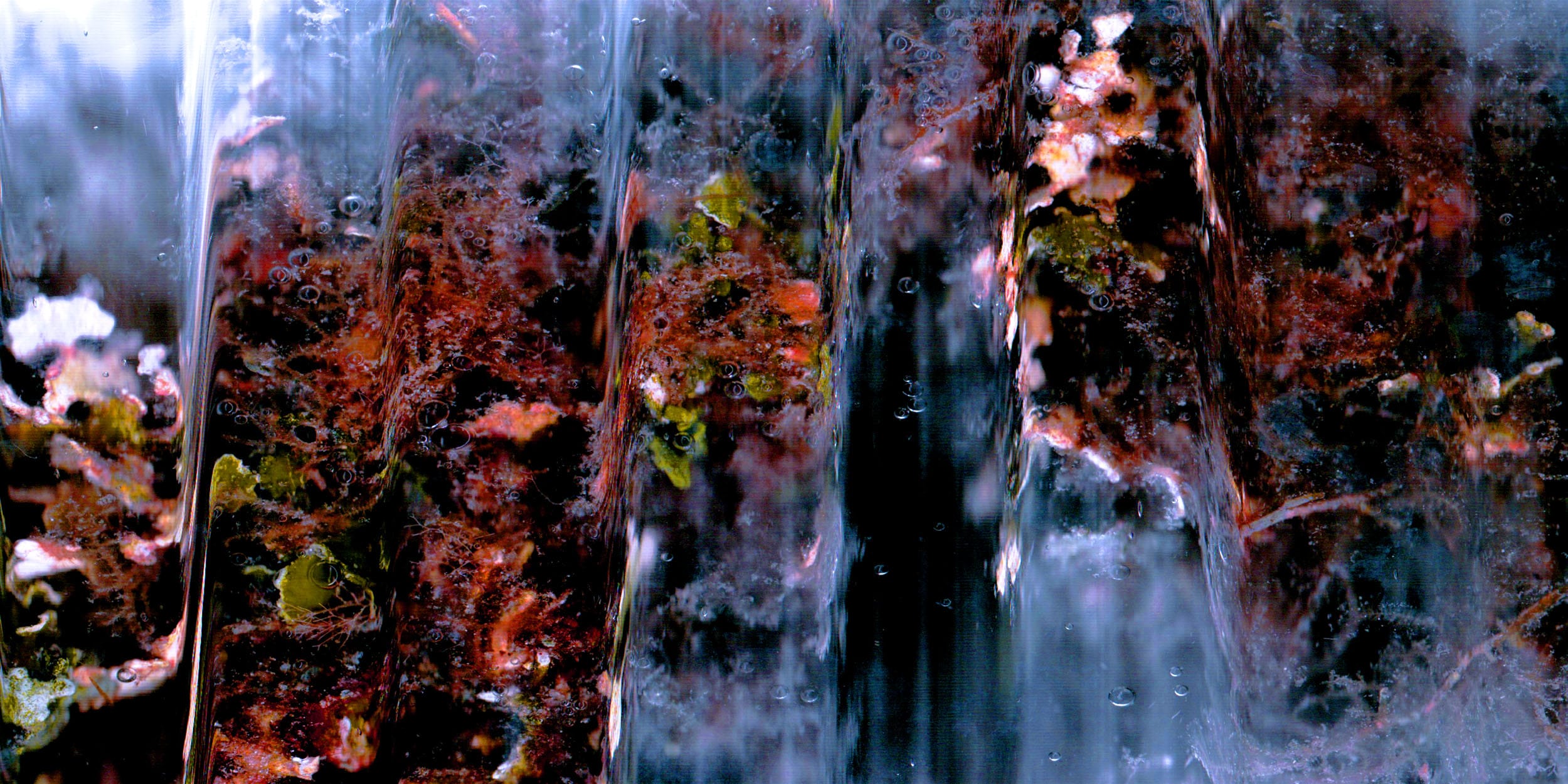
In “Soft,” for instance, we see what looks like scrubby, organic matter undulating in water and pressed up against glass, presumably the face of the scanner. It’s akin to what we might expect from a work of art, a pictorial depiction beneath glass. But we also see the gravity of it, the sensation of these wheat-colored plants with a faint purple tinge brushing against the surface.
Distorting waves, not unlike those of an analog TV screen with the horizontal hold out of whack, are a visual hint that we’re looking at manipulated media. Throughout the series, mysterious digital hiccups, skips, drags and scratches are further pictorial pointers. In them, oscillations of time and movement are inferred. Some works have an inherent quickness, while others are more unhurried and stretch out a moment in time.
Barely detectable inside this expression of narrative is the artist himself, and the sense of performance he brings physically to the work. He says he “performs images into existence.” I like that. I like that the primary artistic act of this work, fundamentally about the mediation of imagery, isn’t made with a computer but with a body out in the world doing things.
It is intriguing to consider our changing visual literacy, by the way. Much of Stern’s iconography would be unintelligible to our 19th-century counterparts.
The best works in the “Rippling Images” series, for me, were those where realism, simulation and abstraction combined in playful and surprising ways, when the digital ripples and the watery ones that are Stern’s subject become inseparable, when reality and its copies dance.
The result is something quite transporting, works reminiscent of the primordial and the pliability of human perception in the 21st century. My only quibble is the somewhat informal presentation of the works, which are set loosely into the frames so that ripples in the paper are visible. I’m told this is intentional, that the artist wants us to see these prints as objects with a surface. I’m just not sure this works.
Stern is represented by the Tory Folliard Gallery, 233 N. Milwaukee St., which is currently showing some of his works. He also has related work up at the Milwaukee Institute of Art & Design, 273 E. Erie St., through Saturday, Dec. 6. He will also have a show at the Museum of Wisconsin Art, 205 Veterans Ave., West Bend, opening April 11. For more information: nathanielstern.com
Related artworks:
Other related texts:
Furtherfield
The Performance of Infrastructure: Review of Interactive Art and Embodiment: The Implicit Body As Performance by Nathaniel Stern
Book review by Robert Jackson
Excerpt:

… Nathaniel Stern’s Interactive Art and Embodiment establishes two first events: not only Stern’s debut publication but also the first of a new series from Gylphi entitled “Arts Future Book” edited by Charlotte Frost, which began in 2013. All quotations are from this text unless otherwise stated.
Stern’s vision in brief: in order to rescue what is philosophically significant about interactive art, he justifies its worth through the primary acknowledgement of embodiment, relational situation, performance and sensation. In return, the usual dominant definitions of interactive art which focus on technological objects, or immaterial cultural representations thereof are secondary to the materiality of bodily movement. Comprehending digital interactive art purely as ‘art + technology’ is a secondary move and a “flawed priority” (6), which is instead underscored by a much deeper engagement, or framing, for how one becomes embodied in the work, as work. “I pose that we forget technology and remember the body” (6) Stern retorts, which is a “situational framework for the experience and practice of being and becoming.” (7). The concepts that are needed to disclose these insights are also identified as emergent.
“Sensible concepts are not only emerging, but emerging emergences: continuously constructed and constituted, re-constructed and re-constituted, through relationships with each other, the body, materiality, and more.” (205)
Interactive Art and Embodiment then, is the critical framework that engages, enriches and captivates the viewer with Stern’s vision, delineating the importance of digital interactive art together with its constitutive philosophy.
One might summarise Stern’s effort with his repeated demand to reclaim the definition of “interactive”. The term itself was a blatantly over-used badge designed to vaguely discern what made ‘new media’ that much newer, or freer than previous modes of consumption. This was quickly hunted out of discursive chatter when everyone realised the novel qualities it offered meant very little and were politically moribund. For Stern however, interactivity is central to the entire position put forward, but only insofar as it engages how a body acts within such a work. This reinvigorated definition of “interactive” reinforces deeper, differing qualities of sensual embodiment that take place in one’s relational engagement. This is to say, how one literally “inter-acts” through moving-feeling-thinking as a material bodily process, and not a technological informational entity which defines, determines or formalises its actions. A digital work might only be insipidly interactive, offering narrow computational potentials, but this importance is found wanting so long as the technology is foregrounded over ones experience of it. Instead ones relationship with technological construction should melt away through the implicit duration of a body that literally “inter-acts” with it. In Stern’s words:
“…most visually-, technically-, and linguistically-based writing on interactive art explains that a given piece is interactive, and how it is interactive, but not how we inter-act” (91)
Chapter 1 details how aesthetic ‘vision’ is understood through this framework, heavily criticising the pervasive disembodiment Stern laments in technical discussions of digital art and the VR playgrounds from the yesteryear of the 90s. Digital Interactive Art has continually suppressed a latent embodied performance that widens the disembodied aesthetic experience towards – following Ridgway and Thrift – a “non-representational experience.” Such experiences take the body as an open corporal process within a situation, which includes, whilst also encompassing, the corporal materiality of non-human computational processes. This is, clearly, designed to oppose any discourse that treats computation and digital culture as some sort of liberating, inane, immaterial phenomenon: to which Stern is absolutely right. Moreover, all of these material processes move in motion with embodied possibilities, to “create spaces in which we experience and practice this body, its agency, and how they might become.” (40) To add some political heft, Stern contrasts how the abuse of interactivity is often peddled towards consumerist choice, determining possibilities, put against artistic navigation that relinquishes control, allowing limitless possibilities. Quoting Erin Manning, Stern values interactive art’s success when it doesn’t just move in relation to human experience, but when humans move *the* relation in experience (Manning, 2009: 64; Stern, 46).
Stern’s second chapter moves straight into a philosophical discussion denoting what he means by an anti-Cartesian, non-representational, or implicit body. Heavily contexualised by a host of process, emergent materialist thinkers (Massumi, Hayles, Barad), Stern concentrates on the trait of performance as the site of body which encapsulates its relationally, emergence and potential. The body is not merely formed in stasis, (what Stern dubs “pre-formed” (62) but is regularly and always gushingly “per-formed” (61) in its movement. Following Kelli Fuery, the kind of interactivity Stern wants to foreground is always there, not a stop-start prop literate to computer interaction, but an effervescent ensemble of “becoming interactive” (Fuery, 2009: 44; Stern, 65). Interactive art is not born from an effect bestowed by a particular medium of art making, but of “making literal the kinds of assemblages we are always a part of.” (65)
Chapter three sets out Stern’s account for the implicit body framework: detailing out four areas: “artistic inquiry and process; artwork description; inter-activity and relationally.” (91) Chapters four, five and six flesh out this framework with actual practices. Four considers close readings of the aforementioned work of Penny together with Camille Utterback merging the insights gained from the previous chapters. What both artists encapsulate for Stern is that their interventions focus on the embodied activities of material signification: or “the activities of writing with the body” (114) Utterback’s 1999 installation “Textrain” is exemplary to Stern’s argument: notably the act of collecting falling text characters on a screen merges dynamic body movements with poetic disclosure. The productions of these images are always emergent and inscribed within our embodied practices and becomings: that we think with our environment. Five re-contextualises this with insights into works by Scott Scribbes and Mathieu Briand’s interventions in societal norms and environments. Six takes on the role of the body as a dynamic, topological space: most notably as practiced in Rafael Lozano-Hemmer. Chapter seven I’ll discuss near the conclusion: the last chapter shortly.
Firstly, the good stuff. Interactive Art and Embodiment is probably one of the most sincerest reads I’ve encountered in the field for some time. Partly this is because the book cultivates Stern’s sincerity for his own artistic practice, together with his own philosophical accounts that supplement that vision. His deep understanding of process philosophy is clearly matched by his enthusiastic reassessment of what interactive art purports to achieve and how other artists might have achieved it too. And it’s hard to disagree with Stern’s own position when he cites examples (of his work and others) that clearly delegate the philosophical insights to which he is committed. One highlight is Stern’s take on Scribbes’ Boundary Foundations (1998) and the Screen Series (2002-03) which intervenes and questions the physical and metaphorical boundaries surrounding ourselves and others, by performing its questioning as work. This is a refreshingly earnest text, proving that theory works best not when praxis matches the esoteric fashions of philosophical thinking, but when art provides its own stakes and its own types of thinking-experience which theory sets out to faithfully account and describe. Stern’s theoretical legitimacy is never earned from just digesting, synthesising and applying copious amounts of philosophy, but from the centrality of describing in detail what he thinks the bodily outcomes of interactive art are and what such accounts have to say: even if they significantly question existing philosophical accounts.
Stern leaves the most earnest part of his book towards the end in his final semi-auto-biographical companion chapter called “In Production (A Narrative Inquiry on Interactive Art)”. This is a snippet of a much larger story, available online and subject to collaboration [4]. Here, Stern recounts or modifies the anxiety inducing experience of being a PhD student and artist, rubbing up alongside the trials of academic rigour, dissertation writing and expected standards. Quite simply, Stern is applying his insights of performative processual experience into the everyday, ordinary experiences faced by most PhD students in this field, and using it to justify a certain writing style and a sense of practice. It’s an enjoyable affair – in large part because it outclasses the dry scholarly tone usually associated with writing ‘academically’, elevating imaginative, illuminating redescriptions for how the experiences of interactive art broadly hang together rather than relying on relentless cynical critique. And most of that is down to Stern’s strong literary metaphorical technique for grounding his vision, perhaps even more effectively than the previous chapters.
Yet earnest experiences aside, there are two problems with Stern’s vision which, in my eyes, leave it flawed. That isn’t a bad thing: all visions are flawed of course. That’s why the similarities between art and philosophy feed our heuristic, academic compulsion to come up with them and debate: well, that and sometimes the most flawed can end up being the most influential…
Read the entire review in context (with introduction and conclusion) on Furtherfield
Related artworks:
Other related texts:
TEDx talk
“Nathaniel Stern is an awkward artist, teacher and writer, who likes awkward art, students and writing. Stern’s talk, Ecological Aesthetics, discusses tweets in space, scans at the bottom of the sea, interactive installations, and art in virtual worlds – all work about the complex relationships between humans, nature, and politics.”

What is TEDx?
“Imagine a day filled with brilliant speakers, thought-provoking video and mind-blowing conversation. By organizing a TEDx event, you can create a unique gathering in your community that will unleash new ideas, inspire and inform…. A TEDx event is a local gathering where live TED-like talks and videos previously recorded at TED conferences are shared with the community.” – from the TED web site
Related artworks:
Other related texts:
WIRED
This Guy Takes Awesome Underwater Photos With a Desktop Scanner
Jason Kehe

Nathaniel Stern is diving off the coast of Florida, scanning the gorgeous seascape before him—literally. He’s got a desktop scanner strapped to his back, uploading images to an on-board Windows tablet. A few jellyfish, a bit of coral, the expanse of blue—he scans it all. He isn’t capturing these images for science or study, but for gallery walls.
Stern is a digital artist, and for the past 10 years, this has been his medium. His latest show, Rippling Images, opens today at the Tory Folliard Gallery in Milwaukee (it premiered at South Africa’s Turbine Art Fair in July). Its 18 “underwater performative prints” are distorted swashes of vibrant color—what you’d expect if you scanned, say, a school of fish—but beautiful just the same.
“For me,” Stern says, “the way time and space are folded into each image—as vertical slashes or angled swooshes of movement and stasis—are like potent mappings of land and sea, body and technology, together.”
The series, which the artist calls “Compressionism,” began in 2005 in South Africa, where Stern was living at the time. He’d been experimenting with various kinds of interactive art, and galleries started seeking his work. He had no idea what to do, so he simply showed up at a gallery with his “mobile studio”: laptop, video camera, scanner, and hard drive. Then he scanned every object he could find, from windows and walls to doors and benches. He hung each print alongside to its subject—a scan of a window next to the window, for example—and hoped people would get it.
“I thought this would be an intervention in how we understand space and tech,” he says. “People went gaga for it.”
One of Stern’s favorite artists, William Kentridge, attended the show, and said Stern’s prints reminded him of Japanese woodcuts like Hokusai’s classic The Great Wave Off Kanagawa. “You should go out and scan the landscape,” Kentridge told the artist.
For the next decade, he did just that.

Making His Own Water Lilies
His favorite work—prior to Rippling Images, of course—was Giverny of the Midwest, his techy homage to Monet’s Water Lilies. (Stern is a self-described fan of the impressionist.) To create it, Stern brought a laptop, five scanners and battery packs, and two student assistants to South Bend, Indiana, to spend three days scanning a lily pond. The water claimed two scanners and his phone, but they wound up with 130 scans that Stern then spent two years editing into an installation composed of 93 prints. Laid out in a Mondrian-like arrangement, the piece covers more than 250 square feet and is nearly identical in size to Monet’s masterpiece. Giverny of the Midwest was shown in South Africa in 2011, but Stern’s continued to work on it since, and it will have a US debut at the Museum of Wisconsin Art in April next year.
After he’d waded through water for Giverny, Stern decided it was time to go under it. His brother-in-law Emyano Mazzola, an Italian scuba instructor (and Stern’s occasional photographer), suggested scanning a coral reef. He sought a grant from University of Wisconsin–Milwaukee, where he teaches. It loved the idea, so he became a certified diver and went to the Florida Keys.
Though he’s been using rigs of various sorts over the years, going underwater posed a particular challenge. He designed 10 rigs, built five, and brought three. One consisted of a FlipPal portable scanner and a DryCase for the tablet. But the “most fun” rig, Stern says, was made entirely of Plexiglas. Vacuum-sealed with a bike valve, it kept his Windows tablet dry.
To a point. The rig started leaking at 30 feet (it was supposed to go to 60), and some of the images included scratches and bubbles. “I love this,” Stern says. “The work is meant to frame and amplify the forces of land and sea, show how they affect movements and actions and performances. None of this technology ever did precisely what I wanted or intended, and you can see that in every image. It’s beautiful.”

Scanning On
That’s one reason Stern wants to keep creating this kind of art—an unusual move in an era when digital artists are expected to constantly grow, adapt, iterate, change. “To stick with one image-making process for 10 years—and it’s easily going to be another 20—is not something most digital artists do,” says Stern, who’s planning an ice dive for his project. “The process and what comes out of it are so rich and full of wonder.”
Don’t believe him? If you meet him on the street, Stern might even give you a try: He loves watching people attempt to scan their world for the first time. “They want to move quickly,” Stern says. “But the images don’t capture anything. Then they start to slow down. And instead of just moving, they’re moving with, or moving around. It’s pretty magical to watch people dance with the landscape.”
“You can hear,” he adds, “that I’m a hopeless romantic.”
[SlideDeck2 id=3425 ress=1]
Read the original on WIRED.com
Related artworks:
Other related texts:
MKE Journal Sentinel
Visual Arts Splash Fall Season with Color: Must-see exhibits, projects are on the calendar
This article by Mary-Louise Schumacher appeared in both the online and print editions of the MJS

With a number of shows that look at the landscape through a 21st-century lens — whether Nathaniel Stern’s underwater impressions, Terese Agnew’s contemplation of layered epochs, Pegi Christiansen’s walks through a sculpture garden or John Shimon and Julie Lindemann looking at the state of Wisconsin as a medium of sorts — the coming months promise many ways to consider the world.
Here are some visual art exhibits and projects not to miss in the coming months, including several that will be open for Gallery Night & Day, the citywide art crawl this Friday evening and Saturday.
Nathaniel Stern
Tory Folliard Gallery, 233 N. Milwaukee St.
This is pretty much Nathaniel Stern’s year. While he’s shown some of his collaborative works in Milwaukee for some years, he has not shown the solo work he is most known for internationally. For this work, he straps a scanner, laptop and custom battery pack to his body and “performs into existence” his strange and beautiful artworks. What’s more he does this in and under water with a special rig made at the University of Wisconsin-Milwaukee. There are moments of intense clarity that surface from the visual skips and drags. These 21st-century versions of Impressionism debut Friday at the Tory Folliard Gallery. Stern will speak at 1 p.m. Saturday. He also will have work exhibited at the Milwaukee Institute of Art & Design, 273 E. Erie St., as part of “Vital Technology,” starting Friday and at the Museum of Wisconsin Art starting April 11.
Read the rest of this article in the online or print editions of the MJS
Related artworks:
Other related texts:
Popular Mechanics
These Stunning Underwater Photos Were Taken With a Desktop Scanner
Tim Newcomb

Rippling Images is a fitting name for Nathaniel Stern’s latest works of art, and in more ways than one. The collection shows off 18 prints captured under the rippling water of a live coral reef near Kay Largo, Fla., and he made those images using a device known for rippling: a desktop scanner.
Stern has been known for more than a decade for his method of scanning landscapes. The inspiration for this aqueous art came when his brother-in-law suggested he take the idea under the sea. Stern says he designed 10 different subaqueous scanner systems, built five to completion, and took three with him underwater. The scanners used custom electronics, plus melted and welded Plexiglas, metal, towels, and even some duct tape to operate in the ocean.
“They leaked, they broke, and they captured things I never wanted and never intended,” he says. But that’s what you get with experimental work.
[SlideDeck2 id=3425 ress=1]
Using custom-made rigs and battery packs, Stern strapped the devices to his back or held them out in front as he swam to capture the beauty and color of the reef and the marine life that frolics nearby.
“My goal was an exhibition where site and technology—their limitations, possibilities, and potentials—take great agency in the constitution and construction of printed forms,” he writes on his website. “I provoke thinking and feeling and movement that never would have came to me had I not worked beyond the scope of what was possible.”
Stern’s images debuted during a July art fair in Johannesburg, South Africa. They now lead a solo Rippling Images show that will run from Oct. 17 through Nov. 15 in the Tory Folliard Gallery in Milwaukee, Wisc.—Stern’s hometown. A scan through the 18 prints can toss a ripple into what you thought possible from a nearly antiquated piece of electronics.


See the original article on Popular Mechanics.
Related artworks:
Other related texts:
MKE Journal Sentinel
Artist Nathaniel Stern scans a subaqueous terrain
This article by Mary-Louise Schumacher appeared in both the online and print editions of the MJS

If memory serves, the first time I laid eyes on Nathaniel Stern, it was in a Facebook profile picture years ago. He was standing up to his chest in a lily pond, a straw hat tipped over his brow and sweeping what looked like a desktop scanner over the surface of the water. I remember thinking, “Who is this modern-day Claude Monet pondering perception in new ways?”
Since then, I’ve had the chance to get to know Stern, who is a contributor to Art City, the Milwaukee Journal Sentinel’s online journal about art, architecture, design and the urban landscape. And while I’ve seen many of his installations, prints and videos here in Milwaukee, I’ve not had the chance to see some of his highly unusual scanner work, except in online reproductions and a few small prints.
Though they’ve been exhibited elsewhere in the world, including South Africa, they’ll be exhibited here for the first time at the Tory Folliard Gallery in October. For his more recent scanner pieces, Stern straps on the scanner, laptop and custom battery pack and “performs images into existence.” Lately, this process has taken Stern beneath the water’s surface to subaqueous terrain, too.
Truth be told, by today’s standards, scanners are pretty quaint technology, not the kinds of machines one typically dunks in the drink. Stern not only took months of diving lessons to be able to do this work, he spent countless hours with a team at the University of Wisconsin-Milwaukee designing a special rig for his equipment, which leaked horribly in the first several attempts.
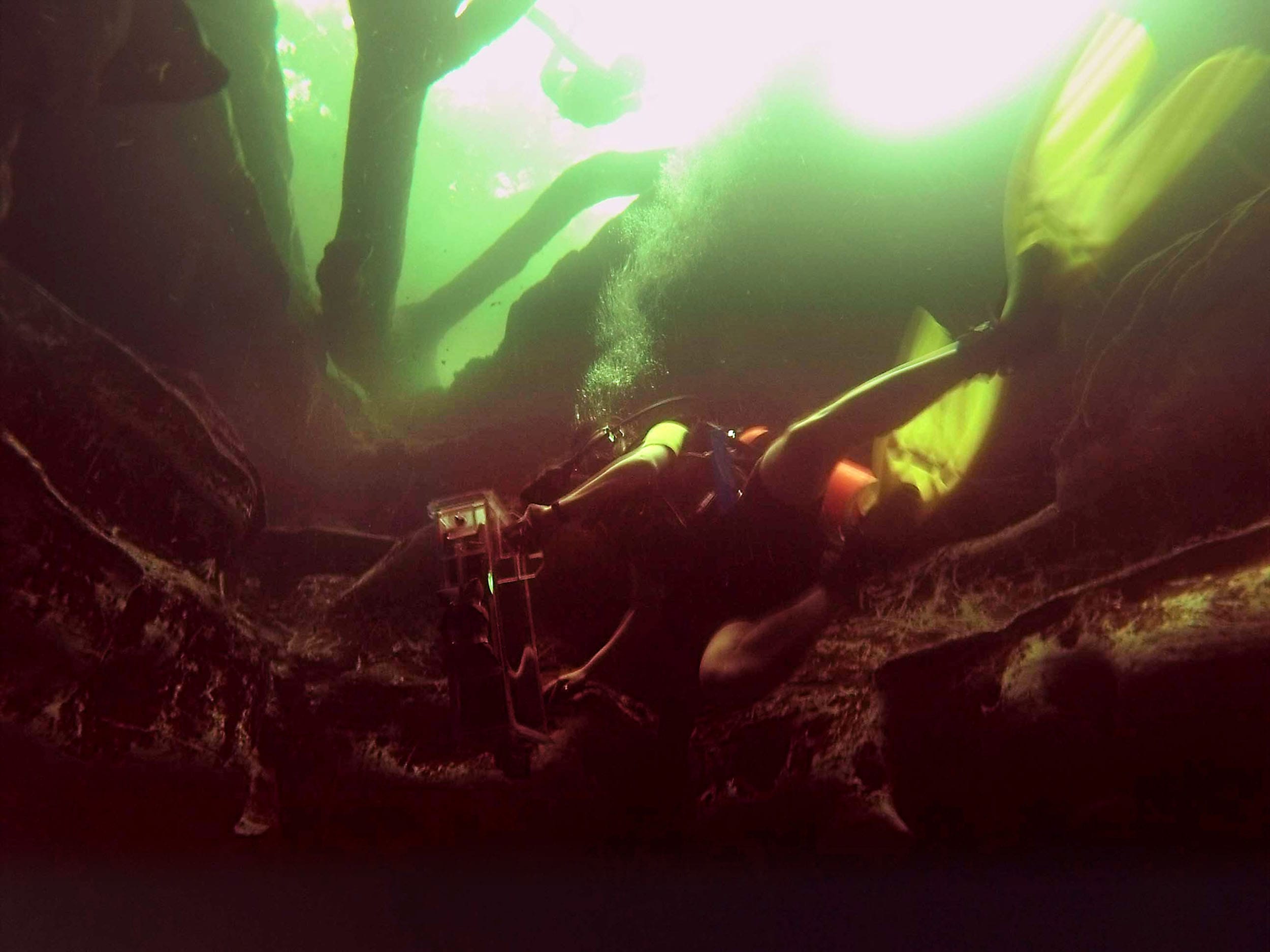
Nathaniel Stern has a desktop scanner strapped to his body while scuba diving to create his latest series of art images.
The resulting images, some made on a coral reef off the coast of Key Largo in Florida, are beautiful and strange. I can’t wait to see them on the gallery wall. I’m reminded of the way the mind perceives, less directly than we might imagine, filling in pieces of what we see not unlike the way computers fill in pixels based on sophisticated, technology-driven guesses. There are moments of intense clarity that surface from the visual skips and drags. They are so otherly, but the images will also be familiar to anyone used to the digital hiccups of the 21st century.
As a writer at Gizmodo asked, maybe this is how fish see the world.
“The resulting artworks are full of care, thought, and wonder,” states the website for the Tory Folliard Gallery, 233 N. Milwaukee St. The show opens Oct. 17.
Mary Louise Schumacher is the Journal Sentinel’s art and architecture critic. Follow her coverage at Art City: www.jsonline.com/artcity.
See the original article by Mary-Louise Schumacher online or in print.
Related artworks:
Other related texts:
Juxtapoz
After much trial and even more error, artist Nathaniel Stern was finally able to create an underwater casing for a flatbed scanner. With the help of a team, Stern was able to develop custom software and hardware that he would use with his underwater scanner while scuba diving off the coast of Key Largo, Florida in a live coral reef. The resulting images are bold abstractions of the coral that Stern captured with his scanner and mirrors the ripples of water in the way the scanner creates each composition.
text by Canbra Hodsdon
[SlideDeck2 id=3373 ress=1]
Related artworks:
Other related texts:
engadget
This artist waterproofed a scanner to create stunning ocean art
James Trew for Engadget

“In my ongoing series of “Compressionism” prints, I strap a desktop scanner, computing device and custom battery pack to my body, and perform images into existence.” That’s how artist Nathaniel Stern describes his collection of unconventional images captured with a desktop scanner. An extension of this project is “Rippling Images,” a new collection which takes the idea underwater. Stern worked with a team to create a “marine rated” scanner rig, which he took with him as he scuba-dived off the coast of Key Largo, florida. The results in the gallery below show the ocean environment as interpreted through Stern’s scanner and body movements. That explains the rippling part, at least.






See original slideshow and post on Engadget
Related artworks:
Other related texts:
Incident Magazine
Polaroid Excavations: the Opening of Weather Patterns: The Smell of Red
Angeli Sion for Incident Magazine
Weather Patterns: The Smell of Red, a sensorial and collaborative ecological installation, surfaced to air the proposition of artists Erin Manning and Nathaniel Stern, co-produced with Marcelino Barsi [and curated by Jennifer Johung], to heighten an exchange of the senses in a body that barely registers the arrival of intersensoriality.
Tapping into weather as a medium via architectural and sculptural elements, the installation materialized conditions for bodies to come together in unexpected ways across becoming mercurial fields. The appearance of a tornado becomes contingent on the bodies around it. At a certain alignment of body and object, a dancing of the field occurs.
Coinciding the same evening as the installation were Juliana España Keller’s “Food Gestures“ and Michael Hornblow’s explorations of the infrathin with “OmegaVille”. Keller’s installation of hanging glass terrariums offered food such as almonds, blueberries, dried ginger, and reindeer moss from Quebec in the yard. In its poetic gesture to foraging and the act of reaching and going back to the earth it enacted an exchange of knowledge. Through video and online photo spheres downstairs, Hornblow produced an exchange of perceived space at the interface of insides and outsides, street to gallery, through conflating layers of time.
Although all three installations generated participatory conditions in disparate locations throughout Glasshouse, the long-term art-life-lab project and space of Lital Dotan and Eyal Perry, their undercurrents converged through and across the bodies of those who came the night of the opening, back and forth in loops, transforming the senses.
The following Polaroids mark this dancing of the field between bodies in performing their own mutable states, excisions into inside, outside the image, and material engagement with image-making as one that unfolds over time.


Weather Patterns: The Smell of Red, was a sensorial and collaborative ecological installation, produced by Erin Manning and Nathaniel Stern with Marcelino Barsi, coinciding with installation Food Gestures by Juliana España Keller and OmegaVille by Michael Hornblow the same evening at Glasshouse, June 1, 2014.
See original post in Incident Magazine
Related artworks:
Other related texts:
De Arte
Interactive art and embodiment: The implicit body as performance
Reviewed by Rob Myers for De Arte
Nathaniel Stern. Interactive art and embodiment: The implicit body as performance. 2013. Canterbury: Glyphi Limited. £ 18.99.
This review is copyrighted and available from Sabinet, though some highlights follow:
Abstract
In Interactive art and embodiment, artist and art theorist Nathaniel Stern develops and applies a rigorous set of frameworks for reconsidering the concepts of interactive multimedia, performance, and the creation of bodily meaning and experience. Stern begins by building a lineage for his novel understanding of these ideas. He then develops a framework for the critical evaluation of interactive art based on this understanding, and applies it to some exemplary artworks. Finally he applies the parts of this framework that are relevant for non-interactive multimedia art to some well-known examples of that genre in order to show their further applicability.
“The book as a whole continues this concern both with bodily experience through interactive art and with grounding discourse in examples of art and criticism.”
“By collapsing and making strange what we think we know both intuitively and critically about our bodies as ‘performed and emerging emergence’, Stern lays the concept of the body open to productive re-thinking.”
“Interactive art, Stern argues, can interrupt and intervene in the performance of bodily relationality. ‘Moving- thinking-feeling’ is both limited by and amplified by art, as it is by games or drama.”
“Stern’s use of examples – both familiar and unfamiliar – illustrates the strength of the implicit body framework and makes it useful both to critics and to artists who wish to better understand what makes successful interactive art.”
“The implicit body framework concentrates on artistic enquiry and process rather than the ontology of such a piece, and on the experience of it as interaction and interactivity, beyond merely describing its technological construction or mechanical appearance. Doing so allows interactive art to stand or fall on its merits as interactive art, and highlights the value of a work…”
“Interactive art and embodiment makes a considerable contribution to the state of criticism andtheory of interactive art. It is useful for critics, theorists and artists who wish to further their understanding of interactive art and serves as an introduction to its worth for those unfamiliar with or unconvinced by it.”
Read the entire review in De Arte
Related artworks:
Other related texts:
Art Journal
Beyond Technology and Representation: What Can Interactive Art Do?
Nathaniel Stern. Interactive Art and Embodiment: The Implicit Body as Performance. Canterbury, UK: Gylphi, 2013. 291 pp., 41 color ills. $29.99 paper
Troy Rhoades, for CAA’s Art Journal, Spring 2014
Download Art Journal’s PDF spread of this article from Taylor and Francis
Forget technology.
Forget representation.
Remember the body.
Re-member: Embody again (6).
In Interactive Art and Embodiment: The Implicit Body as Performance, Nathaniel Stern would like us to remember the body’s potential for moving, thinking, and feeling in relation to digital interactive artworks. He wants this triumvirate of bodily activities – what he defines as embodiment – to be placed in the foreground of thought when we discuss interactive art. It is his contention that technology and representational content have been the focal points of interactive art for too long, and it is time for a paradigm shift. “We must get away from concentrating only on the signs and images on the screen or the interface, away from privileging the technology and what it affords. We must engage with the quality and styles of movement that are rehearsed with interactive art” (15–16). Stern sees the need to stop explaining what interactive art is as a technological object or a generator of signs. He asserts instead that our attention should be placed on what interactive art does as it shapes our potential for embodiment, that is, our ability to move-think-feel with the work. It is important to note that Stern is not completely rejecting technological and representational approaches to interactive art and solely focusing on embodiment. Rather, he wants us to notice that there is a glaring absence of embodiment in many of the present methods used to analyze this type of work. This book is his attempt to address the long-overdue need to reevaluate this field of art. He reveals that we have always been moving-thinking-feeling with interactive art.
Stern begins his reassessment of interactive art by clearly defining his approach to this work. First, he declares that he will not value or define the potential of any individual artwork categorically: “I begin and end with singular works in the gallery space, and am interested in creating a discrete critical framework for encountering interactive art” (5). Stern then defines the interactive artwork as digital and electronic art that uses “various forms of sensors or cameras for input; computers, microcontrollers, simple electronic circuits, or other digital or analogical terminals for processing; and any form of sensory output – audiovisual, tactile, olfactory, mechanical, or otherwise; where all are placed together in a system that responds to the embodied participation of viewers, either in real-time, and/or over lengths of time” (5–6). From here Stern states that his theoretical approach is aligned with process philosophy and affect theory, primarily based on the work of the philosopher Brian Massumi, in order to “explore interactive art’s potential, outside of signification alone” (9).1 By approaching interactive art from an affective and processual approach, Stern associates himself with other contemporary new media thinkers (some of whom he cites) such as Anna Munster, Steve Goodman, and Stamatia [Portanova].2
With his approach and theoretical foundation clearly stated, Stern delineates in the first two chapters how recent research practices in interactive art, which have focused on technology and representation, connect and diverge from his understanding of embodiment as the body’s potential for moving-thinking-feeling. In the first chapter Stern tackles the notion that digital technology is somehow incorporeal, as espoused by thinkers such as Friedrich Kittler and David Rodowick.3 He argues against the notion that data, computational processes, and networks do not have any physical presence or materiality. For Stern all of these technologies and digital processes take on some physical form, on hard drives, computer chips, or fiber-optic cables: “Neither bodies nor information can exist without form and embodiment, and intelligence encompasses far more than informational processing” (33). Stern wants us to be aware not only of the corporeal aspects of digital and electronic technology that interactive art uses but also how we are affected and effected when participating in these technologies. He sees a real challenge in keeping “the participant’s attention on the quality of their own movements, rather than the response of the machine” (45). In Stern’s view, we need to become more attuned to the moving-thinking-feeling experience we have with interactive art, rather than focusing on the technology that drives the work.
In the second chapter Stern challenges recent thought concerning the body and representation in interactive art. He asks that we pay attention to the body as “more than its signs and significations, more than what we see or look at, more than skin, flesh, and bone” (54–55). According to Stern, for a body to be understood as a series of signs or an object, it needs to be static or “pre-formed,” like the many static points of Zeno’s famous arrow. A body becomes “explicit,” lacking any potential to experience embodiment. For a body to move-think-feel, Stern contends, it must be seen as a continuously changing entity that “situates embodiment as always per-formed: emergent and relational” (67). A body that experiences the ongoing activity of embodiment during an encounter with interactive art is, for Stern, an “implicit body” as performance.
After critiquing technological and language-based approaches to interactive art, Stern outlines a potentially paradigm-shifting method for understanding interactive art and embodiment through what he calls the “implicit body framework.” This framework comprises four areas of examination: “artistic inquiry and process; artwork description; inter-activity; and, relationality” (91). The first area looks at the artwork from the artist’s perspective, focusing on his or her approach to the work and the techniques chosen for its production. The second area gives us a detailed description of the artwork: how it looks, sounds, and plays. For Stern, these first two areas of examination are standard in most investigations of interactive art. They also represent the point at which most inquiries stop. As he states, “most visually-, technically-, and linguistically-based writing on interactive art explains that a given piece is interactive, and how it is interactive, but not how we inter-act” (91, emphasis in orig.).
Stern sees the third and fourth areas of examination – interactivity and relationality – as the missing elements in discussions of interactive art. The two areas focus on the potential for an awareness of embodiment to emerge in the viewer-artwork encounter; they foreground our capacity to move-think-feel our potential for change when we experience interactive art. The third area specifically examines the interaction itself, that is, how viewers and artworks connect at the level of embodiment. It focuses on the emergent affects, feelings, and movements generated in the midst of the viewer-artwork encounter. The final area of examination focuses on the relations that emerge in our encounter with interactive art and how these “relationships intervene in our transformation with the world around us” (97). Stern wants us to become aware of the extensive potential for relations to alter and affect our ability to move, think, and feel with regard to an interactive artwork.
In the next three chapters Stern presents a series of case studies using his implicit body framework, approaching several interactive artworks under three different thematics: body-language, social-anatomies, and flesh-space. For Stern these thematics reveal various emergent relations between embodiment and some other sensible concept, such as “language, society, architecture, other matter, forces, and matters” (97–98). The body-language chapter examines the work of Simon Penny and Camille Utterback and its parallels with Jean-Luc Nancy’s notion of “excription,” looking specifically at body and language as “mutually immanent” (104). The social-anatomies chapter investigates Nick Crossley’s idea of “intercorporeality” – the capacity for the body and society to reciprocally produce each other – through the work of the Millefiore Effect, Mathieu Briand, and Scott Snibbe. The third thematic chapter, on flesh-space, approaches the interactive work of David [Rokeby], Rafael Lezano-Hemmer, and Norah Zuniga Shaw through the thought of José Gil and Erin Manning, investigating the ability of these artworks to make viewers aware of the ways in which “bodies and space are made of their relations” (176). These three chapters demonstrate Stern’s implicit body framework as rigorous yet flexible when applied to the analysis of interactive art.
In the penultimate chapter Stern takes his implicit body framework further, demonstrating that it can be used beyond the limits of interactive art. He investigates a large cross-section of new-media works by artists such as Erwin Driessens and Maria Verstappen, Brandon Labelle, and John F. Simon, Jr., as well as his own work, which he calls “potentialized art.” For Stern all of these works have the capacity to “amplify action, affect, embodiment, performativity, transformation, and/or materiality” (206). Potentialized art enables us to become aware of our ability to move-think-feel with a work in the midst of our mutual encounter. We can experience the potential for embodiment as we perform with these artworks. We can become aware of our ability to move-think-feel.

The most rewarding and riskiest chapter of Stern’s book is saved for the end. “In Production (A Narrative Inquiry on Interactive Art)” is a case study of Stern’s own art and writing practices from 2000 to the present. What makes this chapter such a rewarding and refreshing read is that it is written in an unconventional autobiographical style that is also academically rigorous, a style Stern calls an “autoethnographic experiment” (254). This experiment blends conversations, personal narrative, and several analyses of his interactive artworks using his implicit body framework in order to “amplify” and “potentialize” the reading experience (259). Stern consolidates everything he has advocated about the relationship between embodiment and interactive art into a personal story about himself and his work, effectively exposing us to an example of the experience of moving-thinking-feeling that we have been reading about throughout the book.
Stern’s experimental approach to writing is also one of this chapter’s many risks. There is the possibility that more traditional readers of art theory and history may find such a self-referential and unconventionally written account off-putting, even jarring. However, Stern’s storytelling ability is strong and will likely win over even the most curmudgeonly reader. Another risk this chapter takes is the form in which it has been published. The book surprisingly ends by giving us only the introductory section of this concluding chapter. We are invited to go online to view or download the remaining sections (253, 259).4 We are allowed just a taste of this chapter and then must shift our attention from the written page to the written screen. The risk here is that readers may be lost in this transition from the book to the Internet, leaving some of Stern’s best writing unread.
The book is part of the Arts Future Book initiative, a research project and academic book series investigating the future of academic publishing in the arts, led by Charlotte Frost. Placing this final chapter online appears to be part of the series’ mandate to exploit “recent technological advances in publishing” (xxi). Readers who go online and read the complete text of “In Production” will find the possibility to interact with others, in the ability to make comments at every paragraph. This gives readers a platform to share thoughts about some of their favorite (or less agreeable) passages. The ability to comment is an appealing feature, but publishing this chapter online has the potential to take away some of its affective impact. Moreover, it feels like an unnecessary use of digital technology, one that does not appear to follow the spirit of the book, as the online publication breaks a sense of continuity and makes it more difficult to experience moving-thinking-feeling in the work itself. As Stern states, “Embodiment only is through its ongoingness and continuity” (57, emphasis in orig.). If this chapter – which encapsulates everything Stern advocates with regard to interactive and potentialized art – were printed in its entirety at the end of the book, readers would have a better opportunity to experience the embodied potential the book commands. Despite these misgivings, everyone who reads Stern’s book (and those who are interested in reading it) should visit the website and discover the complete text of this wonderful final chapter.
It will be interesting to see how those behind the Arts Future Book series continue to explore the potential that digital and online media offers to expand the form of the book. Interactive Art and Embodiment is the first from this series, making it the first to experiment with the hybrid approach to publishing. I hope the editors will embrace Stern’s notion of embodiment and ensure that digital incarnations of future titles emerge from the potential activated within the texts themselves.
By asking us to engage with interactive art at the level of potential for movement, thinking, and feeling, Stern alters the idea of what inquiry can be, changing it from an analysis of something static into a dynamic event. The act of examination becomes as much a performance as the interactive art it investigates. Through the use of Stern’s implicit body framework, artworks become more than mere descriptions placed within a historical context. Through his writing, artworks become alive in the reading, giving us a sense of how the embodied interactions and emergent relations feel as they are encountered.
1. Throughout the book, Stern focuses on three of Massumi’s texts: Brian Massumi, Parables for the Virtual: Movement, Affect, Sensation (Durham, NC: Duke University Press, 2002); “The Thinking-Feeling of What Happens: An Interview with Brian Massumi,” in Interact or Die: There Is Drama in the Network, ed. Joke Brouwer and Arjen Mulder (Rotterdam: V2 Pub./NAi, 2007), 70–91; and Semblance and Event: Activist Philosophy and the Occurent Arts (Cambridge, MA: MIT Press, 2011)
2. See Anna Munster, Materializing New Media: Embodiment in Information Aesthetics (Hanover, NH: Dartmouth College Press, 2006); Steve Goodman, Sonic Warfare: Sound, Affect, and the Ecology of Fear (Cambridge, MA: MIT Press, 2009); and Stamatia Portanova, Moving without a Body: Digital Philosophy and Choreographic Thoughts (Cambridge, MA: MIT Press, 2013).
3. See Friedrich Kittler, Gramophone, Film, Typewriter (Palo Alto, CA: Stanford University Press, 1999); and David N. Rodowick, Reading the Figural, or, Philosophy after the New Media (Durham, NC: Duke University Press, 2001).
4. The concluding chapter in its entirety is at http://stern.networkedbook.org, as of February 11, 2014.
Download the Journal’s PDF spread of this article from Taylor and Francis
Related artworks:
Other related texts:
CNET
Homemade undersea scanner finds strange new world
Nathaniel Stern dives beneath the sea armed with DIY photography rigs toggled from custom electronics. The artist’s results? Bizarre and beautiful.
by Leslie Katz for CNET
This rig has a bicycle valve so Stern can vacuum-seal it closed when he goes underwater. He got it down to 30 feet before experiencing leaks.
It’s easy to find a good compact underwater camera, but artist Nathaniel Stern opted to go a different route for his deep-sea imaging. Really different. He strapped on homemade rigs built from custom electronics and software, melted and welded plexiglass, plastic bags, duct tape, and other bits and bobs and proceeded to dive into the subaqueous world.
The resulting odd and beautiful renderings make up “Rippling Images,” a new series of fluid and often-abstract images of flora and fauna created as Stern and his marine-rated contraptions dove along a live coral reef off the coast of Key Largo in Florida. Because Stern wears the gizmos, his movements help compose the shots, some of which would look more at home hanging in the Museum of Modern Art than among other, more typical undersea photographs.
As he puts it, “I perform images into existence.”

Stern gets up close with a three-eyed undersea creature, or maybe that’s just the photographic effect.
“My movements underwater, my relations to life and gravity, what I see and cannot see, fish and plants, breathing and fluidity, all affect and are affected as these images [are] being made,” Stern, a professor of art and design at the University of Wisconsin-Milwaukee’s Peck School of the Arts, says on the project’s website.
Nathaniel Stern dives beneath the sea armed with DIY photography rigs toggled from custom electronics. The artist’s results? Bizarre and beautiful.
The images are an outgrowth of Stern’s ongoing “Compressionism” series, in which he hitches a flat-bed desktop scanner, computing device, and custom battery pack to his body and moves through the terrestrial world doing things like swinging over flowers or jumping over bricks to capture images of objects and spaces. When he captures a shot, every part of the image is broken up into moments of time because of how the scanner beam moves across the surface of the scanner and how Stern maneuvers the entire custom rig across the landscape.
For the aqueous version of his art, Stern spent three months getting certified to scuba dive. He and his team designed 10 underwater systems, and built 5 of them to completion. He toted 3 of these hacked-together getups under the sea.
“They leaked, they broke, they scanned scratches on the surface of the boxes, they reflected, they captured things that I never wanted and never intended,” Stern reports, “and that is precisely the nature of experimental work.”
Stern, whose art often focuses on how people engage with and experience the world, previously afforded us Earth-bound social-media addicts the chance to tweet to aliens.
“Rippling Images” will be on display at the Turbine Art Fair in Johannesburg from July 17 to 20, and as a solo show at the Tory Folliard Gallery in Milwaukee in October. For a deeper dive (so to speak) into the project, watch this video.

“Flower,” a digital print on metallic paper. “The colors and hairs and mossy-like textures came out stronger than I ever could have imagined, in formation, soft and aqueous,” Stern told Crave of his technique.

“Metallic,” one of the “Rippling Images” pieces created with one of Stern’s undersea rigs.

Some of the works from the series look like they’d be at home at a modern-art museum.
Read the original article on CNET
Related artworks:
Other related texts:
Gizmodo
These Underwater Photos Were Taken By a Desktop Scanner
Kelsey Campbell-Dollaghan for Gizmodo
The desktop scanner is a wonderful thing, but rugged it ain’t. Yet Nathaniel Stern didn’t let that stop him: The Wisconsin-based artist, who is known for his experimental camera designs, created a waterproof version of an off-the-shelf scanner that captured a series of incredible images of sea life.
“Everything leaked, everything broke, nothing did what I wanted or expected,” Stern writes on his website about the project, Rippling Images, for which he took months of diving courses to become certified to complete it. But the finished product was certainly worth it—here’s how Stern carried it out:
For Rippling Images, I worked with a team to produce a marine-rated scanner rig, including custom hard- and software, and performed a new series of digital works while scuba diving on a live coral reef off the coast of Key Largo in Florida. My goal was an exhibition where where site and technology – their limitations, possibilities and potentials – take greater agency in the constitution and construction of printed forms. My movements underwater, my relations to life and gravity, what I see and cannot see, fish and plants, breathing and fluidity, all affect and are affected in and as these images, being made.
You can check out the complete batch of images on Stern’s website. They’re both bizarre and beautiful, unlike any photos of the marine world I’ve ever seen. It almost feels as though we’re experiencing how fish see the world. [PetaPixel]
See the original post on Gizmodo
Related artworks:
Other related texts:
Boing Boing
Artistic scanner-photos taken on a coral-reef
Cory Doctorow for Boing Boing
Nathaniel Stern straps modified document scanners to his body and then walks around, producing beautiful, glitched out art-images. Now he’s taken his scanners to the bottom of the ocean.
For the last decade or so, I’ve been making fine art prints by strapping a desktop scanner, custom battery pack, and computing devices to my body, then traversing the landscape to produce abstract but detailed slit scan imagery… The reasons are threefold: very high resolution; proximity – I’m a part of the landscape I’m capturing, rather than distanced from it (no added lens); and the potency of multiple adjacent times and spaces viewed on a 2D plane.
For the latest in the series, I produced several marine-rated, scuba scanning rigs – metal, plastic and/or polycarbonate, with various forms of gaskets, vacuum seals, and hall effect (magnetically-triggered) buttons to create the scans.
The complete body of work, 18 prints, premiere at the Turbine Art Fair in Johannesburg next week (July 17 – 20). The show comes to Milwaukee WI, where I now live, in October.
See it on Boing Boing
Related artworks:
Other related texts:
What Animals Teach Us about Politics

Cover image: detail from Giverny of the Midwest (2011).
“This is a truly brilliant book, one of Brian Massumi’s best. More than anyone else I have read, Massumi makes real progress in untangling the relationship between play, sympathy, politics, and animality. What Animals Teach us About Politics provides a fascinating and persuasively non-subject-centered account of sympathy, and it goes a long way toward helping us to see how the practice and theorization of ‘politics’ would be radically refigured within a process-ontology.” – Jane Bennett, author of Vibrant Matter: A Political Ecology of Things
Title: What Animals Teach Us about Politics
Author: Brian Massumi
Publisher: Duke University Press
Date of Publication: September 2014
Language: English
ISBN-10: 082235800X
ISBN-13: 978-0822358008
Order this book from Amazon.com
Related artworks:
Other related texts:
PetaPixel
Experimental Underwater Scanner Makes for Beautiful Happy Accidents
Gannon Burgett for PetaPixel
If you enjoy strange and experimental photography, Nathaniel Stern‘s work should delight you.
For the past ten years, Stern has been creating experimental image-capturing devices using a conglomeration of hacked-together desktop scanners, battery packs and other various computer components. Once created, he straps these machines to his body and takes them from location to location capturing images unlike any other camera out there.

In his latest series, Rippling Images, Stern decided to take his images one step further by venturing to take these experimental camera creations underwater. It didn’t come easy though.
Stern spent months getting certified for a number of open-water diving licenses. And when he wasn’t doing that, he was helping his team piece together what would eventually become the five final models of the device he would be taking underwater.
Made out of everything from welded metal to magnetically-triggered buttons, the devices didn’t actually capture what Stern was hoping for at all. But what they capture, Stern still found beautiful… if not more beautiful than his usual work.
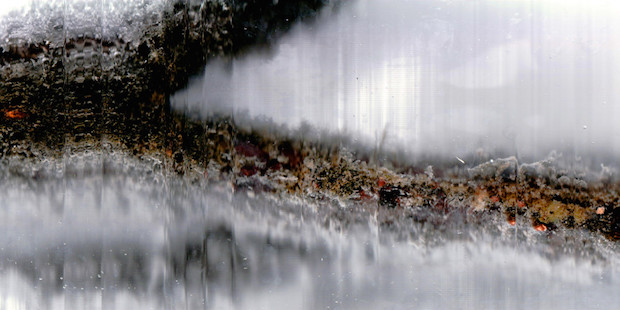
The scratched surfaces of the plastic showed up, unplanned reflections made several appearances, and the images were just overall more experimental than he could’ve ever expected:


Experiment might as well be Stern’s middle name though, so he took everything in stride and used it as a learning experience, sharing his thoughts in a video that we’ve embedded at the top.
It comes in just shy of three minutes, so give it a quick watch to see Stern and his unusual devices at work, and then head over to his website to see more of his work.
Read the article on PetaPixel
Related artworks:
Other related texts:
WORT fm
 The 8’oclock Buzz: Return of the Frankensteined Scanners
Last time we spoke with Milwaukee artist Nathaniel Stern, he was trying to jerry-rig dozens of flatbed scanners to take peculiarly framed, high resolution underwater photographs. Well since then, Nathaniel reports that nearly everything that could possibly go wrong with that project did. Nathaniel Stern joined the Monday Buzz once more by phone from Milwaukee with an update.
Download the mp3 (13mb), or listen to the entire interview about performative printmaking / Compressionism with host Brian Standing:
Related artworks:
Other related texts:
earn advertising fees by advertising and linking to Amazon.com. Amazon and the Amazon logo are trademarks of Amazon.com, Inc, or its affiliates
Powered by WordPress | Albedo / Graph Paper Press Theme | Child Theme by Andrew McConville + Nathaniel Stern