
Artistic scanner-photos taken on a coral-reef
Cory Doctorow for Boing Boing
Nathaniel Stern straps modified document scanners to his body and then walks around, producing beautiful, glitched out art-images. Now he’s taken his scanners to the bottom of the ocean.

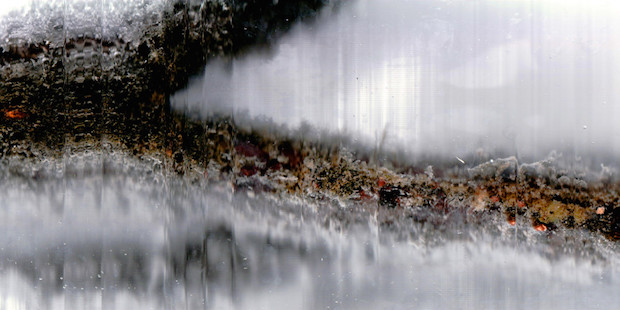
For the last decade or so, I’ve been making fine art prints by strapping a desktop scanner, custom battery pack, and computing devices to my body, then traversing the landscape to produce abstract but detailed slit scan imagery… The reasons are threefold: very high resolution; proximity – I’m a part of the landscape I’m capturing, rather than distanced from it (no added lens); and the potency of multiple adjacent times and spaces viewed on a 2D plane.
For the latest in the series, I produced several marine-rated, scuba scanning rigs – metal, plastic and/or polycarbonate, with various forms of gaskets, vacuum seals, and hall effect (magnetically-triggered) buttons to create the scans.
The complete body of work, 18 prints, premiere at the Turbine Art Fair in Johannesburg next week (July 17 – 20). The show comes to Milwaukee WI, where I now live, in October.
See it on Boing Boing
Related artworks:
Other related texts:
PetaPixel
Experimental Underwater Scanner Makes for Beautiful Happy Accidents
Gannon Burgett for PetaPixel
If you enjoy strange and experimental photography, Nathaniel Stern‘s work should delight you.
For the past ten years, Stern has been creating experimental image-capturing devices using a conglomeration of hacked-together desktop scanners, battery packs and other various computer components. Once created, he straps these machines to his body and takes them from location to location capturing images unlike any other camera out there.

In his latest series, Rippling Images, Stern decided to take his images one step further by venturing to take these experimental camera creations underwater. It didn’t come easy though.
Stern spent months getting certified for a number of open-water diving licenses. And when he wasn’t doing that, he was helping his team piece together what would eventually become the five final models of the device he would be taking underwater.
Made out of everything from welded metal to magnetically-triggered buttons, the devices didn’t actually capture what Stern was hoping for at all. But what they capture, Stern still found beautiful… if not more beautiful than his usual work.
The scratched surfaces of the plastic showed up, unplanned reflections made several appearances, and the images were just overall more experimental than he could’ve ever expected:


Experiment might as well be Stern’s middle name though, so he took everything in stride and used it as a learning experience, sharing his thoughts in a video that we’ve embedded at the top.
It comes in just shy of three minutes, so give it a quick watch to see Stern and his unusual devices at work, and then head over to his website to see more of his work.
Read the article on PetaPixel
Related artworks:
Other related texts:
Neural Magazine
Nathaniel Stern – Interactive Art and Embodiment: The Implicit Body as Performance
AURELIO CIANCIOTTA

GYLPHI LIMITED, ISBN-13: 978-1780240091, ENGLISH, 304 PAGES, 2013, USA
Man/machine interfaces have involved the body in progressively more sophisticated ways, from the mechanical finger pressure on a keyboard to the intellectual challenge of voice-recognition-based software assistants. Media art has interpreted interfaces dynamically, abstracting the interaction and playing with its modalities, symbols and meanings. Stern analyses almost forty different artworks to augment his theory: “interactive art suspends and amplifies the ways we experience embodiment – as per-formed, relational, and emergent”. The text investigates “how we interact” and the role of the body in the interaction process is here exploded and carefully delineated. Many of the connotations that the body assumes in artworks – being perceived as a structure, a tool, a territory or an imagined space – are analysed as performative and symbolic instances. One of the qualities of this book is that it provides extensive references on the topic, while remaining very focused. The artworks are carefully described in their mechanisms and their performative dimensions are acknowledged separately, representing an annotated anthology in itself. There’s also a “digital companion” chapter (called “In Production”, partially printed and freely available online, meant to be updated and expanded at will), which has been aggregated to the book as its dynamic (in a way even performative) extension. This book is very helpful for understanding our physical relationship with the digital and how to properly relate to interactive art.
See the review on Neural.it
Related artworks:
Other related texts:
Archée
Interactif, implicite, performatif, éprouvé, le corps exploré
Louise Boisclair (read the whole article, or read the google English translation)
Dans Always More Than One, Erin Manning croise philosophie ou mouvement de pensée, chorégraphie ou mouvement du corps, art et autisme. De son côté, avec Interactive Art and Embodiment : The Implicit Body as Performance, Nathaniel Stern propose de considérer le corps implicite dans sa triple relation de mouvement, sensation et pensée lors de l’appropriation interactive. Quant au collectif, Personnage virtuel et corps performatif. Effets de présence, dirigé par Renée Bourassa et Louise Poissant, quinze artistes et théoriciens explorent, chacun, chacune, sous un angle singulier, diverses facettes du corps performatif et du personnage virtuel. Pour sa part, dans L’instance du regard sur le corps éprouvé. Pathos et contre-pathos, Élène Tremblay examine les notions de pathos et contre-pathos à travers l’insistance du regard sur le corps éprouvé. Chaque auteur-e arrime son analyse à la théorie philosophique, médiatique ou phénoménologique selon l’approche singulière ou multiple qu’ils ou elles adoptent pour cheminer avec le corpus sélectionné.
…
Interactive Art and Embodiment: The Implicit Body as Performance (Nathaniel Stern)

Pour sa part, l’ouvrage de l’artiste-enseignant-chercheur Nathaniel Stern constitue une refonte de sa thèse de doctorat qu’il a auparavant résumée dans un article intitulé : « The Implicit Body as Performance: Analyzing Interactive Art. », publié dans le Leonardo Journal of Art, Science and Technology (MIT Press). Vol 44, No 3 (2011): 233-238. Globalement, la thèse est la suivante : au lieu de s’en tenir à la vision, à la structure et à la signification, Stern propose de recentrer l’intérêt sur le « corps en relation ». Il conçoit l’interaction en tant que performance et la manière d’être en tant que manière d’« être avec ». Dans un cadre de travail sur le corps implicite au sein de l’installation interactive, il propose une approche qui réunit quatre volets: la recherche et le processus artistique, la description de l’œuvre d’art, l’interactivité et la relationalité. Selon lui, les deux derniers volets propres à l’expérience interactive doivent faire l’objet d’un examen détaillé.
Cette prescription, Stern la met à l’épreuve dans son ouvrage. Composé de huit chapitres dont le huitième introduit un texte à paraître sur le WEB seulement, il met la table dès la première page :
« When we move and think and feel, we are, of course, a body. This body is constantly changing, in and through its ongoing relationships. This body is a dynamic form, full of potential. It is not “a body,” as thing, but embodiment as incipient activity. Embodiment is a continuously emergent and active relation. It is our materialization and articulation, both as they occur, and about to occur. Embodiment is moving-thinking-feeling, it is the body’s potential to vary, it is the body’s relations to the outside. And embodiment, I contend, is what is staged in the best interactive art. » (Stern, 2013, 2)
Lui-même artiste spécialiste de l’art interactif, sa réflexion philosophique, aussi stimulante que novatrice, est ancrée dans le corps implicite, c’est-à-dire ce corps qui vit et déborde le corps vécu, notion renvoyant au corps pensé. Stern invite la recherche à considérer bien davantage les forces et les champs en puissance dans le corps, alors que la corporéité est en « per-formance », ici-maintenant, au sein de l’installation interactive. L’incorporation s’accompagne donc de la métabolisation d’informations sensorielles issues du milieu d’immersion, sorte de sémiose corporelle pré-signifiante. Elle s’apparente au sens dynamique que lui donne Stern:
« The conception of a continuous embodiment, however, allows us to rethink bodies as formed through how we move in, and relate to, our surroundings. Embodiment, I contend, is not a pre-formed thing, but incipient and per-formed. » (Stern, 2013, 12).
Ainsi, la corporéité, dans sa dynamique, n’est pas une chose pré-formée, mais per-formée, insiste Stern; elle n’est pas constituée, elle se constitue. Continuellement en action, la corporéité évolue de façon dynamique au fil de l’incorporation, elle n’est jamais figée.
Tout au long de cet ouvrage, le lecteur, la lectrice rencontrera de nombreux artistes de l’art interactif et immersif, ce qui a le bénéfice non seulement d’illustrer le propos de Stern, mais bien davantage d’incarner sa réflexion philosophique dans une encyclopédie d’art interactif encore en train d’évoluer. Graduellement, au fil des chapitres, Stern joue avec les thèmes performatifs suivants: 1- « Digital is as Digital does »; 2- « The Implicit Body as Performance »; 3- « A Critical Framework for Interactive Art », 4- « Body-Langage » ; 5- « Social Anatomies »; 6- « Flesh-Space »; 7- « Implicating Art Works » et 8- « In production ». Ce livre d’une grande importance rend compte d’une vision actuelle non seulement artistique, mais « spectatorielle » du corps, assisté ou outillé technologiquement, comme on l’est de plus en plus même dans notre vie quotidienne. Bien plus que le corps performant, c’est toujours et encore le « corps implicite » qui sert de fil rouge pour explorer l’art interactif.
Read the whole article, or read the google English translation
Related artworks:
Other related texts:
MKE Journal Sentinel
‘Surfacing’ at Lynden Sculpture Garden
This article by Diane Bacha appeared in both the online and print editions of the MJS

 Jessica Meuninck-Ganger and Nathaniel Stern, colleagues at the Peck School of the Arts, took their kids on a trip to the Milwaukee County Zoo one day and came back with an idea for a collaboration. That was three collaborations ago, and they don’t plan to stop.
I can only imagine the conversation that day at the zoo. I am picturing a continuous loop of ideas and theory interrupted by chatter with the kids and pauses to watch the polar bear play. They would have been two families walking at various paces, passing groups moving in other directions, everyone having different conversations about different things while the animals moved in their enclosures. In the background the sky and clouds had their own rhythm. It’s a familiar scene at one glance, but there’s a lot happening on closer inspection. And that’s the way this collaborative work feels: a layering of experiences, moments, ideas, and intersections that teeter between mundane and complex.
Stern is a video and installation artist and Meuninck-Ganger is a printmaker. Although any description of what they do requires asterisks – their work doesn’t exist in silos – their collaboration draws on those specific disciplines, then veers.
“Surfacing” is their latest installation together, and it’s at the Lynden Sculpture Garden until March 24. In it, Stern and Meuninck-Ganger continue their fascinating exercise in layering printmaking and video one atop the other. Each of the six pieces in the small Lynden gallery is a framed, rear-projected video over which has been laid a translucent editioned print or, in one case, a drawing. The viewer sees a static black picture in the foreground and moving, color images in the background. The static image on the skin is taken from a moment or multiple moments occurring in the video beneath.
“Pantograph” uses transportation to convey the idea of layered moments. It’s four minutes in the life of a city intersection where rail, automotive, bicycle and foot traffic converge. The static image is a collection of moments from the traffic – an electric railroad car entering the frame at right, a woman guiding some children at left, a row of automobiles cutting through the middle. As you watch, moving images interact in conflict or harmony with the still image. “Midst” is seemingly less complex: the video depicts a man doing tai-chi exercises on a waterfront, his movements barely visible beneath a woodcut. In this case, a dragon’s form on the static woodcut introduces an element outside the literal. 3-D interpretations of the original woodcut hang on each side of the framed piece. Still more layers.
Other pieces depict a bowling ball striking pins, the Allen-Bradley clock tower, another street scene, and two seated subway-car passengers with their backs to each other. The video loops range in time from 15 seconds to 5 minutes.
Where Stern’s video ends and Meuninck-Ganger’s printmaking begins is fuzzy, since the two have traded off roles depending on the piece. They want to blur the lines between individual contributions and also between the two media. The image applied to the video gives the video a new meaning, and vice-versa. Each is a singular experience – neither video nor print but a distinct hybrid.
Someone viewing this work for the first time might not see it that way. You find yourself fascinated by the technique, so you’re aware of it and you’re trying to figure out its trick – when will the images line up with each other? Is there something I’m supposed to see when it does? Are there other sleights-of-art to watch for? And why was this particular moment chosen as the static image?
Then there is the blending of old media and new and all that’s implied with that. There is the idea of time stopped (perhaps a memory) and time looped (perhaps an obsession). One thinks of the “key block / color block” elements of traditional printmaking. And of the endless possibilities of a particular moment in time, and how few of those possibilities we usually perceive.
 What are we to make of these images as a whole? Is it a fable about patience? About being watchful for the beauty in mundane moments? Each piece is different enough in tone, context and even technique that the overall experience doesn’t feel cohesive.
Ultimately, what I found most rewarding with “Surface” was the meditative experience it offered when I let my questions go. It was akin to finding a park bench to watch the world go by. Like most times I’ve spent on a park bench, it takes a while for me to empty my mind and just observe. The rewards come throughout the process, not just at one moment.
Adjacent to the exhibition space, in a porch whose windows overlook the snow-covered sculpture garden, there’s a lovely echo of this experience. The artists have created an installation here by using the windows as a membrane covering the landscape outside. Images drawn on the windows repeat static elements of the landscape in the same way they do on the framed pieces. This time, the movement comes from whatever happens outside randomly, but also from the viewer who changes position to discover visual alignments and misalignments. In a nice interactive touch, the artists have invited visitors to add their own images to the glass.
Meuninck-Ganger and Stern offer up a beautiful opportunity to shift our way of seeing. It is a more conscious way of seeing, to be sure. How often does that happen in the Age of Attention Deficit? The possibilities are exciting.
read the entire article online
see the print edition
Related artworks:
Other related texts:
MKE Journal Sentinel
 Making a Scene: Milwaukee’s Avant-Garde
This article by Mary Louise Schumacher appeared in both the online and print editions of the MJS

A decade ago, Milwaukee’s art scene seemed to be having a moment.
Even the most cynical and pragmatic among us fell under the spell of hopefulness, the notion that Milwaukee, this flyover locale that was nowhere on the art-world map, was becoming an important, artistic frontier, to use artist David Robbins’ term.
Connective tissue began to form between disparate pockets of the art community. Underground, do-it-yourself art projects, galleries, art schools, academics, major institutions and culture makers of all kinds took note of one another and surfaced as one remarkable, indigenous scene.
The catalyst, of course, was the unfurling of Santiago Calatrava’s avant-garde structure on the lakefront, perhaps the single most important artistic gesture in the city’s history. But the period of raucous invention that ensued had little to do with the Milwaukee Art Museum’s new wing.
Milwaukee was becoming a gathering place for artists with a unique and decidedly generous artistic ethic. Cheerfully unorganized, maverick artists found inspiration and an audience first in each other. A playful amateurism prevailed, as artists embraced their obscurity, understanding both the freedoms and limitations that are part of being set apart from the larger art world.
Chicago artist Kirsten Stoltmann said something at that time that would later inspire the title of my column and blog — Art City.
“Milwaukee is one of the most creative art cities now,” she told me. “There is a new kind of ambition here. It’s a different, more honest art…a different ethic.”
That period was captured in a large, group portrait featuring some of the personalities that defined the scene at the time (image, below). I took another look at that Journal Sentinel picture and article recently. As I looked at the faces — some still with us, others long gone — I realized that it was time to consider to what extent that sense of promise has been realized.
As I considered what has — and has not — taken root, I conducted dozens of interviews and studio visits and collected surveys from about 65 people. What I can tell you is that almost no one, myself included, found the question easy to answer.
If we’re honest, we know that the sense of promise of the early 2000s dissipated over time, almost imperceptibly, like a slow leaking tire. And yet, one of the things that defines the art scene today is its connection to that lived history, a trait that larger and more transient art scenes don’t enjoy in the same way.
Some strain of art scene was birthed here a decade ago, and some of the best, new artists in our community are conscious of this and connected to the artists and ideas that defined that time. Our art scene may be small, but one of the things that makes it muscular is the access and proximity between the old and new guards.
I consider it a positive sign that there is less talk of a “moment” and more art of note being made today.
Given this changing picture, it seemed time for a whole new portrait.
So, recently, we gathered some of the artists, curators and thinkers that represent the fulfillment — or potential fulfillment — of what was hoped for 10 years ago. More than that, they represent a portrait of our avant-garde.
Why the avant-garde? It’s a funny term, of course. Ironically, it is antiquated, quaint even.
For a long while, it meant little more than “new” and belonged to an era when art historical beginnings and endings seemed to bump into each other like train cars running down some kind of a linear track. But in an era when art can be — and is — just about anything, a time the art world sometimes calls a “post historical condition,” what does it mean to be avant-garde?
I don’t have a precise definition for you, just a loose list of attributes that I often refine and edit in my mind. It has something to do with qualities related to research and asking good questions. Instead of breakthroughs in cancer research or quantum physics, avant-garde artists explore and reveal something of the human condition. It has to do with intellectual rigor and inventive uses of materials, among other things. And it has something to do with keeping it real, too, with not separating the real world from the art world.
Put most simply, though, it is an important term, worth holding onto, that recognizes that some artists are ahead of others.
The group I selected is not definitive. But these people are certainly ahead of most, are creating an exceptional quality of work and define the current scene. Some were selected because of the strength of their work, others for the strength of their ideas and their influence. And a few are here because of their promise alone.
Before we look at this avant-garde, though, let’s roll the clock back briefly for a glimpse at the essential back story.
In 2001, I described Paul Druecke’s christening of a forlorn patch of concrete, a tidbit of urban space that he dubbed Blue Dress Park, in the lead for that article I wrote a decade ago. The project was then — and remains — a symbol of that time. Not unlike the way artists approached Milwaukee itself, Druecke took a spot that didn’t look like much and radically altered it with an open-air art happening.
Nicholas Frank, too, was an essential figure. He was a principal advocate for creating a vibrant dialogue around contemporary art and helped create an audience for challenging work. He had — and has — a great eye and became a trusted curatorial voice. Though he showed difficult art at his Hermetic Gallery, his space was routinely jammed for art openings and discussions. He also had his hand in a multitude of thoughtful and often participatory projects, such as The Nicholas Frank Public Library.
Robbins was a critical, quiet influence, as well. A conceptual artists with a long history of exhibiting work around the world, Robbins sensed possibility here and made Milwaukee his home. He was a critical link to the wider art universe and the dialogues happening there. In the now defunct New Art Examiner, a magazine that for a while was dedicated to the coverage of art in the Midwest, he wrote about why Milwaukee and other Corn- and Rust Belt cities were experiencing cultural renaissances.
The graduate film program at the University of Wisconsin-Milwaukee was turning out more visually sophisticated and conceptually rigorous artists than the art schools were, it seemed. And UWM was home to what was, to my mind, the most important institution of that period, Inova. While the wider art world was still coming to grips with a more pluralistic reality, Inova curators Marilu Knode and Peter Doroshenko (left) were among the first to truly grasp the implications of globalism on art and create a program that responded to it. They staged some of the most important exhibits of international artists in the nation right here. Though the importance of Inova was not always recognized locally, the impact that this whole new range of art-making practices had on some local artists cannot be underestimated.
Elsewhere, theMilwaukee Artists Resource Network, still an important support organization for artists, was being formed; a group ofMilwaukee Institute of Art & Designstudents and graduates formulated collaborative forms of site-specific curating, staging Rust Spot shows in an abandoned produce building (Image right); Theresa Columbus created a space for performance art called Darling Hall; collectives such as Milhouse created anonymous and even secret art; Riverwest Film & Video, a video shop known as Pumpkin World, became famous for its Sunday night spaghetti dinners, hosted by brothers Xav and Didier Leplae, a salon for the creative set.
In Riverwest, the General Store, Bamboo Theater, Flying Fish Gallery, Jody Monroe Gallery and Hotcakes Gallery opened within walking distance of one another. The art was hit-or-miss but exceptional frequently enough.
Everyone wore multiple art-world hats, perfomance artists were filmmakers, writers were painters, curators were band mates. (Raise your hand if you remember the Singing Flowers and Horn Band bands!).
Beneath the chummy and seemingly casual veneer of much that existed then, there was a seriousness, too.
One of the most daring projects was Jennifer Montgomery’s 2003 film “Threads of Belonging,” which depicted the daily life of an alternative treatment facility for people with mental illnesses such as schizophrenia. The ideas were based on the writings of a famous anti-psychiatry proponent R.D. Laing, but the characters and unscripted scenes became defined by the community of artists and filmmakers who produced and acted the work. The artistic trust and resiliency among the participating artists was breathtaking. Some of the artists and filmmakers who worked on the project include Druecke, Frank, Stephanie Barber, Didier Leplae, Peter Barrickman, Carl Bogner, Dave O’Meara, Kelly Mink, Renato Umali, Lori Connerlley and Jennifer Geigel. (See video below, which includes nudity).
I’ll never forget, too, encountering the magical paintings of Laura Owens casually hung in the tiny back gallery at General Store. Owens’ was on her way to becoming a world-class name in the art world, with a solo show of large-scale paintings opening at MAM.
At that particular General Store opening I met two artists for the first time: Andrew Swant and Bobby Ciraldo (right).They told me about their new project, an art-film called “Hamlet A.D.D.” I couldn’t possibly do justice to their description these years later except to say that listening felt like a strange, out-of-body experience. It sounded incongruous, ambitious, impossible — and utterly captivating (more on this in a bit). It was the kind of encounter that became emblematic of that time for me.
The number of artists with considerable success that opted to make Milwaukee home at the time was a visible indicator to the local tribe that something was afoot here, too. Fresh from their success at Sundance with “American Movie,” filmmakers Chris Smith and Sarah Price set up shop, forming Bluemark Productions, a commercial venture that spun out several artistic endeavors such as Zero TV. Artists such as Robbins, Barber, Santiago Cucullu and Scott Reeder, each well known in the art world, found the terrain fertile and opted to remain too.
“There was a moment where I think all of the hard work that all of us were doing really was coming to fruition,” said Frank. “This absurd notion that Milwaukee could have an interesting and vibrant art scene actually happened.”
Perhaps one of the most visible indicators that things had taken a turn was the mounting loss of powerful, female voices. Barber, Columbus, Price, Montgomery and Knode all decamped to pursue new opportunities, as did artist and Rust Spot leader Sara Daleiden and artist Naomi Montgomery. Sisters Kiki and Mali Anderson (right) shut down their Jody Monroe Gallery.
Some artists, reaching and pushing their 40s, some with families, started to peel away, citing among other things a lack of teaching opportunities, one of the primary ways for artists to make a living.
But many artists remained, and a few, as we shall see, have maintained an influence despite their distance. It is telling to see who was included in the portraits from both then and now. Not surprisingly, the artists who were already dug in and focused on making their own work are among those that have continued to make it work in Milwaukee. It’s an indicator of a simple truth — persistence in the studio pays off.
Many of them are mature artists who are making more work than ever and exhibiting locally more than they once did.
Dick Blau (right), who helped shape the influential film program at UWM and who is a leader within the photography community, remains a consistent influence among younger artists. Whenever there is a screening of local films, Blau is thanked as much as anyone I know.
Frank continues to be a critical voice. For a while, he did the impossible and filled the shoes of the team that ran Inova in its heyday. His mission was different, as was the time, but it was a solid attempt at international programming and a knowing homage to the important institution.
Tom Bamberger, an award winning critic, nationally known artist and the former photography curator at MAM, is known locally primarily for a legacy of contemporary exhibitions including the first U.S. show for Andreas Gursky, whose large-scale landscape photographs are among the priciest photographs in the world today. Bamberger has a New York gallery and rarely shows work here, but the immersive, sensuous video installations he has shown very recently are among the most exciting works I’ve seen here in recent years.
Jill Sebastian (left), Xav Leplae and Robbins are pictured again, too, each holding a positive influence, producing more art individually than ever – and visibly showing more work here than they once did.
Fast forward to today. Once again, Druecke’s Blue Dress Park is an apt symbol. Druecke gave up on Milwaukee for a while but was drawn back to the possibilities here a few years ago. His Blue Dress Park was recently revitalized, resurrected with with additional art happenings. This time, his once obscure “park” even found its way onto an official city tour or significant sites.
So, what has changed? What’s different today?
Context is part of it. The relationship that Milwaukee itself has to art is an issue. Few have illusions any longer that the heightened profile of the Milwaukee Art Museum will translate into a larger, more art-literate audiences for local galleries and artists. There was a lot of discussion 10 years ago about the investment in MAM being something that would “lift all boats.”
For 10 years we’ve seen travel stories appear in publications around the world, celebrating MAM and predictably declaring Milwaukee no longer a beer-and-brats city. We are an art city, they say. Milwaukeeans have embraced this idea – but not the art. It is too bad that local audiences haven’t more fully embraced the art outside of MAM.
In truth, the case for art is as hard to make as it’s ever been in my time here. This has played out in various public art-related debates over the years. There’s no evidence that the base of collectors and general support for local artists and galleries has changed much.
The Mary L. Nohl Fellowships, which awards $65,000 to seven individual artists each year, is critical support for artists. The jurying process gives local artists an audience with curators outside the region. Many artists mentioned in this article and featured in the portrait have won a Nohl fellowship. Still, unto itself it is limited.
It seems especially important, in fact, to showcase those who are serious about art at a time when the political climate is increasingly hostile to the arts and funding is being slashed. Even civic leaders keen on supporting the arts, who work to promote the “creative industries” as an economic driver, often seem more interested in art marketing than art making and remarkably disconnected from the people I’ve highlighted here.
This has, of course, been hugely disappointing to some artists and gallery owners, and not much of a surprise to others. But most accept the limited degree of interest as part of the dynamic, as a constraint that has to be worked around. Some have even made this particular challenge part of their art-making practice and business plans.
A good example of this kind of pragmatic entrepreneurialism isAmerican Fantasy Classics, a four-person collective made up of Alec Reagan, Brittany Ellenz, Oliver Sweet and Liza Pfloghoft (right). The group are skilled fabricators, which is essentially how they make a living. But they have turned the role of artist assistant and fabricator on its ear, too, blurring the lines of authorship in interesting ways. They approach established artists with proposals for how to give their conceptual aims new forms, working with two-dimensional artists on sculptures, for instance.
Recently, they worked with another four-person collective, the conceptual performance group The White Box Painters, which was part of the first boom and includes Brent Budsberg, Shana McCaw, Harvey Opgenorth and Mark Escribano. The latter two members of the White Box Painters are active artists in Los Angeles today.
The four AFC artists effectively took over the WBP roles and staged performances and installations. They painted a massive white box onto a parking lot, for instance, an alternative to the traditional gallery space, the pristine “white box.” For a time, when you went to the American Fantasy Classics space in Riverwest the door opened to what seemed a shallow storage closet with WBP coveralls and WBP gear tucked neatly inside. It was a poignant homage to a group that has had to hang it up much of the time because of their physical separation.
That project could also be considered a form of criticism, of the younger group pointing to an important passage of regional art history as important and worthy of continuation. These AFC projects widen the nascent group’s exposure and network of art-world contacts, incidentally, which has the practical effect of leading to more work, as well.
This kind of entrepreneurialism is also a defining quality for Plaid Tuba, the brainchild of artists Reginald Baylorand Heidi Witz. Plaid Tuba makes an end run around Milwaukee’s limited gallery system by creating partnerships between artists and commercial interests. Plaid Tuba has been given essential support by developerBarry Mandel and his Mandel Group, an exception to the rule regarding support for art. Plaid Tuba has effectively created a residency program and provides local businesses with ready access to artists for various projects. Currently, the Plaid Tuba artists include Amanda Gerken, Melissa Dorn Richards, Pamela Anderson and Baylor.
Robbins, who spent about a year in Andy Warhol’s Factory as a young artist, who initially made a name for himself in the 1980s with conceptual works about the art machine, has for many years been interested in finding highly entertaining, accessible ways of connecting with an otherwise disinterested mainstream audience. In recent years, he’s worked with Swant and Ciraldo to slip art into the living rooms of Milwaukee’s bleary-eyed, middle-of-the-night, reach-for-the-remote set. The trio created an experimental TV show called “Something Theater” that has aired in late-night slots between infomercials and “Scrubs” reruns. Robbins also creates TV ads for local art exhibits, such as the Warhol show at the Milwaukee Art Museum, too.
“Something Theater” is also one of the few places to catch snippets of Swant and Ciraldo’s previously mentioned andstill-in-progress “Hamlet A.D.D.” Some, myself included, wonder if this tale of an easily distracted Hamlet, shot entirely in green screen and with a B-movie aesthetic, will ever reach completion or is intended to. But the build up alone explores issues of Internet-based fame, it tackles the subject of entertainment while being, by the way, wildly entertaining. It also features a who’s who of Milwaukee’s film and art communities.
Other organizations that creatively tackle issues related to audience include In:Site and the Parachute Project.In:Site, an organization founded by Pegi Christiansen and Amy Mangrich that advocates for temporary public art, is certainly one of the more avant-garde efforts.
While the group’s installations are still experimental and imperfect, it has made our urban geography itself a platform for critical dialogue and put art in front of a wider, more general audience. It experiments with unique forms of community participation that are promising. It has injected locality back into public art here, a community where public art tends to be conventional and general. In:Site has changed the conversation about public art more than any other entity, artist or organization.
Similarly, the newer Parachute Project, formed by Ella Dwyer, Makael Flammini and Jes Myszka, draws attention to forlorn areas and architecture with conceptually focused art installations. Their most recent project, at the Grand Avenue Mall, was a collaboration between German artist Kati Heck and Milwaukee artistColin Matthes.
Debra Brehmer, a longstanding figure and critic, represents this entrepreneurial spirit in the gallery scene. For herPortrait Society Gallery, she has developed an exhibition structure that draws in both meaningful participation and funding or commissions that make the shows financially feasible. The Real Photo Postcard Survey Project (left), featuring the works of Julie Lindemann and John Shimon, was a good example of this. It would be so easy for this sort of approach to take its toll on the quality of exhibitions, but Brehmer continues to run one of the strongest galleries in town. She is, in fact, opening a greatly expanded space in the Third Ward’s Marshall Building in March.
Some will be surprised and critical, to be sure, to see former gallery owner Mike Brenner on my list. But he too represents this do-it-yourself spirit. As an arts agitator famous for shuttering his gallery in protest of the Bronze Fonz and shaving his head in solidarity with then detained Chinese artist Ai Weiwei, he has consistently challenged Milwaukee with one very good question: What would happen if the community supported the best art made here? He has spent tens of thousands of dollars and the last several years of his life getting his MBA and a brewmaster’s license in order to offer an answer of his own. Art will be integrated into the business he hopes to start.
Another issue that’s considered a constant in Milwaukee’s art scene is a lack of diversity. Ten years ago, the portrait we took was of a group of white people, and while the current group features a few people of color, Milwaukee’s art scene remains challenged when it comes to issues of race.
Della Wells (right), an African American artist who has experienced significant success outside of Milwaukee, said there are very few, young emerging artists of color attracted to Milwaukee. The Peltz Gallery, run by Cissie Peltz, is perhaps the only gallery that routinely exhibits local artists of color. But, Wells points out, an increasing number of black and minority artists are building audiences and a base of collectors in other cities by leveraging technology and the Internet.
“As an African American artist, the real story is how some artist have become much more savvy,” Wells said.
Wells, one of the nation’s foremost contemporary folk artist, has herself had several important local exhibits in recent years, including a major survey at the Charles Allis Art Museum. Her colorful collages, drawings, dolls, assemblages and quilts – forms of deeply personal storytelling – were recently the inspiration for a theater production with First Stage Children’s Theater that dealt with issues of race and mental illness.
The fact that Milwaukee’s art scene remains challenged by issues related to diversity surfaced last year in a particular way as a result of a collaboration between the Chipstone Foundation, one of the most progressive arts institutions in Milwaukee, and artist Theaster Gates, an urban planner, performance artist and fierce advocate of black identity. To its great credit, Chipstone gave Gates a platform and total freedom to create art that was effectively a critique of MAM and the city on issues of race. The initial inability to recruit singers from local, African American churches for the project made it clear that there is some longer-term relationship building to do. (See resulting performances, which also included choir members from Chicago-area churches, below).
David Gordon, the former director of the Milwaukee Art Museum, said in an interview that one of his great regrets was not addressing issues of race and poverty more directly during his tenure. In addition to drawing diverse audience to the museum, he said, the museum should find ways to be physically present in underserved neighborhoods.
How else does the current period of inventiveness differ from the last one? The kind of lithe and nimble experimentation we saw then exists now, too. One of the greatest contributions that the first group offered to the current one may be a framework and a sense of permission to create their own community-driven projects.
On the whole, though, the art scene, once very performative and ebullient, seems closer to the ground, less personality driven and increasingly socially conscious.
This groundedness exists even among a spate of independent spaces opened by younger artists. While these kinds of venues come and go perennially, a critical number of them that have opened in the last year or two. Some believe this marks a renewal.
Spaces such as American Fantasy Classics, Small Space,Nabr, Jackpot Gallery, Pink House and Center, among others, represent a would-be avant-garde. An astonishing number of the artists associated with these venues point to the first art boom as a direct influence.
“There was this group of people who had this incredible relationship and ideas that just fit together,” said Sarah Luther, an emerging artist who opened an experimental art-community center of her own earlier this year. Luther has a studio in a Riverwest building that once was and is again crammed with artists and galleries.
“There is a younger group that idolizes that…It’s what drew me back to Milwaukee,” said Luther, who went to art school in Kansas City.
Much of this micro scene can also be traced to a corresponding and recent revival at MIAD, where some of these younger artists have studied and where some of the established artists critical to the discussion about art here in the last several have been hired to teach in recent years. The established clutch includes, among others, Frank, Barrickman, Budsberg, McCaw and Cucullu (left), as well as Kevin Miyazaki.
“They seem like they are up and running even while they are undergrads: running small spaces in Riverwest; showing their work; attending openings and events…really being a present and vital force,” wrote Portrait Society Gallery owner Brehmer in her survey response, referring to the influence of students from both MIAD and UWM. “This definitely energizes the entire scene.”
It can be an insular scene, to be sure. Exhibits tend to be one-night affairs that come together last minute. Invitations are usually sent via Facebook or made word of mouth. It’s unfortunate that some of these spaces don’t lay the groundwork for engaging a wider audience, testing their curatorial chops against audiences with more than a few degrees of separation, since many of them, influenced by the ideas of mentors such as Robbins and Frank, have a mind to present challenging but accessible art. At the same time, this scene within a scene is large enough to support a critical dialogue unto itself, too.
It’s a pretty big group, in truth. Had we invited all of them to be part of the portrait, we would have doubled the size of the crowd. So we made due with a representative few, Reagan and Ellenz.
A strata of the local photography community is also worth noting as a grounded and visually astute clique. A tight-knit but permeable group of photographers manage to engage in rich but informal dialogues about art on a regular basis. I sometimes wonder if this group has taken the place that the UWM film community once held in terms of generating artists of conceptual rigor. Some of these artists include Miyazaki, Jessica K. Kaminski, Sonja Thomsen, Jon Horvath and Mark Brautigam, among others. The influence that MAM’s photography curator Lisa Hostetler holds by exhibiting some of the strongest contemporary art at MAM cannot be underestimated. She has created a platform for a sustained dialogue.
It warrants noting here, too, that Russell Bowman, the director of the Milwaukee Art Museum was included in the portrait 10 years ago. Dan Keegan and Brady Roberts, the director and chief curator at MAM today, were not invited to be included in the current one. This is in large part because of the increasing nonchalance of MAM toward the local art community.
Another major change that we see today are the number of connections that exist between the wider art world and Milwaukee artists and galleries.
Filmmaker and artist Faythe Levine has for years brought an international spectrum of cutting-edge craft to Milwaukee through her spaces and projects, including the gallery she runs today Sky High Gallery. She travels around the world to screen her film “Handmade Nation” and to talk about the global rise of the do-it-yourself crafting movement in recent years.
The newly energized Lynden Sculpture Garden has not only infused contemporary art into the sculpture garden of Milwaukee’s most important collector, the late Peg Bradley, it has also forged connections elsewhere and already begun exhibiting national and international artists. Polly Morris, executive director, is guiding the program there.
Fine Line, a curated, international art magazine devoid of advertising and reviews, founded by Jessica Steeber and Cassandra Smith, creates a new model for exporting emerging artists.
Daleiden, who lives in LA but returns to Milwaukee frequently, has been working in recent years to import Milwaukee ideas to Los Angeles. Last year, she organized “MKE-LAX” to bring Rust Spot’s site-specific curatorial ideas west. That show was on view at Woodbury Hollywood Exhibitions.
Next month, another exhibit featuring Milwaukee artists will open in Los Angeles. Organized around the ideas of UWM contemporary art historian Jennifer Johung and her upcoming book “Replacing Home” (left, from University of Minnesota Press, Dec. 2011) the exhibit at JAUS will featured the works of Yevgeniya Kaganovich, Nathaniel Stern and Kaminiski.
While there seems to be some consensus that MIAD is infusing the local scene with more energy than UWM’s art program, which always seems laden with bureaucratic messiness, the Peck School of the Arts has plenty of bright spots, and Johung, Stern and Kaganovich are among the brightest.
Stern, who is an occasional contributor to this blog, combines new and traditional media in a way that creates unexpected experiences. He, for instance, sometimes straps a desktop scanner, laptop and battery pack to his body and performs, creating dynamic, impressionistic images that are part multimedia, part theater. He is also one of the most knowledgeable experts on interactive art you’ll find anywhere.
As for Johung, the mere existence of an accomplished contemporary art historian is reason enough to celebrate, as many art history programs don’t value the contemporary as a discipline. It’s not really history yet, some argue, to oversimplify a bit. Johung’s research explores how people locate themselves in the world today and our changing notions of home. She has become a performer of her ideas and has engaged with artists in a way that is unusual for a historian.
It is telling that there is no home for these latter two LA exhibitions here in Milwaukee. One of the great shortcomings of Milwaukee’s art scene today is that it lacks a major contemporary art institution. It doesn’t help that the Milwaukee Art Museum has turned its back on more than a century of an emphasis on the art of the contemporary moment (as I explored in a recent article), and nothing has ever quite replaced Inova, the fate of which is up in the air. Other institutions are conscious of this and attempting to fill the gap. The Haggerty Museum of Art at Marquette, under the guidance of director Wally Mason, has upped its game in terms of contemporary art considerably, as have the Villa Terrace Decorative Arts and Charles Allis art museums under the curatorial leadership of Martha Monroe. Despite their subpar physical space, MIAD too has improved its contemporary exhibition program of late. The “Generation Next” exhibit recently curated by Jason Yi being perhaps the best example.
We have some fantastic galleries here, of course. The Tory Folliard Gallery, known especially for showing accomplished painters, has increasingly been gravitating toward conceptual artists, featuring James Franklinand Barrickman recently. Beth Lipman, one of the best conceptual craft artists in the nation, currently has work on view there as well. The Dean Jensen Gallery is the leading gallery for idea-driven work, but we could use about four or five additional spaces of that caliber (Dean Jensen was invited to be part of the avant-garde portrait, incidentally).
Madison is increasingly becoming an art center, of course. The Madison Museum of Contemporary Art and the Chazen Museum have both expanded into new structures with exquisite new galleries for contemporary work. MMoCA’s triennial has become an important showcase for Wisconsin artists, a show where we encounter artists we may not see otherwise.
Still, Milwaukee has more artists actively exhibiting nationally and internationally than ever before, many of whom are unable to find a suitable venues to exhibit their work locally. The loss of the Michael Lord Gallery about a decade ago, which shuttered amid claims of financial mismanagement and lawsuits, meant that artists such as Bamberger and Steven D. Foster had fewer options for routine exhibitions in their own town. It is interesting to consider that the only reason we’ve seen Bamberger’s work of late is because of a unique collaboration forged with Deb Loewen and the Wild Space Dance Company.
Oddly enough, what comes closest to replacing the spirit of Inova may be the Green Gallery. It is hard to believe that John Riepenhoff and Jake Palmert opened their Green Gallery East only three years ago, as its become such an essential space.
Riepenhoff and Palmert don’t flip the art-looking switch on only when in a gallery or museum. They see art anywhere, anytime and in the most populist of platforms. From the start, they have found ways to create meaningful and unorthodox experiences out of those discoveries, exhibits that also question the canon of contemporary art enthusiastically.
In a grubby building crammed with artist’s studios in Riverwest, they run the Green Gallery West. It is a project space, of sorts, for less-known artists, informal art experiments and film screenings, among other things.
The main gallery on the East Side presents conceptual artists, many of whom operate outside the commercial art world. At first glance, the space is more formal, more old-school, with white walls and a high-profile location. But it is also a petite, Atomic Age drive-through, a welcoming building with giant plate glass windows that makes the art visible from the street.
“I want to bring artists from around the world to Milwaukee, and vice versa,” Riepenhoff told me three years ago. “But I want to do it at street level with a take-away feel.”
Fittingly, David Robbins, who hadn’t shown work locally very much, was the first artist exhibited by the Green Gallery East. Local and regional artists such as Barrickman, Cucullu, Druecke, Frank, Scott Reeder and Michelle Grabner, as well as a multitude of international artists, have also shown work.
Last winter, New York-based artist Jose Lerma curated “A Person of Color: A Mostly Orange Exhibition” at the Green Gallery. It was a show of all orange sculptures and paintings, most hung below waist level, where we had to look down at them or crouch to see them properly. The floor itself was painted with a crisscrossing orange pattern, leaving us to walk on the art from the moment we walked into the show.
At that time, the Tory Folliard Gallery, perhaps the most established gallery for contemporary painting in the city, also had a warm color-themed exhibit on view. Hey, it was January. A month when Milwaukeeans could use a fiery blast. At the Folliard Gallery, the show was equally random, a conceit employed to bring together some of the gallery’s better artists. The show was filled with beautifully executed works and was a nice cross section of the artists the gallery works with. A perfectly fine show.
What Lerma did at the Green Gallery, though, was challenge these kinds of curatorial approaches. In many ways it was a show about who rules – the artist or curator. Who was the artist here, those who made the individual works or the artists who pulled them together in this bizarre installation?
The Tory Folliard show was about the display and sale of art, while the Green Gallery show was about challenging ideas.
Last summer, I visited the Green Gallery’s pop-up gallery at Canal 47 in New York’s Chinatown. They took over the gallery during August, when many in the art world flee the city. They were presenting an exhibit of a little known artist curated by Xav Leplae, who was blindfolded when he hung the show. Leplae also, incidentally, hopped freight trains to get to New York, trying to keep his carbon footprint as close to zero as possible. The low-key generosity of the project, the way that artists and gallery owners reliquished their authorial voices to one another (and to random chance) was interesting to me.
It was, in fact, very in keeping with what has proved to be a longstanding collaborative and experimental ethic in Milwaukee. Considerably more common in the art world today, I’d trace this approach back to a term coined by Robbins in the `90s: Platformist.
“There has never been a better time to be an artist in Milwaukee than now,” said Riepenhoff, who is an important crossover figure, someone who got a start during the first boom, who started the first Green Gallery in his Riverwest attic, and who epitomizes the current boom. “We have more critically active venues than I’ve seen before.”
The Green Gallery is probably the most nationally and internationally active gallery in Milwaukee today and the venue most often mentioned as critical to the local avant-garde in the surveys I received. But, again, it’d be nice to have a few more Green Galleries to spare. Like any venue, it is limited, too. It is has a particular focus and exhibits within a certain strata of the art world, and its space is small and not suited to certain types of multimedia work, for instance.
One of the dangers of having a vibrant but small scene is that it can become dependent upon certain people and places. If the Green Gallery were to close, it would be like putting a pin in things.
Riepenhoff, along with Frank, Scott Reeder, Tyson Reeder and Elysia Borowy-Reeder, also organized the Milwaukee International, a homey alternative to the larger art world’s overly commercial art fairs, with polka and bowling to boot. The fairs, the first in 2006, the second in 2008, brought galleries from across the country and around the globe to the basement of the Falcon Bowl in Riverwest, an event that attracted international press.
“Milwaukee” and “international” sounded funny together at first, the organizers told me at the time – until they decided to take it seriously.
When I attended one of those swanky fairs at about this time last year, Art Basel Miami, and introduced myself as I do as a critic from Milwaukee. The reaction from galleries from around the world was revealing. Maybe one in 20, registered a look of recognition. Ah yes, they’d say, and utter a few proper nouns. Calatrava was one of them, sure. But “Green Gallery,” “Inova” and “Milwaukee International” tripped off the tongues of art-world figures often enough, too.
This seems evidence, to me, that there is a small, dedicated and fragile avant-garde here. Milwaukee has been recognized as a place where something special has been happening.
A few questions remain now. What would it take to better sustain — and grow — Milwaukee’s avant-garde? What can the community do during the next decade to retain Milwaukee’s most interesting artists and to keep this fragile and unique ecosystem thriving? And what person or institution might step forward to be sure a dialogue is had?
Special note about the Photographers: While being interviewed for this story, local artist and photographer Kevin J. Miyazaki offered to shoot the portrait of Milwaukee’s avant-garde. He ended up creating the large, group photograph, individual portraits and a cover montage the print version. Had he not been behind the camera, Miyazaki, as well as photographer Jessica Kaminski, who assisted with the project, would have been in front of it, had it been up to me. Kevin is currently working on a series of portraits of Wisconsinites. He is a former winner of the Mary L. Nohl Fellowship and has created several bodies of work in recent years, particularly shooting the fate of buildings once used in Japanese internment camps. Kaminski is preparing to exhibit a dress made of from Jennifer Johung’s book, printed on tissue and intended to be worn by Johung. For more information on these artists:www.kevinmiyazaki.com and www.jessicakaminski.com.
Special note about the 2011 portrait location: The location of the recent portrait, taken by Kevin J. Miyazaki, was the historic Pritzlaff Building. We owe a special thanks to Ken Bruenig of Sunset Investors, owners of the building, who not only allowed us to use the site but helped us find a spot in the historic complex for the photograph and helped us move large objects to make it happen. I would also like to thank Diane Bacha and Lonnie Turner, Art City contributors, for assisting with the project on the day of the shoot.
Images from top:
1. Nicholas Frank and Tyson Reeder, 2002, at the opening of the General Store. From Journal Sentinel archives.
2. Group portrait taken April 10, 2001 by Journal Sentinel photographer Jack Orton. Chris Smith, director of “American Movie.” (Second row, first person on the left); Gabe Lanza, organizer of Rust Spot art shows (First row, first person on the left); Jeremy Wolf, artist (Second row, second person from the left);Peter Barrickman, artist, musician and set designer (Third row, first person on the left); Sonia Kubica, MARN organizer (Left ladder, first person on the left); Scott Reeder, artist, currently works for Zero TV (Left ladder, top of the ladder); Eric Archer, artist, organizer of Factory Soiree (Front row, second person from the left); Naomi Montgomery, artist, organizer of Factory Soiree (Second row, third from left, wearing a black hat); Paul Druecke, artist, founder of Art Street Window (Third row, second from left); Theresa Columbus, artist, playwright, owner of Darling Hall (Third row, third person from left); Sarah Price, “American Movie” filmmaker, drummer in band Competitorr (Left ladder, first person on the right);Stephanie Barber, artist, filmmaker, musician, owner of Bamboo Theater (Front row, center); Didier Leplae, artist, owner Riverwest Video and Film, bassist for The Paragraphs (Second row, center); David Robbins, artist best known for work called “Talent” (Third row, fourt person from left); Nicholas Frank, artist, writer and owner of Hermetic Gallery (On stairs, first person on the left); Tom Bamberger, artist-photographer, writer and a MAM curator (Front row, third person from the right); Marilu Knode, arts writer, inova curator (Second row, fourth person from the right); Bill Budelman, collage artist, risingartist.com (On stairs, third person from the right); Russell Bowman, Milwaukee Art Museum director (On stairs, second person from the right); Dick Blau, head of UWM film department (Second row, third person from the right); Peter Doroshenko, inova director (Front row, second from right); Jennifer Montgomery, writer, artist and filmmaker, and Mila the dog. (Front row, first person on the right); Xav Leplae, owner Riverwest Video and Film (Second row, second from right); Jill Sebastian, sculptor and MIAD teacher (On stairs, first person on the right); Doug Holst, abstract painter and MAM night guard (Second row, first person on the right (seated on ladder).
3. Portrait of Milwaukee’s Avant-Garde, taken by artist-photographer Kevin J. Miyazaki, with help fromJessica Kaminski, 2011. From left to right: Nicholas Frank, artist, curator, early advocate of dialogue about art in Milwaukee and instructor at the Milwaukee Institute of Art & Design; Jennifer Johung, contemporary art historian and writer at the University of Wisconsin-Milwaukee; Roy Staab, internationally recognized ecological artist; Dick Blau, helped create the influential film program at UWM; Della Wells, nationally recognized collage artist; Santiago Cucullu, internationally exhibited artist and influential instructor at MIAD; Wally Mason, director of the Haggerty Museum of Art; Heidi Witz, a founder of the entrepreneurial minded Plaid Tuba; Cassandra Smith, artist and co-founder of Fine Line; Andrew Swant, nationally known artist and experimental filmmaker; Reginald Baylor, painter and founder of Plaid Tuba; Brent Budsberg and Shana McCaw, artists and founding member of the White Box Painters performance group; Faythe Levine, filmmaker and internationally known expert on cutting-edge craft; Jill Sebastian, sculptor, public artist and instructor at MIAD; Jessica Steeber, artist and co-founder of Fine Line; Ashley Morgan, installation artist; Pegi Christiansen, co-founder of In:Site and the Performance Art Showcase; Mark Brautigam, photographer; Lisa Hostetler, curator of photography at the Milwaukee Art Museum; Nathaniel Stern, internationally exhibited interactive artist; Xav LePlae, filmmaker and artist; David Robbins, internationally known writer and artist; Mike Brenner, artist-agitator; Bobby Ciraldo, nationally known artist and experimental filmmaker; Polly Morris, director of the Lynden Sculpture Garden, an important new site for contemporary programming; Paul Druecke, an artist who engages the public and strangers in his ongoing practice; Claudia Mooney, curator with Chipstone Foundation; Greg Klassen, painter; Sonja Thomsen, conceptual photographer; Yevgenia Kaganovich, an artist with a hybrid practice that includes jewelry making, sculpture and installation; Tom Bamberger, former museum curator, award-winning critic and nationally recognized artist; Jason Yi, artist, curator and increasingly influential figure at MIAD; Deb Brehmer, owner of the Portrait Society Gallery; Alec Reagan and Brittany Ellenz, of American Fantasy Classics; John Riepenhoff and Jake Palmert, owners of the internationally connected Green Gallery.
4. Portrait of Paul Druecke, by Kevin J. Miyazaki, 2011.
5. Inova’s former senior curator Marilu Knode and director Peter Doroshenko play a fictitious game by Uri Tzaig, 1999, from Journal Sentinel archives.
6. Artist Harvey Opgenorth with 2002 Rust Spot installation, from Journal Sentinel archives.
7. Excerpt of Jennifer Montgomery’s “Threads of Belonging.”
8. Andrew Swant and Bobby Ciraldo, from Journal Sentinel archives.
9. Kiki and Mali Anderson, sisters and former owners of the Jody Monroe Gallery, from Journal Sentinel archives.
10. Portrait of Dick Blau, by Kevin J. Miyazaki, 2011.
11. Portrait of Jill Sebastian, by Kevin J. Miyazaki, 2011.
12. Portrait of American Fantasy Classics, courtesy the artists and the Bradley Family Foundation.
13. Still, from “Something Theater,” courtesy David Robbins.
14. Portrait of Pegi Christiansen, by Kevin J. Miyazaki, 2011.
15. Image of Clair Chin and her two daughters, by Julie Lindemann and John Shimon, courtesy the artists and the Portrait Society Gallery.
16. Video of collaborative Theaster Gates performance at the Milwaukee Art Museum, 2010.
17. Portrait of Santiago Cucullu, by Kevin J. Miyazaki, 2011.
18. Part of the Re:Current series of photographic art by Sonja Thomsen.
19. Cover of “Replacing Home,” due out from the University of Minnesota Press, Dec. 26, 2011.
20. Portrait of John Riepenhoff and Jake Palmert, owners of the Green Gallery, by Kevin J. Miyazaki, 2011.
21. John Riepenhoff, Nicholas Frank and Tyson Reeder, 2006, before the first “Milwaukee International.”
read the entire article online
see it in the print edition
Related artworks:
Other related texts:
Leonardo
Stern, Nathaniel. ‘The Implicit Body as Performance: Analyzing Interactive Art.’ Leonardo Journal of Art, Science and Technology (MIT Press) Vol 44, No 3 (2011): 233-238. Print.
ABSTRACT: This paper puts contemporary theories of embodiment and performance in the service of interactive arts criticism. Rather than focusing on vision, structure or signification, the author proposes that we explicitly examine bodies-in-relation, interaction as performance, and “being” as “being-with.” He presents four concrete areas of concentration for analyzing the category of interactive art. The author also examines how such work amplifies subjects and objects as always already implicated across one another.
Download full PDF of this article (400KB).

Download full PDF of this article (400KB).
Related artworks:
Other related texts:
Art South Africa
 Dirty Hands or Hands-off? – The Print Matrix in a Mediated Milieu
by Dominic Thorburn
Since the very first images were made by dipping hands in natural pigment and pressing them on cave walls in Lacaux and Altamira, artists have been getting their hands dirty to make their mark. These simple images have to be some of the most economical, powerful and evocative symbols known to us. I believe it helpful to revisit visual images of this nature, to regain perspective and seek solace in them.
…
Just as language cannot be defined as alphabets, words or syntax, printmaking cannot be defined as a series of technical processes. It is defined by its function, its philosophical approach and the ideas and images it generates. Print may stake claim to creative territory that goes beyond any map; the meaning of the images produced by print media are the expanded terrain, the mediate milieu of the dialogue, the larger picture.
…
Nathaniel Stern is a prolific experimental video installation and time-based artist and writer who harnesses printmaking to extend his repertoire:
“I combine new and traditional media to create unfamiliar experiences of that which we encounter every day. My art attempts to intercept taken for granted categories such as ‘body,’ ‘language,’ ‘vision,’ ’space’ or ‘power.’ It works to refigure fixed subject / object hierarchies as unexpected and dynamic engagements…
Through performance, provocation and play, my work seeks to infold our unfolding relationships with the world, and with one another. I invite viewers to explore, to embody, and to re-imagine.”
Compressionism is a digital performance and analog archive started in 1996 [sic] where Stern straps a desktop scanner, laptop and custom-made battery pack to his body and performs images into existence. He might scan in straight, long lines across tables, tie the scanner around his neck and swing over flowers, do pogo-like gestures over bricks, or just follow the wind over water lilies in a pond. The dynamism of his relationship to the landscape is transformed into beautiful and quirky renderings, which are re-stretched and coloured on his laptop, then produced as archival art objects using photographic or inkjet processes. He also often takes details from these images and reinterprets them as traditional prints: lithographs, etchings, engravings and woodcuts.
Michael Smith comments that “Stern’s entire process expands to encompass fairly traditional printmaking techniques, and a great tension is established by this…. The results are compelling, an amalgamation of visual languages from two very different ends of Western Art history…one that accrues a salacious, lo-fi quality that adds another dimension to Stern’s repertoire”. It is interesting to note that these works are not only painterly but undoubtedly printerly in their aesthetic; in addition the notion of compression and pressure that is so vital to printmaking is central.

Related artworks:
Other related texts:
Milwaukee Magazine

Milwaukee Magazine rated the Current Tendencies exhibition at the Haggerty Museum of Art one of the top 5 things to do in the city for the Fall of 2011. Although uncredited, the included image is a detail of 13 Views of a Journey, a commission for the show by Nathaniel Stern and Jessica Meuninck-Ganger.
Related artworks:
Other related texts:
SA Art Times
 Interview with Nathaniel Stern
This article by Wilhelm van Rensburg appeared in both the online and print editions of the South African Art Times

“The best decision of my life was to chase Nicole Ridgway halfway around the globe, and make her agree to spend her life with me.” So says Nathaniel Stern, world-renowned media artist. When he first met her, Stern was finishing his Masters of Fine Arts in digital art at New York University, where she was a visiting fellow.
He was completely enamoured with Ridgway the moment she began speaking. “She had that beautiful accent (now so familiar to me), and she was the most brilliant and generous person I had ever encountered. For two months I basically harassed her with a flurry of e-mails and letters on her door, and by sliding my arm in hers in the hallways, until she relented and agreed to go on a date with me. And then she stood me up!”
Figuring that Nicole was far too decent to do such a thing without reason, he checked and found a note saying that she was attending a talk by Vito Acconci at Cooper Union. Stern’s response was to show up at that same lecture with another woman on his arm – and one whom he knew would have to leave early for a class – so he could have another shot at Nicole. Finally, the two had their drinks at the Holiday Cocktail Lounge (cheap but watered down bourbon and soda) talking non-stop into the night. That cold February in the East Village in 2001 was when he decided to follow her back to South Africa, where she held a tenured position in the Drama Department at Wits. “I lived in New York until my early twenties,” Stern says, “but I grew up in South Africa.”
Upon arrival in Johannesburg, Stern quickly established himself. As video artist and performance poet, he worked with PJ Sabbagha and the Forgotten Angle Theatre Collaborative on The Double Room, which took the FNB Vita Award for Most Outstanding Presentation of a Contemporary Work (2001). The Mail and Guardian newspaper tersely referred to him as ‘digital guy’ for some time after that. As teacher, he began working with Christo Doherty, Head of Digital Arts at Wits School of the Arts, lecturing in the newly established MAFA program (2002). And as fine artist, Stern won a merit prize at the Brett Kebble Art Awards for his interactive installation, stuttering (2003). With the money from that prize, he bought the software that enabled him to create a major winning work at the second and last Kebble awards for another interactive installation, step inside (2004).
At this point, Stern was offered a solo exhibition at the Johannesburg Art Gallery (JAG, 2004 – 2005). The Storytellers, featuring both a 6-channel and 1-channel video installation, a large-scale interactive art work, and over 3 dozen prints, was sponsored by the American consulate and the JAG itself. “But that still wasn’t enough to cover the show,” Stern begins, an edge of sadness in his voice. He explains that Braamfontein-based Andrew Meintjes, “who was becoming a good friend,” agreed to produce the prints for the show at no initial cost. “As a believer in my work, he said I could pay him back once the pieces sold.” Only hours after their agreement was reached, Meintjes was shot dead in his studio, the culprits getting away with nothing more than a cell phone. “It still haunts me,” Stern vocalized. With only weeks to spare before the opening, Stern was able to use his Kebble winnings for art yet again, this time parlaying the money for his museum show. The Storytellers was dedicated to Meintjes.
In between all of this Nathaniel and Nicole flew back to New York to get married, and Stern did a short residency at Cornell University where he continued to produce video art; he collaborated with Marcus Neustetter on various work and exhibitions (both on- and offline), and worked on a second award-winning piece with PJ Sabbagha.
In 2006 back in Johannesburg, a major breakthrough occurred in Stern’s work. He produced a custom battery-pack and hardware in order to attach a desktop scanner and laptop to his body, and scan or perform art works in the landscape – chief of which was in a lily pond at Emmarentia Park in Johannesburg. The scanned data was compressed into narrow horizontal or vertical strips (playfully coining a new –ism in art, namely Compressionism) and then stretched and edited on his computer to form a new piece.
“I thought of the resultant prints as fundamentally electronic works, in which I attempted to bridge the analog and the digital; but a graduate student at Wits who I was teaching at the time, Richard Kilpert, said these were the best prints he had ever seen. So I asked: ‘Teach me about printmaking?” This led to a whole new direction in Stern’s practice. He soon teamed up with Jillian Ross at David Krut, publishing a new body of work and portfolio for his exhibition Call and Response with Alet Vorster at Art on Paper Gallery (now GALLERY AOP). Stern jokingly laments that Voster did not like the work he first showed her on his laptop, but she took a liking to the prints as soon as she saw them in the real world a few weeks later, and eventually published the catalog for his highly successful solo show (2007).
This was also the time, however, when Stern decided to leave South Africa to pursue a PhD abroad, with Nicole and their newborn, Sidonie Ridgway Stern. Most of the programmes he looked at were either practice-based, or focused on visual interpretations of contemporary work. Stern wanted to pursue written research on interaction and performativity in media art. This landed him study with Professor Linda Doyle at Trinity College, the University of Dublin, in the Electronic and Electrical Engineering Department of all places! “Here I was, a fine artist, in an Engineering Department, pursuing a humanities-based PhD,” Stern observes wryly. “Linda did not have a clue what I wanted to do, but she was completely open to my interests and had no agenda of her own; and most importantly, she asked really smart questions.” During his two-year stay in Dublin, Stern continued to exhibit there, in Cork, Johannesburg, New York and more, and completed a short residency in Belgium.
While he and his family initially intended to return to South Africa on completion of his doctorate, after submitting his dissertation to his supervisor in 2008, Stern accepted a full-time position in the Department of Art and Design at the University of Wisconsin – Milwaukee (UWM), moving his wife and now two-year-old back to the United States literally a month before the global economic crash. “Like most other places during the economic recession, it was not kind to the arts or education, and I have to live with budget cuts and forced pay cuts now; but I’m having a great time of it nevertheless.” He loves his colleagues in his department, and has been collaborating with local, but globally known American artists since his arrival – Jessica Meuninck-Ganger and Yevgeniya Kaganovich in Milwaukee, and Scott Kildall in San Francisco – and writers such as Mary-Louise Schumacher at the Milwaukee Journal Sentinel. The majority of his work now combines new and traditional media – concrete sculpture with 3D imaging, prints with video, electronics and mechanics with sculpture – a trajectory he credits Compressionism with.
Within three years, and thanks to major shows, awards and publications worldwide (including the Venice Biennale, Transmediale and several solos and duos in London, Wisconsin, Minnesota and Johannesburg), he was promoted to Associate Professor with tenure. At UWM Stern manages a fantastic mentorship programme, working with students who help him with his installations, prints and various forms of participatory work, while gaining important experience in the studio and in relation to professional practice. “As in South Africa, where I always did community work in the arts, I am continuing to help build the arts in Milwaukee, by working with organizations like The Upgrade and Milwaukee Artist Resource Network. In fact, I am trying to combine my efforts across cities. I’ve already brought several of my American collaborators to South Africa, and am currently trying to bring South African folks to UWM – taking advantage, for example, of renowned author and director Jane Taylor’s trip to the states in the Fall.”
South Africa, Stern says, is still home. He plays an active role in the arts, plugs his friends and colleagues into each other’s life and careers, and tries to come back to visit everyone and exhibit new work as often as he can – wistfully avowing to move back one day. His latest solo exhibition in Johannesburg is again at GALLERY AOP in August 2011, where he takes the scanning of water lilies to a new level. Entitled Giverny of the Midwest, Stern has become a latter day, albeit electronic Monet, basing his 2 x 12 meter installation on the Impressionist’s famous Water Lilies painting in the Museum of Modern Art, New York. He will also show a selection of older work and a new 6-channel video installation as part of Transcode, curated by Gwen Miller, at UNISA, this September, then museum, gallery and festival exhibitions in the states, New Zealand, and Canada in the weeks that follow.
read the entire article online
see it in the print edition
Related artworks:
Other related texts:
Live Out Loud
 The Art of Compression
This article by Christine Grové appeared in both the online and print editions of Live Out Loud
Delving into the intricate and compelling world of American-born and Joburg-based artist, Nathaniel Stern, one is once again emphatically confronted with the pure immensity that is art appreciation and philosophy. Because Stern’s work is embedded in extensive investigation into subjects so significant to human nature, currently and historically, his art is quite possibly some of the most relevant around.
A productive day in Stern’s life may consist of wading waist-deep in a water-lily pond with a desktop scanner, laptop and custom-made battery pack strapped to his body. Wielding this unique contraption he literally performs images into existence by scanning along table surfaces, swinging over flowers, hopping over bricks or, in this case, floating over water-lily ponds. This active engagement with his surroundings translates into quirky and organic but condensed renderings which he then re-stretches, crops and touches up on his laptop, and finally they are transformed into exquisite archival art prints for the gallery wall. This process of art-making he has suitably named Compressionism.
Stern follows a rather unique trajectory when creating his Compressionist works. From influential roots in Impressionism through to Surrealism imagery, ending in a postmodern sentiment, Compressionism is more than a playful allusion to historical art movements of “isms”. Allegorically, Stern’s term Compressionism dictates the nature of this day and age. In a world of time and space constraints threatening to slow us down, the concept of compression allows us to “zip-folder” large amounts of data into smaller spaces, which is also intrinsic to our lives of trying to fit an alarming amount of activities into one day.
His latest installation, entitled “Giverny of the Midwest”, on display at Art On Paper from 30 July 2011, is part of an ongoing series started in 2005 in Johannesburg. The main work, a 2 x 12 meter installation of 93 prints of water-lily pond scans was inspired by Monet’s work in Giverny where he spent over 30 years painting his famous water lilies. For this particular work Stern spent three days camping beside a lily pond in South Bend, Indiana with his scanner-laptop-battery apparatus, endlessly scanning his surroundings with only his studio assistant and an agitated snapping turtle for company. After this brief adventure, it took over eighteen months of editing and reworking images to achieve the full installation to where it is now.
Using Monet’s Water Lilies triptych at the MoMA in New York as his source for following movement and patterns of colour and light and Mondrian as the inspiration for the spacing of the images, Stern managed to create a kind of digital play between modularity and Modernism in this large installation.
Coining new terminology and experimenting with new hardware combinations are, however, not the only things Stern concerns himself with. He is also a prolific scholar of performative and interactive art and is considered one of the fathers of this progressive movement in South Africa. Throughout his career he has explored an array of different concepts including political commentary, performance, human interaction and language, and has deepened his research around these interests over many years.
Like most progressive artists today, Stern often collaborates with other artists. “I believe that artists no longer simply make images, they make discourse – they ask us not only to look but to look again, to re-examine,” he says, “Art is always dialogical – I mean, simply, that it is in dialogue – with history, with other art and artists, with current events, with politics and pop culture and more. Most of all, it is in dialogue with people, with real people.”
In his 2003/2009 updated work, “Stuttering”, one of his many interactive installations, Stern investigates how we affect, and are affected by conversation and comprehension. Each viewer in the space triggers a large-scale interactive art object projected on the wall in front of them. Body tracking software picks up the movement of the viewers and animates a quote about stuttering and is accompanied by an audio recitation of its text.
When questioned about bringing art to the people via interaction, Stern quotes: “There are a lot of reasons I work with interactive art. A large portion of this is to reach a bigger audience and get them excited about art, while also engaging with complex ideas and materials. And I also believe that such work can be serious stuff, which needs to be investigated further by those in the academy and elsewhere.”
Some of Stern’s other works will also be on display at UNISA in September.
For more information visit https://nathanielstern.com or www.artonpaper.co.za
see this article in the print edition
Related artworks:
Other related texts:
Bad At Sports

Bad at Sports Episode 244: Nathaniel Stern
by Duncan MacKenzie
“Bad at Sports is a weekly podcast produced in Chicago that features artists talking about art and the community that makes, reviews and critiques it. Shows are usually posted each weekend and can be listened to on any computer with an internet connection and speakers or headphones.”
This audio interview (available streaming from the site, or as a download to your computer or mp3 player) begins with Nathaniel Stern rapping a bit of Beastie Boys / Q-Tip, and quickly degrades to him lovingly poking fun at his dad. It’s actually a great interview, where you can hear some off the cuff chatting with Duncan MacKenzie about hektor.net, Distill Life, Compressionism, Wikipedia Art,Given Time, Doin’ my part to lighten the load, and more. It’s good fun, with lots of tangential stories and jokes, and many mentions of good friends and colleagues. Enjoy!
listen to or download interview on B@S
Related artworks:
Other related texts:
MyArtSpace.com
 Art Space Talk: Nathaniel Stern
Q. Nathaniel, you studied at Cornell University and at New York University. How did your academic years influence the direction of your art? Did you have any influential instructors?
At Cornell I studied music and fashion; I think the combination of composition and designing for bodies sparked my interests in movement and visuality. When I went on to NYU, I had already begun working with technology, but it was the combination my newly found comfort with it, and ongoing personal criticism, that help pushed me towards the trajectory of exploring performativity in my work.
Pretty much all the full-time lecturers at ITP (the Interactive Telecommunications Program) influenced me greatly: Marianne Petit, Dan O’Sullivan, Tom Igoe and Danny Rozin.
Q. Nathaniel, I’ve read that you are inspired by Interactive art of David Rokeby and Myron Kruger. Can you tell us about these influences? What else inspires you?
I think Kruger’s core contribution to understanding interactivity was a concentration on action rather than perception. He had little concern for illusion-based and simulated VR that replicated reality, and was more interested in stimulation – with a ‘t’ – how people moved. I think Rokeby is brilliant in many ways, and his work ‘Very Nervous System’ (1986-1990) was one of the first and most important to accomplish, an affective intervention in embodiment through this kind of inter-activity. But what inspires me most about him is his contrariness. He almost always tries ‘something else.’
My other influences are fairly idiosyncratic: from Hiroshige prints, the Impressionists and Homer’s epic tales to Liam GIllick or Camille Utterback or Rafael Lozano-Hemmer. I often turn to contemporary fiction, theory and philosophy in my thinking and making. I should also say that my wife, Nicole Ridgway, is the most wonderful muse and crit I’ve ever met: my biggest fan and supporter precisely because she is also my harshest critic before a work is done.

Q. It has been suggested that “Stuttering” is your most well received piece. Can you discuss Stuttering… compared to the direction you are taking with your work now?
I think ‘stuttering’s’ success comes from its doubled gesture. The best way to describe the piece is as a kind of invisible Mondrian painting, where each of the 34 otherwise white rectangles will play animated text and spoken word when triggered by bodies in the space. So on the one hand, if you walk in front of it, the piece itself ‘stutters.’ But as participants spend more time with it, learn how to move and engage in a kind of intimate and serious play, it is they who wind up ‘stuttering’ – with their bodies. They stand like statues, then twitch or nod or shake just one piece of themselves in order to elicit the smallest amount of verbiage. These interactions have been compared to Tai Chi or Butoh by some reviewers; it can become a deep and literal investigation of our physical relationships to language and structure.
See https://nathanielstern.com/2003/stuttering/
With regards to the direction of the work, my practice is probably best framed as a series of questions and criticisms that follow on from one another. stuttering, for example, came out of a desire to investigate what happens in front of, rather than on, the screen after ‘[odys]elicit’ impressed mostly dancers. ‘step inside’ was a response to, and capitalization on, how some participants with ‘stuttering’ were more interested in performing for and amusing other people in the gallery than in investigating their inter-actions with the work. My ongoing ‘Compressionism’ series of prints is an attempt to capture the dynamism, relationality and performativity in these kinds of pieces with more traditional visual art objects. I sometimes go in several directions at once, but there’s always something gained, and carried on from, what I was doing before.
Q. It seems that with each passing year people are becoming more interested in art involving technology. However, traditionalists are often still wary of technology as a medium. In your opinion, what do people need to consider when viewing these works? How can someone learn to appreciate what you and others are doing? Or would you say that it takes a certain type of individual to ‘get’ what you are striving to do?
I think that, similar to how Nicholas Bourriaud changed the thematic frame for Relational Aesthetics, there can be a few critical questions with interactive and/or technological art that might better open understandings and appreciation for it. In a lot of ways, I see what I do as a material manifestation of his work; we are both concerned with what happens in the gallery space, with relationality and dynamism. But where Bourriaud is interested in sociopolitical relationships, this kind of work is concerned with embodied and physical ones. Where he was concerned with commerce and the social interstice, interactive art tends to highlight emergence and intervene in movement. Not that these are mutually exclusive categories on any level, but we can’t forget how brutally Bourriaud has continued to dismiss digital media, and his followers, like Claire Bishop, continue to overlook physical interactivity even as they sing the praises of social participation.
As with any form of art, all it takes time and effort to grow one’s interest. I’m actually currently working on a PhD dissertation which explores just such a critical framework for interactive art.

Q. Your work often calls for viewer participation. For example, your installation enter allowed participants to chase projected words with their arms so that spoken words would be triggered in the space. I suppose the major problem you run into is the fact that not every viewer wishes to participate. Has that been an issue for you? Or are people generally apt to comply with what the work needs?
Good question. Yes, for me, the participant and how they move in relation to the work, what they learn and what emerges as they move physically, and how they reflect on that later: this is all precisely the ‘work’ of any given work. ‘enter:hektor,’ which preceded ‘stuttering,’ similarly asked performers to explore our physical relationships to language; but rather than stutter, they had to articulate by chasing after (or conversely running away from) animated words – sometimes with great difficulty.
Most people have only seen the work online; and yes, in the gallery space, many are too shy to involve themselves. It’s never quite the same to watch or read about such work, as opposed to enacting and experiencing it. At least in the gallery, I’ve tried to work around or with this in various ways – unwitting participation through external sensors, closed off environments for privacy, and my aforementioned printmaking series. I do my best to see the shortcomings and/or new problems that arise in any given piece as a potential opportunity to explore something new.
Q. So on a philosophical level do you view the participants as a part of the piece itself? A medium of flesh and movement, so to speak?
Exactly that. Perhaps it’s minimalism’s core aesthetic idea – that of the body in space around a simple art object – taken to a different end: active physical provocation.

Q. Can you briefly tell us about your other work… the prints and video art?
The ongoing print series mentioned earlier – ‘Compressionism’ – came out of a desire to enage those viewers who did not want to interact, to invite them into those questions of physical relationality that they might be missing. Here, I strap a custom-made scanner appendage and battery pack to my body, and perform images into existence. I might scan in straight, long lines across tables, tie the scanner around my neck and swing over flowers, do pogo-like gestures over bricks, or just follow the wind over water lilies in a pond. Because of how the technology works, the entire 3D space and object I’ve scanned is compressed to the size of the scanner face, and I then re-stretch and hand-color the images in PhotoShop. What emerges in each file are strips of time that are rendered as an ongoing relationship between my own body movements, and the landscape around me. These are then produced as archival prints using photographic or inkjet processes. I also often take details from these images and iteratively re-make them as traditional prints: lithographs, etchings, engravings and woodcuts, among others.
My video works have a much longer history; they began as monologues by unfolding character-driven narratives, which culminated in a major solo show at the Johannesburg Art Gallery in 2004-2005. The museum housed ‘odys, Nathaniel, hektor, X,’ a video installation projected on a sculpture, ‘the odys series,’ a video installation consisting of 6 separate video works (now available for iPod), ‘step inside,’ an interactive installation, and more than 33 pinhole, generative and ASCII art prints from ‘abstract machines of faciality.’ My more recent video works are either documentation of performance events, such as my Wireframe Series in Croatia and South Africa, or play with hand-carved found footage. An example of the latter would be ‘at interval,’ where I removed all spoken dialogue from Woody Allen’s ‘Annie Hall,’ leaving only stutters, gasps, and oral fumbles. You can see the connection to my interests in language, performativity and interaction in both of these as well.
Q. What are you working on at this time? Can you give our readers some insight into your current projects?
I’ve got a few goings-on at present, so I’ll mention a handful in brief.
I’m finishing up the aforementioned PhD dissertation.
I’m working on an interventionist piece in South Africa that will be part of an exhibition in Cape Town in September. Here, I’ve set up an antagonistic relationship with the lead arts critic in the country, asking him to give up electricity for 24 hours, and hiring street laborers to power his evening with hand-crank generators. The installation will consist of documentation of the complex negotiations that unfolded between all parties.
I’ve just started my first mixed realities installation that sits between Second Life and Real Life, which I hope to launch some time in 2009. It builds on minimalist principals of perception and embodiment.
I’ve got a few other DIY / lo-tech projects brewing that include some hand-made sculptural slide projectors and drawings mounted on hacked digital photo frames playing looped videos. These carry on from some of my ideas with the Compressionism series.
And more, of course….
Q. So is there a specific message that you strive to convey with your collective work?
It’s not so much a message I want to convey as a curiosity I hope to inspire. My prints might ask us to look again, stuttering to feel or listen again. But they do it in ways that words never could.
Q. Nathaniel, you have given your support to Creative Commons (CC). You have been a contributing member of iCommons since its inception. Can you discuss your interest in CC? Having communicated with hundreds– if not thousands– of artists online it seems that many are against what CC stands for– there tends to be a great deal of confusion about it. In your opinion, what do people need to consider when thinking about these issues?
I think there’s a misconception out there that to give Art away for free is to devalue it, both culturally and monetarily. I use a capital A there in Art because I mean it as a category: the content of digital images or video or whatever should be readily available for everyone. People need to see it and talk about it and that brings it more value in the cultural sphere. What is forgotten is that then art (lowercase ‘a’) also gains in value. The more people who have posters of the Mona Lisa, for example, the more the original painting has monetary value to the true collector. I don’t give everything away under CC; but when I do, it’s usually a tactic for the most effective art work, and with the recognition that only this will bring more value – both cultural and monetary value – to the works that are for sale.
Q. What other concerns do you have about the art world or the public acceptance of art at this time?
This is a concern that’s bigger than the art world, I think:
it’s unfortunate there are so many ass holes and idiots out there. And many of them hold public office.
Q. Finally, is there anything else you would like to say about your art or the goals that you have
I guess my greatest goals are relatively humble: intervention, thought and dialogue. I like to challenge even those things we think we’ve challenged. So, if performance art pushes our ideas about the body and identity, I’ll challenge what a body ‘is’, or even ‘that’ it is. If the Impressionists, Surrealists and Postmodernists cited crises in representation, reality and simulation, Compressionism shows how they all relate.
I like making beautiful and interesting things that mess with you.
Related artworks:
Other related texts:
Leonardo
 After Midnight feature in the Leonardo Journal of Art, Science and Technology, February 2007. Written by and also briefly featuring Nathaniel Stern.


Related artworks:
Other related texts:
ArtThrob
 Nathaniel Stern
by Ralph Borland (February, 2006)
Nathaniel Stern is an artist, a teacher, a technologist, a blogger, a social catalyst and constant networker in the art community. As an artist, his works spans performance, poetry, interactive installation and video, net.art and print. Originally from Staten Island, New York (otherwise known as ‘Shaolin’ to those ‘other’ Staten-Islanders the Wu Tang Clan) Nathaniel has been a South African for some time now, after falling in love with (and marrying) South African drama academic Nicole Ridgway and moving to Johannesburg in the early 2000s. Nathaniel’s artwork often touches on the mutability of personal identity, as in his assumption of multiple personas through his video performance work. His ideas around the body, a centre in much of his art and his focus in recent academic work around The Implicit Body, speak of the body and person ‘enfolding’ the world around them into themselves, and so constantly transforming.
His ‘real life’ contains many such echoes, or expressions of, the ideas in his artwork. There is little hierarchy to the number of social and professional roles he plays, as there is an undermining of hierarchy and linearity in the forms of narrative he investigates in his work, especially through his formulation of the Non Aggressive Narrative, or NAN. For his latest art project, Compressionism, Nathaniel rigged up a portable scanning unit which he uses to capture and digitise grass, leaves, objects – the physical environment – which he manipulates on the computer and makes physical again through high-quality prints. Nathaniel the person shifts as fluidly between the physical and the digital worlds as his artwork does; many people must know Nathaniel only through his online presence on his blog, “one of the most popular sites in the South African art world” according to Carine Zaayman.
 ARTIST STATEMENT
A lot of my earlier work treated the body as text and as concept, and I think some interesting provocations came out of that space, but it has inevitably led me now to the inverse: flesh as performed and emergent. Perhaps we are not ‘in the between,’ as mediated and mediating preformed entities, but rather, ‘of the relation’ – continuously transfigured through/with inter-action. I’m interested in the aches and beauty that come out when we aren�t looking, when we experience bodiliness in different ways, when vision is something we gesture towards, rather than own.
…
Although I’d never deny my own fascination with gadgetry, appendages and other prostheses, I see them only as any other catalyst – tools to help us question, engage, play, perform – and the complex inter-course that hopefully manifests is always already beginning.
…
What is at stake is the body and art as cooperative sites of potential resistance, counterinvestments in the automation of meaning, begging us to ‘look again’.
MODUS OPERANDI
Despite his prolific arts production, blogging, writing and collaborative projects, Nathaniel says he must constantly give himself deadlines – both real and artificial – in order to actually “finish” anything in his “gadget- and paper-infested anarchy”. He rapaciously grazes websites, books, magazines, bounces ideas off anyone who will listen – nine out of ten of which never go anywhere. He spends a great deal of time experimenting with his media, and seeing what will happen, but even more time critically engaging with what it does and what is at stake. Dedicated to inter-disciplinarity and collaboration, he has worked across choreography and theatre, poetry and academic writing, photography, video and installation. Things like programming and video editing sometimes dictate purpose and structure to his otherwise chaotic process, and so the final works often exude a very serious playfulness. Of his community-building work, through workshops and teaching, and more informally his hobby of usefully connecting people to one another, he describes himself self-deprecatingly as “a bit of a grazer” – other people’s ideas excite him and fuel his work.
WHAT OTHERS HAVE SAID
“Staged via various media, Nathaniel Stern’s work enacts the interstices of body, language and technology. It seeks to force us to look again at the relationships between the three, and invites us to experiment with their relation. His body of work can, perhaps, be described as an exploration of the interstitial itself – revisiting between technology and text the dangerous spaces of enfleshment, incipience, and process.”
– Nicole Ridgway’s bio / feature on Stern for NY Arts Magazine, March/ April 2006
“More remarkable work from Nathaniel Stern as he reworks, in the most curious of ways, Woody Allen�s Annie Hall. Interesting that although the working method here seems almost diametrically opposed to the hands on, performative approach found in ‘the odys series’ ([Stern’s feature on] dvblog 01/05/06) here too is that same sense of the fragility & vulnerability of human beings and their bodies & psyches & of the unreliability of the language we use to try & make what we want to happen & to relate or lie about what did.”
– Michael Szpakowski on “at interval” and “the odys series,” video artworks in DVblog, January 2006: http://dvblog.org/?p=933
“Nathaniel Stern, new media artist, and tireless blogger of the media art scene in Johannesburg, has created a hauntingly poetic digital backdrop – a combination of sombre, abstract textures and live video feed which enacts a disjointed dialogue with the dancers. Reminiscent in its brooding shadowy forms of Kentridge’s parade of coal black despair, Stern�s work is a new media expression of South Africa�s new sorrow.”
– Lizzie Muller in “The Future Makers” on a work with PJ Sabbagha, RealTime Magazine #70 (Australia), January 2006
“Their second experiment… makes quite a marked impression, in the way that it utilizes simple technological processes to ask viewers to look anew at art and the artwork at hand… Different from the norm of this type of art – the changing and moving image – Neustetter and Stern capture time itself, and not the movement as such.”
– Wilhelm van Rensburg (translated from Afrikaans), on Nathaniel Stern and Marcus Neustetter’s “experiment02” in Die Beeld, “Exsperiment wat kyker se kyk na kuns belig,” May 2005
“Akin to John Cage’s reading of James Joyce’s Wake, the results are unique and aesthetically sound. The narrative cores of the works are not easily detectable, giving the audience licence to navigate. Benjamin writes of the danger of interpretation, commenting that the �chaste compactness of a story which precludes psychological analysis� is powerful enough to arouse �astonishment and thoughtfulness�, forever. Further, he comments on the ability of a story to make the reader lose him/herself. This is one of Stern�s central promises.”
– Robyn Sassen on “the storytellers,” a solo exhibition at the Johannesburg Art Museum: Art South Africa, February 2005.
“Stern and Neustetter’s project is not one for computer geeks or the art world only, but has a broad reach across the production of the urban signwriters, the critical voices against the monopolisation of technology and information as well as the spectrum of people tired of the limited input they have on the web.”
– Carine Zaayman on Nathaniel Stern and Marcus Neustetter’s “getawayexperiment.net,” in “Remixed/Re-signed: The GetAway Experiment.” February 2005: http://www.artthrob.co.za/05feb/project.html
 CURRENTLY
Nathaniel’s current art project is part of an investigation called Compressionism. Nathaniel rigged up a harness for a flatbed scanner and laptop combo – named ‘Action Jackson’ – allowing him to scan any surface, anywhere:
“I literally glide, hover, run and swoop over trees, windows or bodies while the scanner head is in motion, and the results are these amazingly rich and textured, paper-size images. I then re-stretch, hand-color and crop the files, in order to accent the dynamism and refractions of my performance, before going to print; I call it my ‘digital performance and analog archive.'”
With an overt wink to art-historical ‘ism’s, compressionism.net promises a manifesto to come, and spells out a totalising approach to making Compressionist work. Beyond the humour, Compressionism does have real formal links to historical art movements – it is Impressionist in it’s concern with and reliance on light and colour as primary tools of representation; Cubist in its ability to map all surfaces of objects rather than choosing a single viewpoint; and is an act of sampling from the world, as in the art practice of figures like Marcel Duchamp. Titles such as ‘Nude Ascension’, or ‘Emmarentia Lilies’ (a triptych) reinforce the connections to the work of Duchamp and Monet that Nathaniel wishes to establish.
Nathaniel made these formal choices – allusion to art history, the production of a traditional medium – in part to invite more traditional art-viewers into the digital space. He is excited to be working with tangible media whose production was digital and interactive, but that excites non-techies, too – though he notes that the project has in fact been very well received by the digital art community. The work is destined for a solo show at Outlet Gallery in May/ June. MacFormat magazine is doing a back-page spread on the series in an upcoming issue, and a feature in NY Arts magazine comes out next week.
BEFORE THAT
Both ‘step inside’ (2004) and ‘stuttering’ (2003), interactive installation works, were exhibited at, and won prizes at the Brett Kebble Art Awards; ‘stuttering’ a merit prize in 2003, and ‘step inside’ a major prize in 2004. Nathaniel seemed at least partly responsible for opening space within that national art event for interactive or New Media work generally. His proposal for this year’s Kebble Art Awards, a collaboration with Nicole Ridgway, was an even more ambitious work in a similar format.
“The Storytellers (works from the non-aggressive narrative),” was shown at the Johannesburg Art Museum, and featured the ‘odys’ video series, prints and ‘step inside’. After this exhibition, Stern’s work began to branch out of the Non Aggressive Narrative. His serial faces collage work, were featured shortly after in Leonardo (MIT Press), and getawayexperiment.net (with Marcus N) garnered a Turbulence net.art commission (2005). Nathaniel exhibited prints and interactive work at the Klein Karoo National Arts Festival. He was included a large panel discussion on the state of new media art, with the likes of Thando Mama, Sean O’Toole, Clive Kelener, Churchill Madikida, Marcus Neustetter and Christo Doherty.
This period also saw the start of the fruitful and ongoing collaboration of Nathaniel Stern and Christo Doherty, head of Wits University’s Digital Arts MA program. Aside from co-designing the successful Interactive Media Arts program in WSOA digital arts, now in its fourth year, the Stern/ Doherty team initiated atjoburg.net (http://atjoburg.net), an online forum for creators working in electronic media, curated two well-received digital art exhibitions, held half a dozen workshops on physical computing and interactive video and have thrown several VJ parties around town. Doherty was co-director for the Unyazi Electronic Music Festival, while Stern is known as the tireless net-writer on local work – on his blog, rhizome.org, SAartsEmering and networked_performance. Since its inception, the department has boasted its “Digital Soiree,” regular Friday get-togethers that have featured the likes of Hans Ubermogren, Konrad Weltz, Ralph Borland and Aryan Kaganof, and their collaborative efforts brought the first Digital Artist in Residence at Wits, Joshua Goldberg – who performed and lectured throughout Johannesburg and Cape Town.
Nathaniel Stern started his blog in February 2003 and hasn’t looked back since.
AND BEFORE THAT
Nathaniel was moving between New York and South Africa; in South Africa he worked intensively with SA choreographer PJ Sabbagha, writing and performing poetry and animation for stage. “The double room” won 3 Vita Awards. He went on to work on three more pieces with Sabbagha, all of them going to Grahamstown Festival. He worked on Hektor.net, a video poetry site and [odys]elicit, the first interacive installation he built in SA. The former won an International Digital Art award, and traveled around the world with the RRF festival, while the latter went to the MCA in Sydney for the D’Arts02 Festival and to the Chaingmai New Media Festival, Thailand. It was a finalist in the Permian Media Art Festival.
In America, he was awarded an artist residency at Cornell University, where he was a New Media Room featured artist in the Johnsom Museum. Nathaniel and Nicole were married, and he graduated from the Interactive Telecommunication Program (ITP) at New York University and started up nathanielstern.com
AND EVEN BEFORE THAT
At the ITP, Nathaniel made work for his first group exhibition in upstate New York: hektor.net and enter:hektor – video poetry and an interactive installation. He also made it into the “team ithaca” slam poetry team and competed at the Nationals in Minneapolis.
Nathaniel studied fashion and music for his undergraduate degree, and was the saxaphone player and one of two singers in a ska/reggae/jazz band called ‘The dominant Seven’. Their whole album used to be available on mp3.com, says Nathaniel, but alas no more…
NEXT UP
Nathaniel will be exhibiting works from his Compressionism series in May/June at Outlet Galley in Pretoria, and he will be looking for international and group exhibitions for the work. He has just launched saartsemerging.org and Upgrade Joburg, which will feature work by such luminaries as MTAA (NYC) and the co-directors of Turbulence.org (who commissioned getawayexperiment.net) in the coming months. This establishes another node on a global network of Upgrades. In other respects Upgrade is similar to, and will extend the work of, the Digital Soirees organised by Christo and Nathaniel, and other similar local events – like the Upload events held by LIquid Fridge in Cape Town, with which Nathaniel also participates.
He will also have video work on the traveling T-Minus06 video art exhibition, which starts in NYC. There is an all-Gauteng artist exhibition of interactive art in the pipeline, to be held at the prestigious Arts Interactive gallery in Cambridge, Massachusetts. Nathaniel helped to set this up after giving a talk there late last year. He has been invited to make a work for computerfinearts.com, to be archived by The Cornell University Library, The Rose Goldsen Archive of New Media Art, a Division of Rare and Manuscript Collections.
On the academic front, Nathaniel is writing a collaborative chapter for an upcoming book on cyberculture with Nicole Ridgway, called “The Implicit Body” – “it interrogates embodiment as relational and incipient, investigating how interactive art might create sites where flesh and artwork continually co-emerge, enfolding and unfolding, in a complex inter-course”.
He did the rounds of lectures and workshops overseas while travelling last year, from New York to Budapest, and he hopes to do more of the university circuit in South Africa this year – more interactive video and physical computing workshops are in the offing. All this and he’s looking into possible PhD programs too.
And last but definitely not least, Nathaniel is preparing to be a dad – he and Nicole launch their finest collaboration this May.
Related artworks:
Other related texts:
ArtThrob
 nathanielstern.com: project of the month
Commenting on the vagaries of new media practice recently, the young New York born, Johannesburg based artist Nathaniel Stern told me: “Those artists currently working ‘on the edge’ are in a not-so-easy space of, in addition to trying to foster artistic provocations, needing to teach their viewers how to ‘look’ at them.”
Stern’s website, https://nathanielstern.com, evinces this duality perfectly, being both didactic (in a positive sense) and thought engendering. “I use digital and traditional media to create encounters between an ambiguous ‘I’ and potential ‘You’,” he says of his modus operandi. His narrative works refuse transcendence or masterful coherence, embracing the questionable, fragmented memory of a singular past through a set of multiple characters.
One of these online persona is hektor. “hektor.net is my navigable website of one character’s photography, spoken word and video poetry,” explains Stern. “By surfing the site, listeners construct his person. As hektor attempts to re-member, bringing the story back to his body and calling it his own, listeners attempt to piece together the story for themselves.”
Stern’s project stuttering[odys] was recently selected as an exhibiting finalist in the Brett Kebble Art Awards (BKAA), where it won a merit award in the New Media category. It was also exhibited at the launch of the new Wits School of the Arts, University of the Witwatersrand, in October. Commenting on the work in her BKAA overview, Carine Zaayman declared it to be “the only actual new media piece” on the show.
Work that doesn’t easily yield easily to interpretation, it is this quality that defines the provocative possibilities of Stern’s art – particularly in a country grappling with a multiplicity of competing narratives. Says Stern: “By using memory to open up the past and the self in the present, the non-aggressive narrative asks ‘Us’ (‘You’ and ‘I’) to take responsibility for the future.”
Related artworks:
Other related texts:
earn advertising fees by advertising and linking to Amazon.com. Amazon and the Amazon logo are trademarks of Amazon.com, Inc, or its affiliates
Powered by WordPress | Albedo / Graph Paper Press Theme | Child Theme by Andrew McConville + Nathaniel Stern