
Visual Arts Splash Fall Season with Color: Must-see exhibits, projects are on the calendar
This article by Mary-Louise Schumacher appeared in both the online and print editions of the MJS

With a number of shows that look at the landscape through a 21st-century lens — whether Nathaniel Stern’s underwater impressions, Terese Agnew’s contemplation of layered epochs, Pegi Christiansen’s walks through a sculpture garden or John Shimon and Julie Lindemann looking at the state of Wisconsin as a medium of sorts — the coming months promise many ways to consider the world.
Here are some visual art exhibits and projects not to miss in the coming months, including several that will be open for Gallery Night & Day, the citywide art crawl this Friday evening and Saturday.
Nathaniel Stern
Tory Folliard Gallery, 233 N. Milwaukee St.
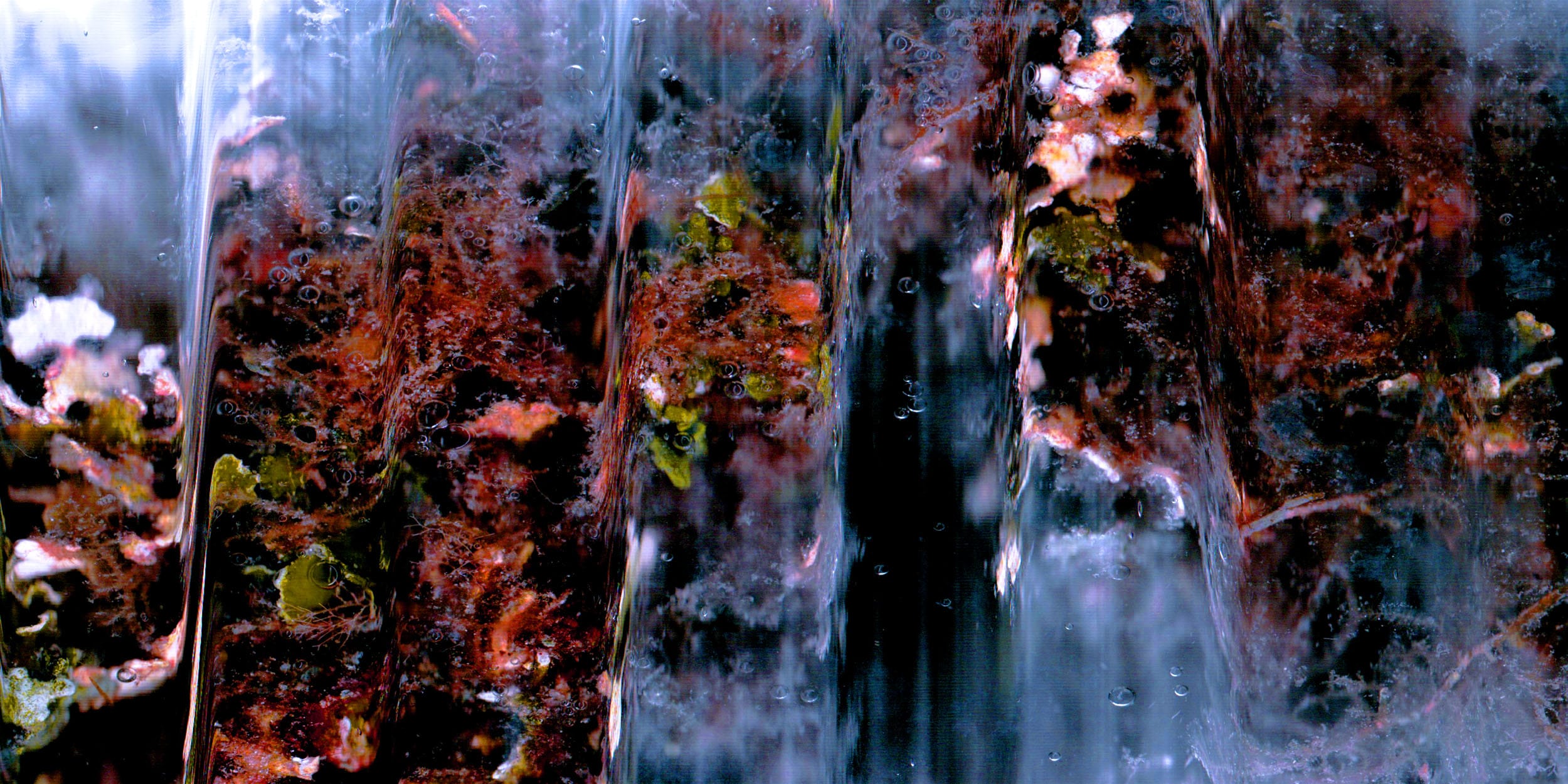
This is pretty much Nathaniel Stern’s year. While he’s shown some of his collaborative works in Milwaukee for some years, he has not shown the solo work he is most known for internationally. For this work, he straps a scanner, laptop and custom battery pack to his body and “performs into existence” his strange and beautiful artworks. What’s more he does this in and under water with a special rig made at the University of Wisconsin-Milwaukee. There are moments of intense clarity that surface from the visual skips and drags. These 21st-century versions of Impressionism debut Friday at the Tory Folliard Gallery. Stern will speak at 1 p.m. Saturday. He also will have work exhibited at the Milwaukee Institute of Art & Design, 273 E. Erie St., as part of “Vital Technology,” starting Friday and at the Museum of Wisconsin Art starting April 11.
Read the rest of this article in the online or print editions of the MJS
Related artworks:
Other related texts:
Popular Mechanics
These Stunning Underwater Photos Were Taken With a Desktop Scanner
Tim Newcomb

Rippling Images is a fitting name for Nathaniel Stern’s latest works of art, and in more ways than one. The collection shows off 18 prints captured under the rippling water of a live coral reef near Kay Largo, Fla., and he made those images using a device known for rippling: a desktop scanner.
Stern has been known for more than a decade for his method of scanning landscapes. The inspiration for this aqueous art came when his brother-in-law suggested he take the idea under the sea. Stern says he designed 10 different subaqueous scanner systems, built five to completion, and took three with him underwater. The scanners used custom electronics, plus melted and welded Plexiglas, metal, towels, and even some duct tape to operate in the ocean.
“They leaked, they broke, and they captured things I never wanted and never intended,” he says. But that’s what you get with experimental work.
[SlideDeck2 id=3425 ress=1]
Using custom-made rigs and battery packs, Stern strapped the devices to his back or held them out in front as he swam to capture the beauty and color of the reef and the marine life that frolics nearby.
“My goal was an exhibition where site and technology—their limitations, possibilities, and potentials—take great agency in the constitution and construction of printed forms,” he writes on his website. “I provoke thinking and feeling and movement that never would have came to me had I not worked beyond the scope of what was possible.”
Stern’s images debuted during a July art fair in Johannesburg, South Africa. They now lead a solo Rippling Images show that will run from Oct. 17 through Nov. 15 in the Tory Folliard Gallery in Milwaukee, Wisc.—Stern’s hometown. A scan through the 18 prints can toss a ripple into what you thought possible from a nearly antiquated piece of electronics.


See the original article on Popular Mechanics.
Related artworks:
Other related texts:
MKE Journal Sentinel
Artist Nathaniel Stern scans a subaqueous terrain
This article by Mary-Louise Schumacher appeared in both the online and print editions of the MJS

If memory serves, the first time I laid eyes on Nathaniel Stern, it was in a Facebook profile picture years ago. He was standing up to his chest in a lily pond, a straw hat tipped over his brow and sweeping what looked like a desktop scanner over the surface of the water. I remember thinking, “Who is this modern-day Claude Monet pondering perception in new ways?”
Since then, I’ve had the chance to get to know Stern, who is a contributor to Art City, the Milwaukee Journal Sentinel’s online journal about art, architecture, design and the urban landscape. And while I’ve seen many of his installations, prints and videos here in Milwaukee, I’ve not had the chance to see some of his highly unusual scanner work, except in online reproductions and a few small prints.
Though they’ve been exhibited elsewhere in the world, including South Africa, they’ll be exhibited here for the first time at the Tory Folliard Gallery in October. For his more recent scanner pieces, Stern straps on the scanner, laptop and custom battery pack and “performs images into existence.” Lately, this process has taken Stern beneath the water’s surface to subaqueous terrain, too.
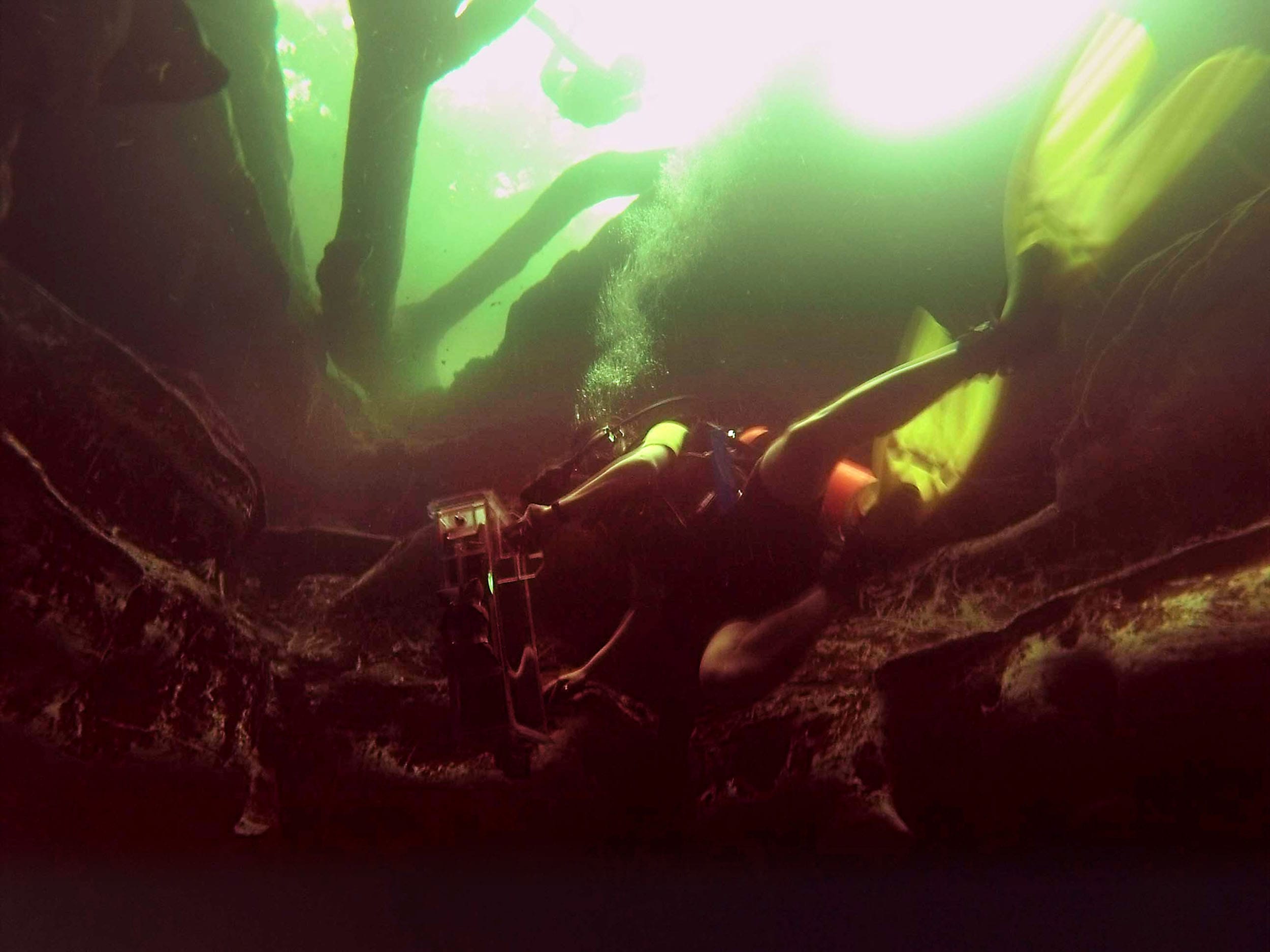
Truth be told, by today’s standards, scanners are pretty quaint technology, not the kinds of machines one typically dunks in the drink. Stern not only took months of diving lessons to be able to do this work, he spent countless hours with a team at the University of Wisconsin-Milwaukee designing a special rig for his equipment, which leaked horribly in the first several attempts.

Nathaniel Stern has a desktop scanner strapped to his body while scuba diving to create his latest series of art images.
The resulting images, some made on a coral reef off the coast of Key Largo in Florida, are beautiful and strange. I can’t wait to see them on the gallery wall. I’m reminded of the way the mind perceives, less directly than we might imagine, filling in pieces of what we see not unlike the way computers fill in pixels based on sophisticated, technology-driven guesses. There are moments of intense clarity that surface from the visual skips and drags. They are so otherly, but the images will also be familiar to anyone used to the digital hiccups of the 21st century.
As a writer at Gizmodo asked, maybe this is how fish see the world.
“The resulting artworks are full of care, thought, and wonder,” states the website for the Tory Folliard Gallery, 233 N. Milwaukee St. The show opens Oct. 17.
Mary Louise Schumacher is the Journal Sentinel’s art and architecture critic. Follow her coverage at Art City: www.jsonline.com/artcity.
See the original article by Mary-Louise Schumacher online or in print.
Related artworks:
Other related texts:
Juxtapoz
After much trial and even more error, artist Nathaniel Stern was finally able to create an underwater casing for a flatbed scanner. With the help of a team, Stern was able to develop custom software and hardware that he would use with his underwater scanner while scuba diving off the coast of Key Largo, Florida in a live coral reef. The resulting images are bold abstractions of the coral that Stern captured with his scanner and mirrors the ripples of water in the way the scanner creates each composition.
text by Canbra Hodsdon
[SlideDeck2 id=3373 ress=1]
Related artworks:
Other related texts:
engadget
This artist waterproofed a scanner to create stunning ocean art
James Trew for Engadget

“In my ongoing series of “Compressionism” prints, I strap a desktop scanner, computing device and custom battery pack to my body, and perform images into existence.” That’s how artist Nathaniel Stern describes his collection of unconventional images captured with a desktop scanner. An extension of this project is “Rippling Images,” a new collection which takes the idea underwater. Stern worked with a team to create a “marine rated” scanner rig, which he took with him as he scuba-dived off the coast of Key Largo, florida. The results in the gallery below show the ocean environment as interpreted through Stern’s scanner and body movements. That explains the rippling part, at least.




See original slideshow and post on Engadget
Related artworks:
Other related texts:
CNET
Homemade undersea scanner finds strange new world
Nathaniel Stern dives beneath the sea armed with DIY photography rigs toggled from custom electronics. The artist’s results? Bizarre and beautiful.
by Leslie Katz for CNET
This rig has a bicycle valve so Stern can vacuum-seal it closed when he goes underwater. He got it down to 30 feet before experiencing leaks.
It’s easy to find a good compact underwater camera, but artist Nathaniel Stern opted to go a different route for his deep-sea imaging. Really different. He strapped on homemade rigs built from custom electronics and software, melted and welded plexiglass, plastic bags, duct tape, and other bits and bobs and proceeded to dive into the subaqueous world.
The resulting odd and beautiful renderings make up “Rippling Images,” a new series of fluid and often-abstract images of flora and fauna created as Stern and his marine-rated contraptions dove along a live coral reef off the coast of Key Largo in Florida. Because Stern wears the gizmos, his movements help compose the shots, some of which would look more at home hanging in the Museum of Modern Art than among other, more typical undersea photographs.
As he puts it, “I perform images into existence.”

Stern gets up close with a three-eyed undersea creature, or maybe that’s just the photographic effect.
“My movements underwater, my relations to life and gravity, what I see and cannot see, fish and plants, breathing and fluidity, all affect and are affected as these images [are] being made,” Stern, a professor of art and design at the University of Wisconsin-Milwaukee’s Peck School of the Arts, says on the project’s website.
Nathaniel Stern dives beneath the sea armed with DIY photography rigs toggled from custom electronics. The artist’s results? Bizarre and beautiful.
The images are an outgrowth of Stern’s ongoing “Compressionism” series, in which he hitches a flat-bed desktop scanner, computing device, and custom battery pack to his body and moves through the terrestrial world doing things like swinging over flowers or jumping over bricks to capture images of objects and spaces. When he captures a shot, every part of the image is broken up into moments of time because of how the scanner beam moves across the surface of the scanner and how Stern maneuvers the entire custom rig across the landscape.
For the aqueous version of his art, Stern spent three months getting certified to scuba dive. He and his team designed 10 underwater systems, and built 5 of them to completion. He toted 3 of these hacked-together getups under the sea.
“They leaked, they broke, they scanned scratches on the surface of the boxes, they reflected, they captured things that I never wanted and never intended,” Stern reports, “and that is precisely the nature of experimental work.”
Stern, whose art often focuses on how people engage with and experience the world, previously afforded us Earth-bound social-media addicts the chance to tweet to aliens.
“Rippling Images” will be on display at the Turbine Art Fair in Johannesburg from July 17 to 20, and as a solo show at the Tory Folliard Gallery in Milwaukee in October. For a deeper dive (so to speak) into the project, watch this video.

“Flower,” a digital print on metallic paper. “The colors and hairs and mossy-like textures came out stronger than I ever could have imagined, in formation, soft and aqueous,” Stern told Crave of his technique.

“Metallic,” one of the “Rippling Images” pieces created with one of Stern’s undersea rigs.

Some of the works from the series look like they’d be at home at a modern-art museum.
Read the original article on CNET
Related artworks:
Other related texts:
Gizmodo
These Underwater Photos Were Taken By a Desktop Scanner
Kelsey Campbell-Dollaghan for Gizmodo
The desktop scanner is a wonderful thing, but rugged it ain’t. Yet Nathaniel Stern didn’t let that stop him: The Wisconsin-based artist, who is known for his experimental camera designs, created a waterproof version of an off-the-shelf scanner that captured a series of incredible images of sea life.
“Everything leaked, everything broke, nothing did what I wanted or expected,” Stern writes on his website about the project, Rippling Images, for which he took months of diving courses to become certified to complete it. But the finished product was certainly worth it—here’s how Stern carried it out:
For Rippling Images, I worked with a team to produce a marine-rated scanner rig, including custom hard- and software, and performed a new series of digital works while scuba diving on a live coral reef off the coast of Key Largo in Florida. My goal was an exhibition where where site and technology – their limitations, possibilities and potentials – take greater agency in the constitution and construction of printed forms. My movements underwater, my relations to life and gravity, what I see and cannot see, fish and plants, breathing and fluidity, all affect and are affected in and as these images, being made.
You can check out the complete batch of images on Stern’s website. They’re both bizarre and beautiful, unlike any photos of the marine world I’ve ever seen. It almost feels as though we’re experiencing how fish see the world. [PetaPixel]
See the original post on Gizmodo
Related artworks:
Other related texts:
Boing Boing
Artistic scanner-photos taken on a coral-reef
Cory Doctorow for Boing Boing
Nathaniel Stern straps modified document scanners to his body and then walks around, producing beautiful, glitched out art-images. Now he’s taken his scanners to the bottom of the ocean.
For the last decade or so, I’ve been making fine art prints by strapping a desktop scanner, custom battery pack, and computing devices to my body, then traversing the landscape to produce abstract but detailed slit scan imagery… The reasons are threefold: very high resolution; proximity – I’m a part of the landscape I’m capturing, rather than distanced from it (no added lens); and the potency of multiple adjacent times and spaces viewed on a 2D plane.
For the latest in the series, I produced several marine-rated, scuba scanning rigs – metal, plastic and/or polycarbonate, with various forms of gaskets, vacuum seals, and hall effect (magnetically-triggered) buttons to create the scans.
The complete body of work, 18 prints, premiere at the Turbine Art Fair in Johannesburg next week (July 17 – 20). The show comes to Milwaukee WI, where I now live, in October.
See it on Boing Boing
Related artworks:
Other related texts:
What Animals Teach Us about Politics

Cover image: detail from Giverny of the Midwest (2011).
“This is a truly brilliant book, one of Brian Massumi’s best. More than anyone else I have read, Massumi makes real progress in untangling the relationship between play, sympathy, politics, and animality. What Animals Teach us About Politics provides a fascinating and persuasively non-subject-centered account of sympathy, and it goes a long way toward helping us to see how the practice and theorization of ‘politics’ would be radically refigured within a process-ontology.” – Jane Bennett, author of Vibrant Matter: A Political Ecology of Things
Title: What Animals Teach Us about Politics
Author: Brian Massumi
Publisher: Duke University Press
Date of Publication: September 2014
Language: English
ISBN-10: 082235800X
ISBN-13: 978-0822358008
Order this book from Amazon.com
Related artworks:
Other related texts:
PetaPixel
Experimental Underwater Scanner Makes for Beautiful Happy Accidents
Gannon Burgett for PetaPixel
If you enjoy strange and experimental photography, Nathaniel Stern‘s work should delight you.
For the past ten years, Stern has been creating experimental image-capturing devices using a conglomeration of hacked-together desktop scanners, battery packs and other various computer components. Once created, he straps these machines to his body and takes them from location to location capturing images unlike any other camera out there.

In his latest series, Rippling Images, Stern decided to take his images one step further by venturing to take these experimental camera creations underwater. It didn’t come easy though.
Stern spent months getting certified for a number of open-water diving licenses. And when he wasn’t doing that, he was helping his team piece together what would eventually become the five final models of the device he would be taking underwater.
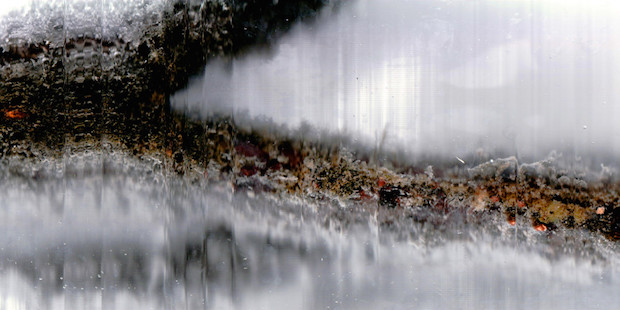
Made out of everything from welded metal to magnetically-triggered buttons, the devices didn’t actually capture what Stern was hoping for at all. But what they capture, Stern still found beautiful… if not more beautiful than his usual work.
The scratched surfaces of the plastic showed up, unplanned reflections made several appearances, and the images were just overall more experimental than he could’ve ever expected:


Experiment might as well be Stern’s middle name though, so he took everything in stride and used it as a learning experience, sharing his thoughts in a video that we’ve embedded at the top.
It comes in just shy of three minutes, so give it a quick watch to see Stern and his unusual devices at work, and then head over to his website to see more of his work.
Read the article on PetaPixel
Related artworks:
Other related texts:
WORT fm
 The 8’oclock Buzz: Return of the Frankensteined Scanners
Last time we spoke with Milwaukee artist Nathaniel Stern, he was trying to jerry-rig dozens of flatbed scanners to take peculiarly framed, high resolution underwater photographs. Well since then, Nathaniel reports that nearly everything that could possibly go wrong with that project did. Nathaniel Stern joined the Monday Buzz once more by phone from Milwaukee with an update.
Download the mp3 (13mb), or listen to the entire interview about performative printmaking / Compressionism with host Brian Standing:
Related artworks:
Other related texts:
WORT fm
 The 8’oclock Buzz: Frankensteined Scanners Under the Sea
Last time the Monday Buzz talked with Milwaukee artist, Nathaniel Stern, he was sending tweets into space and subverting Wikipedia for his own nefarious artistic ends. Now, he’s jerry-rigging flatbed scanners for high-resolution, time-shifting underwater duty. Listen as Nathaniel explains to host Brian Standing how to turn a flat imager into a self-contained scuba camera, the philosophical nature of an image, and more.
Download the mp3 (13mb), or listen to the entire interview about performative printmaking / Compressionism with host Brian Standing:
Related artworks:
Other related texts:
MKE Journal Sentinel
‘Surfacing’ at Lynden Sculpture Garden
This article by Diane Bacha appeared in both the online and print editions of the MJS
 Jessica Meuninck-Ganger and Nathaniel Stern, colleagues at the Peck School of the Arts, took their kids on a trip to the Milwaukee County Zoo one day and came back with an idea for a collaboration. That was three collaborations ago, and they don’t plan to stop.
I can only imagine the conversation that day at the zoo. I am picturing a continuous loop of ideas and theory interrupted by chatter with the kids and pauses to watch the polar bear play. They would have been two families walking at various paces, passing groups moving in other directions, everyone having different conversations about different things while the animals moved in their enclosures. In the background the sky and clouds had their own rhythm. It’s a familiar scene at one glance, but there’s a lot happening on closer inspection. And that’s the way this collaborative work feels: a layering of experiences, moments, ideas, and intersections that teeter between mundane and complex.
Stern is a video and installation artist and Meuninck-Ganger is a printmaker. Although any description of what they do requires asterisks – their work doesn’t exist in silos – their collaboration draws on those specific disciplines, then veers.
“Surfacing” is their latest installation together, and it’s at the Lynden Sculpture Garden until March 24. In it, Stern and Meuninck-Ganger continue their fascinating exercise in layering printmaking and video one atop the other. Each of the six pieces in the small Lynden gallery is a framed, rear-projected video over which has been laid a translucent editioned print or, in one case, a drawing. The viewer sees a static black picture in the foreground and moving, color images in the background. The static image on the skin is taken from a moment or multiple moments occurring in the video beneath.
“Pantograph” uses transportation to convey the idea of layered moments. It’s four minutes in the life of a city intersection where rail, automotive, bicycle and foot traffic converge. The static image is a collection of moments from the traffic – an electric railroad car entering the frame at right, a woman guiding some children at left, a row of automobiles cutting through the middle. As you watch, moving images interact in conflict or harmony with the still image. “Midst” is seemingly less complex: the video depicts a man doing tai-chi exercises on a waterfront, his movements barely visible beneath a woodcut. In this case, a dragon’s form on the static woodcut introduces an element outside the literal. 3-D interpretations of the original woodcut hang on each side of the framed piece. Still more layers.
Other pieces depict a bowling ball striking pins, the Allen-Bradley clock tower, another street scene, and two seated subway-car passengers with their backs to each other. The video loops range in time from 15 seconds to 5 minutes.
Where Stern’s video ends and Meuninck-Ganger’s printmaking begins is fuzzy, since the two have traded off roles depending on the piece. They want to blur the lines between individual contributions and also between the two media. The image applied to the video gives the video a new meaning, and vice-versa. Each is a singular experience – neither video nor print but a distinct hybrid.
Someone viewing this work for the first time might not see it that way. You find yourself fascinated by the technique, so you’re aware of it and you’re trying to figure out its trick – when will the images line up with each other? Is there something I’m supposed to see when it does? Are there other sleights-of-art to watch for? And why was this particular moment chosen as the static image?
Then there is the blending of old media and new and all that’s implied with that. There is the idea of time stopped (perhaps a memory) and time looped (perhaps an obsession). One thinks of the “key block / color block” elements of traditional printmaking. And of the endless possibilities of a particular moment in time, and how few of those possibilities we usually perceive.
 What are we to make of these images as a whole? Is it a fable about patience? About being watchful for the beauty in mundane moments? Each piece is different enough in tone, context and even technique that the overall experience doesn’t feel cohesive.
Ultimately, what I found most rewarding with “Surface” was the meditative experience it offered when I let my questions go. It was akin to finding a park bench to watch the world go by. Like most times I’ve spent on a park bench, it takes a while for me to empty my mind and just observe. The rewards come throughout the process, not just at one moment.
Adjacent to the exhibition space, in a porch whose windows overlook the snow-covered sculpture garden, there’s a lovely echo of this experience. The artists have created an installation here by using the windows as a membrane covering the landscape outside. Images drawn on the windows repeat static elements of the landscape in the same way they do on the framed pieces. This time, the movement comes from whatever happens outside randomly, but also from the viewer who changes position to discover visual alignments and misalignments. In a nice interactive touch, the artists have invited visitors to add their own images to the glass.
Meuninck-Ganger and Stern offer up a beautiful opportunity to shift our way of seeing. It is a more conscious way of seeing, to be sure. How often does that happen in the Age of Attention Deficit? The possibilities are exciting.
read the entire article online
see the print edition
Related artworks:
Other related texts:
M Magazine
Scanning the Artscape
Five artists on the rise in the cream city
by Tory Folliard with Christine Anderson; portraits by Dan Bishop
Milwaukee’s Third Ward has been named one of America’s Top Twelve Art Places 2013, which recognizes neighborhoods in the largest 44 metropolitan areas in the country where the arts are central to the social and economic vibrancy of a neighborhood. Even with a flourishing art scene and a wealth of talented artists — in the Third Ward and beyond — many artists still remain unknown to most Milwaukeeans. Here are five artists to watch chosen by Milwaukee art curators….

“I believe that art can change what we see and do, and are.”
— Nathaniel Stern, Milwaukee: Interactive, Installation and Video Art | nathanielstern.com

Curator: Graeme Reid, assistant director of the Museum of Wisconsin Art.
“Stern is one of the most creative, articulate, imaginative artists in the state and, frankly, the country. He should be an international art star. Actually, he is! I can’t think of too many other artists in the state who are building a similar resumé.”


Back Story: The former New Yorker has an impressive resumé of exhibitions and awards from all over the world. (He recently exhibited in January in Johannesburg, South Africa.)
Stern’s interactive art often centers on bodily performances. In his current “Compression” series of prints he straps a laptop and desktop scanner to his body and performs “images into existence.”
Moving his body while he scans the landscape around him, Stern creates images that are later made into prints. He is an associate professor of art and design at the Peck School of the Arts at UW-Milwaukee. His work is on exhibit locally at Lynden Sculpture Garden in a collaborative piece with Jessica Meuninck-Ganger.
Download full / print article (PDF, 1.5mbs)

Related artworks:
Other related texts:
Sunday Independent
 Creating new Impressions
This article by Mary Corrigall appeared in both the online and print editions of the Sunday Independent

Impressionism has become so unsexy in the last couple of decades. Well, in art circles, that is. Mostly it’s because this once avant-garde French movement has been embraced with such gusto by the masses. For this reason many overseas public galleries wishing to up the foot traffic in their institutions and assert their relevance to society stage themed shows from this period, or exhibitions by artists connected to it.
The frequency of these impressionism blockbusters has rendered the art from that movement blasé. So it is surprising to find a multi-media artist who embraces what is termed “contemporary practice” to be so captured by the art of Claude Monet and in particular his artwork Water Lilies (1914-1926). As the title suggests they are paintings of the most banal of still life subject matter: tranquil ponds dotted with lilies Monet spied in his garden in Giverny, France.
For Nathanial Stern the radicalism of the impressionist vocabulary hasn’t quite worn off. He returns to it anew with an eye for reinventing it for the digitised era. Like many viewers who have stood in front of Monet’s large scale paintings in the Museum of Modern Art in New York, Stern was seduced by the romantic, hazy lens through which Monet depicted this bucolic scene. In his version of Monet’s Water Lilies he has retained the large scale in his triptych Giverny of the Midwest – the pond he studied was in Indiana. Stern was aware scale played an important role in creating an immersive experience for viewers. He deconstructs and then reconstructs Monet’s approach, but this activity is not in service of demystifying, or satirising it, but re-enacting a moment in art history using digital media.
“Immersion” and “deconstruction” inform this body of work and Stern’s mode of documenting reality, which involves an HP scanner harnessed around his neck as he wades through the pond. Put plainly, he scans his subject matter. Because he does not remain static while doing this he generates images that appear life-like, but distorted. Not too unlike the kind of distortion reality undergoes under Monet’s heightened gaze, which amplifies the physical and sensual properties of his interest.
Just as Monet realised a purely figurative rendering of organic life doesn’t quite relay the physical experience or weight of reality, so does Stern recognise a straight life-like scan won’t do so either. Stern’s proximity to his subject matter facilitates a level of abstraction before he has even begun his process of “decompression”, which involves undoing the compression of the image. He is so close to his subject matter he doesn’t necessarily observe it, but is immersed in it. Because of this the view is distorted. It is a bit like putting the lens of a camera right up against that which is to be photographed.
Physical distance is a prerequisite for representation. Stern’s approach challenges this idea for not only is he immersed in his subject matter, but ironically he equips himself with a gadget that has no view-finder so he is unable to see the images he is capturing. As a result he records while not being trapped by, or implicated in, the act of recording. Thus representation is separated from seeing, it becomes an intuitive act of another kind.
This, of course, is the antithesis of the effect digital mediums have had on a society which has become more consumed with the act of documenting life that reality is viewed through a lens. In this way Stern succeeds in achieving what Monet never could: he is able to exist in a moment without the burden of reconstructing it. For this reason he is a participant rather than a detached observer. Stern is able to produce images that relay so much detail, like a insect caught in a petal or the veins of a leaf. These details might have evaded his detection despite his proximity and immersion. This suggests he was unable to fully appreciate the scene in its totality. In this way the full weight of reality is always withheld.
It is only in the processing of his scanned images, in which he stretches them out, that another encounter with his subject matter becomes possible. This encounter is obviously subject to his manipulation; he heightens the colours and decompresses the images to such a point that they are abstracted.
Stern doesn’t present one cohesive view of the pond, but a plethora of cropped details of it. The images are pieced together to form three larger “canvases”. They need to be scrutinised up close, where you can spy traces of the submersion of his physical being in the work – denoted by finger prints.
These works are excessively beautiful and compel immersion. Viewing them is a time-demanding exercise, which defies our usual consumption of imagery. This is exacerbated by the number of small canvases one must view, which appear like pieces of a puzzle even though they do not fit together to create a complete image. These are fragments of reality. Stern suggests a scene cannot be relayed in its entirety, so despite his reverence he challenges Monet’s work. Stern doesn’t order the visual world; he casts his garden pond scene as an indeterminate one that exists beyond the boundaries of any frame.
*Giverny of the Midwest has been on show at the Art on Paper Gallery in Joburg.
read the entire article online
see it in the print edition
Related artworks:
Other related texts:
Printmaking Today
 Printmaking Today article on contemporary practices in South Africa. Covers performative scanner art, and Nathaniel Stern’s work with Jillian Ross at the David Krut Workshop in Johannesburg, South Africa.


Related artworks:
Other related texts:
Guardian Unlimited
 Catch of the day: Second Life’s new gallery
Three artists are showcasing their art in a new virtual gallery. But is this really the best place to see their work?
I’ll be honest. My experience of Second Life is fairly limited. Somewhere on Linden Lab’s virtual world, there’s an inert avatar I created, sat fully clothed in someone’s bath. Sorry about that. The door was open and I got a bit tired of people approaching me and trying to turn me into a busty lady, so I sought refuge in the first empty house I found.
But I’m not really the Second Life type. After seeing Wonderland: Virtual Adultery and Cyberspace Love last night on BBC2, I’m quite glad. So you’ll have to forgive me if I’m not as excited as some people about the launch of Ten Cubed, a new art gallery in Second Life, which goes live here today.

The gallery has been developed by Depo Consulting in association withGalleryica. Don’t get me wrong; it all looks very well designed. “Most virtual galleries are like your average website, poorly designed without any sense of optimising a visitor’s experience,” announced Depo CEO and creative director Peter Dunkley. “Ten Cubed has been designed by a professional architect to exploit fully the showcasing opportunities of the virtual medium.”
I’m sure he’s right. The inaugural show features the work of Chris Ashley, Scott Kildall and Nathaniel Stern, all interesting artists whose use of new technology makes them perfect for this sort of project.
I just don’t get why viewing their work in Second Life is the best place to showcase their work. Dunkley insists the gallery is “perfectly placed to be accessed and visited by business people generally too busy to physically attend art galleries, which should benefit sales”.
Well yes, if you’re the sort of business person who hangs out in Second Life. But after a much publicised credit scam and a run on the virtual bank, the Second Life business model seems to be on shaky ground. And “Second Thoughts on Second Life” editorials have been springing up for over a year now – almost as soon as the mainstream press picked up on it (and about the time my avatar first went for a bath).
So – nice design, nice publicity stunt. It’s made me check out the artists online anyway, via their own websites. Which is the only place I’d even contemplate buying their art.
Related artworks:
Other related texts:
earn advertising fees by advertising and linking to Amazon.com. Amazon and the Amazon logo are trademarks of Amazon.com, Inc, or its affiliates
Powered by WordPress | Albedo / Graph Paper Press Theme | Child Theme by Andrew McConville + Nathaniel Stern