

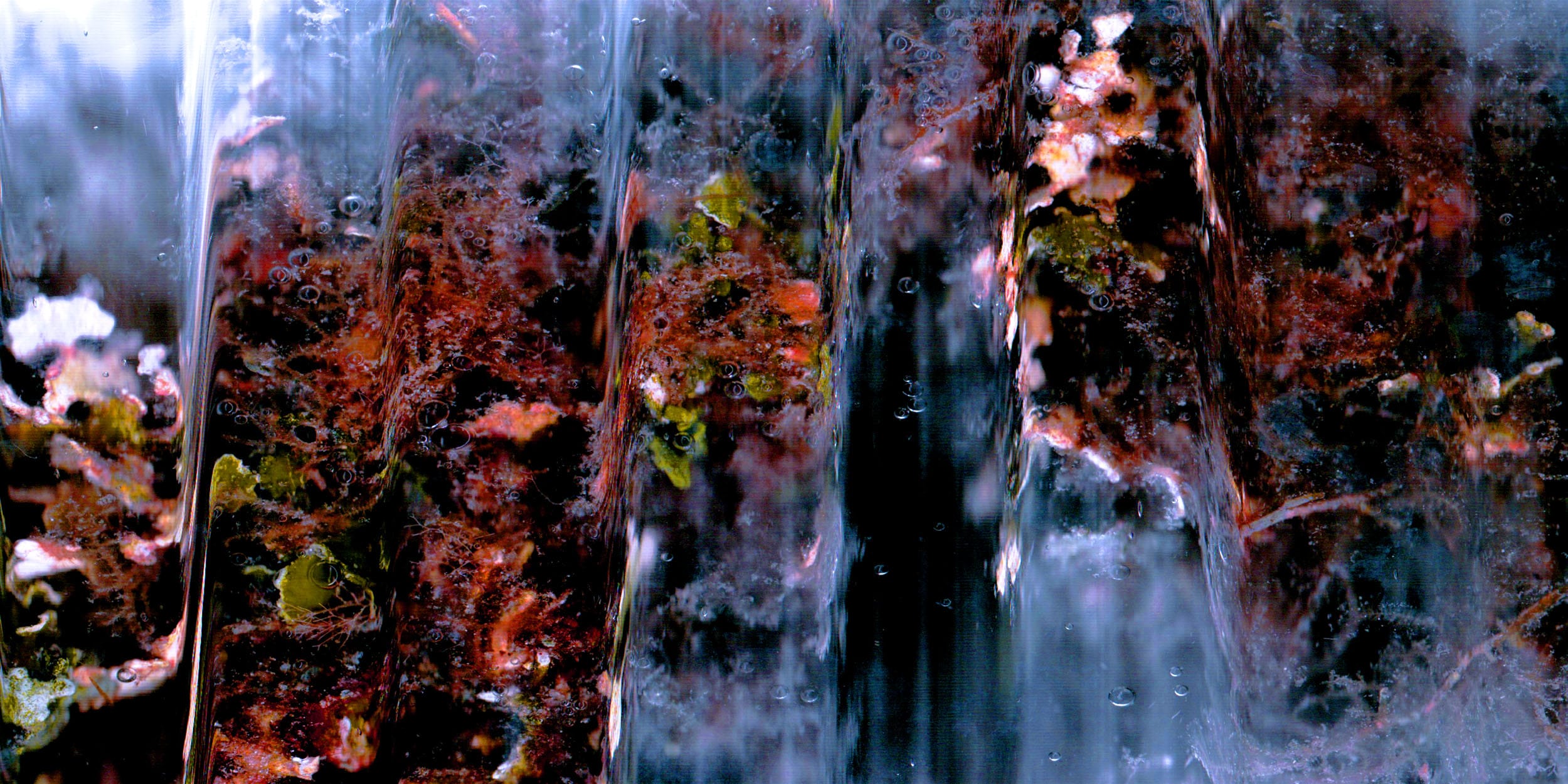
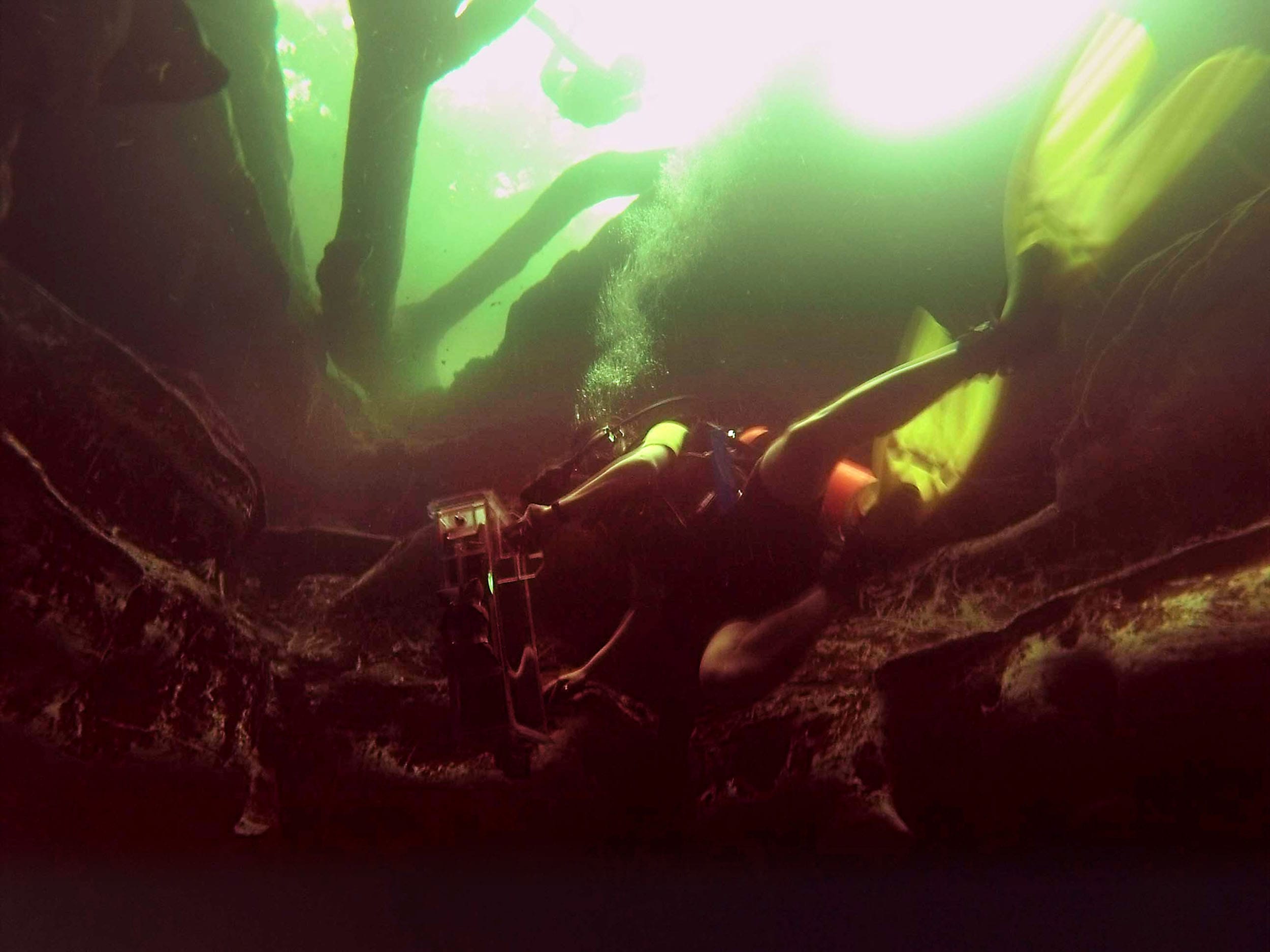
After much trial and even more error, artist Nathaniel Stern was finally able to create an underwater casing for a flatbed scanner. With the help of a team, Stern was able to develop custom software and hardware that he would use with his underwater scanner while scuba diving off the coast of Key Largo, Florida in a live coral reef. The resulting images are bold abstractions of the coral that Stern captured with his scanner and mirrors the ripples of water in the way the scanner creates each composition.
text by Canbra Hodsdon
[SlideDeck2 id=3373 ress=1]
Related artworks:
Other related texts:
TAF Catalog
Interview: Nathaniel Stern, Featured Artist
Photos: Nathaniel Stern
Publisher: Turbine Art Fair, Johannesburg
Date of Publication: 2014
Language: English

Related artworks:
Other related texts:
engadget
This artist waterproofed a scanner to create stunning ocean art
James Trew for Engadget

“In my ongoing series of “Compressionism” prints, I strap a desktop scanner, computing device and custom battery pack to my body, and perform images into existence.” That’s how artist Nathaniel Stern describes his collection of unconventional images captured with a desktop scanner. An extension of this project is “Rippling Images,” a new collection which takes the idea underwater. Stern worked with a team to create a “marine rated” scanner rig, which he took with him as he scuba-dived off the coast of Key Largo, florida. The results in the gallery below show the ocean environment as interpreted through Stern’s scanner and body movements. That explains the rippling part, at least.






See original slideshow and post on Engadget
Related artworks:
Other related texts:
CNET
Homemade undersea scanner finds strange new world
Nathaniel Stern dives beneath the sea armed with DIY photography rigs toggled from custom electronics. The artist’s results? Bizarre and beautiful.
by Leslie Katz for CNET
This rig has a bicycle valve so Stern can vacuum-seal it closed when he goes underwater. He got it down to 30 feet before experiencing leaks.
It’s easy to find a good compact underwater camera, but artist Nathaniel Stern opted to go a different route for his deep-sea imaging. Really different. He strapped on homemade rigs built from custom electronics and software, melted and welded plexiglass, plastic bags, duct tape, and other bits and bobs and proceeded to dive into the subaqueous world.
The resulting odd and beautiful renderings make up “Rippling Images,” a new series of fluid and often-abstract images of flora and fauna created as Stern and his marine-rated contraptions dove along a live coral reef off the coast of Key Largo in Florida. Because Stern wears the gizmos, his movements help compose the shots, some of which would look more at home hanging in the Museum of Modern Art than among other, more typical undersea photographs.
As he puts it, “I perform images into existence.”

Stern gets up close with a three-eyed undersea creature, or maybe that’s just the photographic effect.
“My movements underwater, my relations to life and gravity, what I see and cannot see, fish and plants, breathing and fluidity, all affect and are affected as these images [are] being made,” Stern, a professor of art and design at the University of Wisconsin-Milwaukee’s Peck School of the Arts, says on the project’s website.
Nathaniel Stern dives beneath the sea armed with DIY photography rigs toggled from custom electronics. The artist’s results? Bizarre and beautiful.
The images are an outgrowth of Stern’s ongoing “Compressionism” series, in which he hitches a flat-bed desktop scanner, computing device, and custom battery pack to his body and moves through the terrestrial world doing things like swinging over flowers or jumping over bricks to capture images of objects and spaces. When he captures a shot, every part of the image is broken up into moments of time because of how the scanner beam moves across the surface of the scanner and how Stern maneuvers the entire custom rig across the landscape.
For the aqueous version of his art, Stern spent three months getting certified to scuba dive. He and his team designed 10 underwater systems, and built 5 of them to completion. He toted 3 of these hacked-together getups under the sea.
“They leaked, they broke, they scanned scratches on the surface of the boxes, they reflected, they captured things that I never wanted and never intended,” Stern reports, “and that is precisely the nature of experimental work.”
Stern, whose art often focuses on how people engage with and experience the world, previously afforded us Earth-bound social-media addicts the chance to tweet to aliens.
“Rippling Images” will be on display at the Turbine Art Fair in Johannesburg from July 17 to 20, and as a solo show at the Tory Folliard Gallery in Milwaukee in October. For a deeper dive (so to speak) into the project, watch this video.

“Flower,” a digital print on metallic paper. “The colors and hairs and mossy-like textures came out stronger than I ever could have imagined, in formation, soft and aqueous,” Stern told Crave of his technique.

“Metallic,” one of the “Rippling Images” pieces created with one of Stern’s undersea rigs.

Some of the works from the series look like they’d be at home at a modern-art museum.
Read the original article on CNET
Related artworks:
Other related texts:
Gizmodo
These Underwater Photos Were Taken By a Desktop Scanner
Kelsey Campbell-Dollaghan for Gizmodo
The desktop scanner is a wonderful thing, but rugged it ain’t. Yet Nathaniel Stern didn’t let that stop him: The Wisconsin-based artist, who is known for his experimental camera designs, created a waterproof version of an off-the-shelf scanner that captured a series of incredible images of sea life.
“Everything leaked, everything broke, nothing did what I wanted or expected,” Stern writes on his website about the project, Rippling Images, for which he took months of diving courses to become certified to complete it. But the finished product was certainly worth it—here’s how Stern carried it out:
For Rippling Images, I worked with a team to produce a marine-rated scanner rig, including custom hard- and software, and performed a new series of digital works while scuba diving on a live coral reef off the coast of Key Largo in Florida. My goal was an exhibition where where site and technology – their limitations, possibilities and potentials – take greater agency in the constitution and construction of printed forms. My movements underwater, my relations to life and gravity, what I see and cannot see, fish and plants, breathing and fluidity, all affect and are affected in and as these images, being made.
You can check out the complete batch of images on Stern’s website. They’re both bizarre and beautiful, unlike any photos of the marine world I’ve ever seen. It almost feels as though we’re experiencing how fish see the world. [PetaPixel]
See the original post on Gizmodo
Related artworks:
Other related texts:
Boing Boing
Artistic scanner-photos taken on a coral-reef
Cory Doctorow for Boing Boing
Nathaniel Stern straps modified document scanners to his body and then walks around, producing beautiful, glitched out art-images. Now he’s taken his scanners to the bottom of the ocean.

For the last decade or so, I’ve been making fine art prints by strapping a desktop scanner, custom battery pack, and computing devices to my body, then traversing the landscape to produce abstract but detailed slit scan imagery… The reasons are threefold: very high resolution; proximity – I’m a part of the landscape I’m capturing, rather than distanced from it (no added lens); and the potency of multiple adjacent times and spaces viewed on a 2D plane.
For the latest in the series, I produced several marine-rated, scuba scanning rigs – metal, plastic and/or polycarbonate, with various forms of gaskets, vacuum seals, and hall effect (magnetically-triggered) buttons to create the scans.
The complete body of work, 18 prints, premiere at the Turbine Art Fair in Johannesburg next week (July 17 – 20). The show comes to Milwaukee WI, where I now live, in October.
See it on Boing Boing
Related artworks:
Other related texts:
PetaPixel
Experimental Underwater Scanner Makes for Beautiful Happy Accidents
Gannon Burgett for PetaPixel
If you enjoy strange and experimental photography, Nathaniel Stern‘s work should delight you.
For the past ten years, Stern has been creating experimental image-capturing devices using a conglomeration of hacked-together desktop scanners, battery packs and other various computer components. Once created, he straps these machines to his body and takes them from location to location capturing images unlike any other camera out there.

In his latest series, Rippling Images, Stern decided to take his images one step further by venturing to take these experimental camera creations underwater. It didn’t come easy though.
Stern spent months getting certified for a number of open-water diving licenses. And when he wasn’t doing that, he was helping his team piece together what would eventually become the five final models of the device he would be taking underwater.
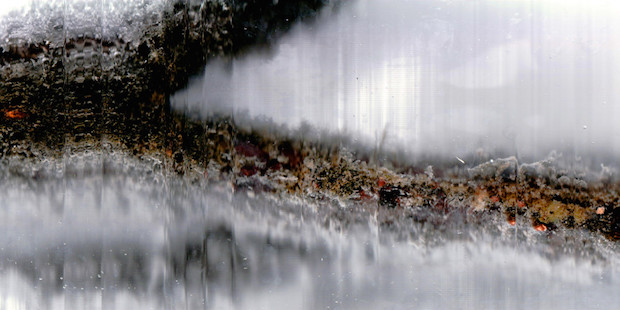
Made out of everything from welded metal to magnetically-triggered buttons, the devices didn’t actually capture what Stern was hoping for at all. But what they capture, Stern still found beautiful… if not more beautiful than his usual work.
The scratched surfaces of the plastic showed up, unplanned reflections made several appearances, and the images were just overall more experimental than he could’ve ever expected:


Experiment might as well be Stern’s middle name though, so he took everything in stride and used it as a learning experience, sharing his thoughts in a video that we’ve embedded at the top.
It comes in just shy of three minutes, so give it a quick watch to see Stern and his unusual devices at work, and then head over to his website to see more of his work.
Read the article on PetaPixel
Related artworks:
Other related texts:
WORT fm
 The 8’oclock Buzz: Return of the Frankensteined Scanners
Last time we spoke with Milwaukee artist Nathaniel Stern, he was trying to jerry-rig dozens of flatbed scanners to take peculiarly framed, high resolution underwater photographs. Well since then, Nathaniel reports that nearly everything that could possibly go wrong with that project did. Nathaniel Stern joined the Monday Buzz once more by phone from Milwaukee with an update.
Download the mp3 (13mb), or listen to the entire interview about performative printmaking / Compressionism with host Brian Standing:
Related artworks:
Other related texts:
WORT fm
 The 8’oclock Buzz: Frankensteined Scanners Under the Sea
Last time the Monday Buzz talked with Milwaukee artist, Nathaniel Stern, he was sending tweets into space and subverting Wikipedia for his own nefarious artistic ends. Now, he’s jerry-rigging flatbed scanners for high-resolution, time-shifting underwater duty. Listen as Nathaniel explains to host Brian Standing how to turn a flat imager into a self-contained scuba camera, the philosophical nature of an image, and more.
Download the mp3 (13mb), or listen to the entire interview about performative printmaking / Compressionism with host Brian Standing:
Related artworks:
Other related texts:
M Magazine
Scanning the Artscape
Five artists on the rise in the cream city
by Tory Folliard with Christine Anderson; portraits by Dan Bishop
Milwaukee’s Third Ward has been named one of America’s Top Twelve Art Places 2013, which recognizes neighborhoods in the largest 44 metropolitan areas in the country where the arts are central to the social and economic vibrancy of a neighborhood. Even with a flourishing art scene and a wealth of talented artists — in the Third Ward and beyond — many artists still remain unknown to most Milwaukeeans. Here are five artists to watch chosen by Milwaukee art curators….

“I believe that art can change what we see and do, and are.”
— Nathaniel Stern, Milwaukee: Interactive, Installation and Video Art | nathanielstern.com

Curator: Graeme Reid, assistant director of the Museum of Wisconsin Art.
“Stern is one of the most creative, articulate, imaginative artists in the state and, frankly, the country. He should be an international art star. Actually, he is! I can’t think of too many other artists in the state who are building a similar resumé.”

Back Story: The former New Yorker has an impressive resumé of exhibitions and awards from all over the world. (He recently exhibited in January in Johannesburg, South Africa.)
Stern’s interactive art often centers on bodily performances. In his current “Compression” series of prints he straps a laptop and desktop scanner to his body and performs “images into existence.”
Moving his body while he scans the landscape around him, Stern creates images that are later made into prints. He is an associate professor of art and design at the Peck School of the Arts at UW-Milwaukee. His work is on exhibit locally at Lynden Sculpture Garden in a collaborative piece with Jessica Meuninck-Ganger.
Download full / print article (PDF, 1.5mbs)

Related artworks:
Other related texts:
Art South Africa
 Dirty Hands or Hands-off? – The Print Matrix in a Mediated Milieu
by Dominic Thorburn
Since the very first images were made by dipping hands in natural pigment and pressing them on cave walls in Lacaux and Altamira, artists have been getting their hands dirty to make their mark. These simple images have to be some of the most economical, powerful and evocative symbols known to us. I believe it helpful to revisit visual images of this nature, to regain perspective and seek solace in them.
…
Just as language cannot be defined as alphabets, words or syntax, printmaking cannot be defined as a series of technical processes. It is defined by its function, its philosophical approach and the ideas and images it generates. Print may stake claim to creative territory that goes beyond any map; the meaning of the images produced by print media are the expanded terrain, the mediate milieu of the dialogue, the larger picture.
…
Nathaniel Stern is a prolific experimental video installation and time-based artist and writer who harnesses printmaking to extend his repertoire:
“I combine new and traditional media to create unfamiliar experiences of that which we encounter every day. My art attempts to intercept taken for granted categories such as ‘body,’ ‘language,’ ‘vision,’ ’space’ or ‘power.’ It works to refigure fixed subject / object hierarchies as unexpected and dynamic engagements…
Through performance, provocation and play, my work seeks to infold our unfolding relationships with the world, and with one another. I invite viewers to explore, to embody, and to re-imagine.”
Compressionism is a digital performance and analog archive started in 1996 [sic] where Stern straps a desktop scanner, laptop and custom-made battery pack to his body and performs images into existence. He might scan in straight, long lines across tables, tie the scanner around his neck and swing over flowers, do pogo-like gestures over bricks, or just follow the wind over water lilies in a pond. The dynamism of his relationship to the landscape is transformed into beautiful and quirky renderings, which are re-stretched and coloured on his laptop, then produced as archival art objects using photographic or inkjet processes. He also often takes details from these images and reinterprets them as traditional prints: lithographs, etchings, engravings and woodcuts.
Michael Smith comments that “Stern’s entire process expands to encompass fairly traditional printmaking techniques, and a great tension is established by this…. The results are compelling, an amalgamation of visual languages from two very different ends of Western Art history…one that accrues a salacious, lo-fi quality that adds another dimension to Stern’s repertoire”. It is interesting to note that these works are not only painterly but undoubtedly printerly in their aesthetic; in addition the notion of compression and pressure that is so vital to printmaking is central.

Related artworks:
Other related texts:
Sunday Independent
 Creating new Impressions
This article by Mary Corrigall appeared in both the online and print editions of the Sunday Independent

Impressionism has become so unsexy in the last couple of decades. Well, in art circles, that is. Mostly it’s because this once avant-garde French movement has been embraced with such gusto by the masses. For this reason many overseas public galleries wishing to up the foot traffic in their institutions and assert their relevance to society stage themed shows from this period, or exhibitions by artists connected to it.
The frequency of these impressionism blockbusters has rendered the art from that movement blasé. So it is surprising to find a multi-media artist who embraces what is termed “contemporary practice” to be so captured by the art of Claude Monet and in particular his artwork Water Lilies (1914-1926). As the title suggests they are paintings of the most banal of still life subject matter: tranquil ponds dotted with lilies Monet spied in his garden in Giverny, France.
For Nathanial Stern the radicalism of the impressionist vocabulary hasn’t quite worn off. He returns to it anew with an eye for reinventing it for the digitised era. Like many viewers who have stood in front of Monet’s large scale paintings in the Museum of Modern Art in New York, Stern was seduced by the romantic, hazy lens through which Monet depicted this bucolic scene. In his version of Monet’s Water Lilies he has retained the large scale in his triptych Giverny of the Midwest – the pond he studied was in Indiana. Stern was aware scale played an important role in creating an immersive experience for viewers. He deconstructs and then reconstructs Monet’s approach, but this activity is not in service of demystifying, or satirising it, but re-enacting a moment in art history using digital media.
“Immersion” and “deconstruction” inform this body of work and Stern’s mode of documenting reality, which involves an HP scanner harnessed around his neck as he wades through the pond. Put plainly, he scans his subject matter. Because he does not remain static while doing this he generates images that appear life-like, but distorted. Not too unlike the kind of distortion reality undergoes under Monet’s heightened gaze, which amplifies the physical and sensual properties of his interest.
Just as Monet realised a purely figurative rendering of organic life doesn’t quite relay the physical experience or weight of reality, so does Stern recognise a straight life-like scan won’t do so either. Stern’s proximity to his subject matter facilitates a level of abstraction before he has even begun his process of “decompression”, which involves undoing the compression of the image. He is so close to his subject matter he doesn’t necessarily observe it, but is immersed in it. Because of this the view is distorted. It is a bit like putting the lens of a camera right up against that which is to be photographed.
Physical distance is a prerequisite for representation. Stern’s approach challenges this idea for not only is he immersed in his subject matter, but ironically he equips himself with a gadget that has no view-finder so he is unable to see the images he is capturing. As a result he records while not being trapped by, or implicated in, the act of recording. Thus representation is separated from seeing, it becomes an intuitive act of another kind.
This, of course, is the antithesis of the effect digital mediums have had on a society which has become more consumed with the act of documenting life that reality is viewed through a lens. In this way Stern succeeds in achieving what Monet never could: he is able to exist in a moment without the burden of reconstructing it. For this reason he is a participant rather than a detached observer. Stern is able to produce images that relay so much detail, like a insect caught in a petal or the veins of a leaf. These details might have evaded his detection despite his proximity and immersion. This suggests he was unable to fully appreciate the scene in its totality. In this way the full weight of reality is always withheld.
It is only in the processing of his scanned images, in which he stretches them out, that another encounter with his subject matter becomes possible. This encounter is obviously subject to his manipulation; he heightens the colours and decompresses the images to such a point that they are abstracted.
Stern doesn’t present one cohesive view of the pond, but a plethora of cropped details of it. The images are pieced together to form three larger “canvases”. They need to be scrutinised up close, where you can spy traces of the submersion of his physical being in the work – denoted by finger prints.
These works are excessively beautiful and compel immersion. Viewing them is a time-demanding exercise, which defies our usual consumption of imagery. This is exacerbated by the number of small canvases one must view, which appear like pieces of a puzzle even though they do not fit together to create a complete image. These are fragments of reality. Stern suggests a scene cannot be relayed in its entirety, so despite his reverence he challenges Monet’s work. Stern doesn’t order the visual world; he casts his garden pond scene as an indeterminate one that exists beyond the boundaries of any frame.
*Giverny of the Midwest has been on show at the Art on Paper Gallery in Joburg.
read the entire article online
see it in the print edition
Related artworks:
Other related texts:
Die Beeld

Giverny of the Midwest and Compressionism feature in Die Beeld. Time-based work on paper, Aug 2011.
Related artworks:
Other related texts:
Live Out Loud
 The Art of Compression
This article by Christine Grové appeared in both the online and print editions of Live Out Loud
Delving into the intricate and compelling world of American-born and Joburg-based artist, Nathaniel Stern, one is once again emphatically confronted with the pure immensity that is art appreciation and philosophy. Because Stern’s work is embedded in extensive investigation into subjects so significant to human nature, currently and historically, his art is quite possibly some of the most relevant around.
A productive day in Stern’s life may consist of wading waist-deep in a water-lily pond with a desktop scanner, laptop and custom-made battery pack strapped to his body. Wielding this unique contraption he literally performs images into existence by scanning along table surfaces, swinging over flowers, hopping over bricks or, in this case, floating over water-lily ponds. This active engagement with his surroundings translates into quirky and organic but condensed renderings which he then re-stretches, crops and touches up on his laptop, and finally they are transformed into exquisite archival art prints for the gallery wall. This process of art-making he has suitably named Compressionism.
Stern follows a rather unique trajectory when creating his Compressionist works. From influential roots in Impressionism through to Surrealism imagery, ending in a postmodern sentiment, Compressionism is more than a playful allusion to historical art movements of “isms”. Allegorically, Stern’s term Compressionism dictates the nature of this day and age. In a world of time and space constraints threatening to slow us down, the concept of compression allows us to “zip-folder” large amounts of data into smaller spaces, which is also intrinsic to our lives of trying to fit an alarming amount of activities into one day.
His latest installation, entitled “Giverny of the Midwest”, on display at Art On Paper from 30 July 2011, is part of an ongoing series started in 2005 in Johannesburg. The main work, a 2 x 12 meter installation of 93 prints of water-lily pond scans was inspired by Monet’s work in Giverny where he spent over 30 years painting his famous water lilies. For this particular work Stern spent three days camping beside a lily pond in South Bend, Indiana with his scanner-laptop-battery apparatus, endlessly scanning his surroundings with only his studio assistant and an agitated snapping turtle for company. After this brief adventure, it took over eighteen months of editing and reworking images to achieve the full installation to where it is now.
Using Monet’s Water Lilies triptych at the MoMA in New York as his source for following movement and patterns of colour and light and Mondrian as the inspiration for the spacing of the images, Stern managed to create a kind of digital play between modularity and Modernism in this large installation.
Coining new terminology and experimenting with new hardware combinations are, however, not the only things Stern concerns himself with. He is also a prolific scholar of performative and interactive art and is considered one of the fathers of this progressive movement in South Africa. Throughout his career he has explored an array of different concepts including political commentary, performance, human interaction and language, and has deepened his research around these interests over many years.
Like most progressive artists today, Stern often collaborates with other artists. “I believe that artists no longer simply make images, they make discourse – they ask us not only to look but to look again, to re-examine,” he says, “Art is always dialogical – I mean, simply, that it is in dialogue – with history, with other art and artists, with current events, with politics and pop culture and more. Most of all, it is in dialogue with people, with real people.”
In his 2003/2009 updated work, “Stuttering”, one of his many interactive installations, Stern investigates how we affect, and are affected by conversation and comprehension. Each viewer in the space triggers a large-scale interactive art object projected on the wall in front of them. Body tracking software picks up the movement of the viewers and animates a quote about stuttering and is accompanied by an audio recitation of its text.
When questioned about bringing art to the people via interaction, Stern quotes: “There are a lot of reasons I work with interactive art. A large portion of this is to reach a bigger audience and get them excited about art, while also engaging with complex ideas and materials. And I also believe that such work can be serious stuff, which needs to be investigated further by those in the academy and elsewhere.”
Some of Stern’s other works will also be on display at UNISA in September.
For more information visit https://nathanielstern.com or www.artonpaper.co.za
see this article in the print edition
Related artworks:
Other related texts:
Critical Mass

Book on Contemporary Printmaking
Title: Critical Mass: Printmaking Beyond the Edge
Author: Richard Noyce
Publisher: A&C Black
Date of Publication: 2010
Language: English
ISBN: 978-1408109397
Order this book from Amazon.com
Related artworks:
Other related texts:
Non-toxic Printmaking

Book on Non-toxic Printmaking
Title: Non-toxic Printmaking
Author: Mark Graver
Publisher: A&C Black
Date of Publication: 2010
Language: English
ISBN: 978-1408113257
Order this book from Amazon.com
Related artworks:
Other related texts:
Bad At Sports

Bad at Sports Episode 244: Nathaniel Stern
by Duncan MacKenzie
“Bad at Sports is a weekly podcast produced in Chicago that features artists talking about art and the community that makes, reviews and critiques it. Shows are usually posted each weekend and can be listened to on any computer with an internet connection and speakers or headphones.”
This audio interview (available streaming from the site, or as a download to your computer or mp3 player) begins with Nathaniel Stern rapping a bit of Beastie Boys / Q-Tip, and quickly degrades to him lovingly poking fun at his dad. It’s actually a great interview, where you can hear some off the cuff chatting with Duncan MacKenzie about hektor.net, Distill Life, Compressionism, Wikipedia Art,Given Time, Doin’ my part to lighten the load, and more. It’s good fun, with lots of tangential stories and jokes, and many mentions of good friends and colleagues. Enjoy!
listen to or download interview on B@S
Related artworks:
Other related texts:
Antinomies of Art + Culture

Title: Antinomies of Art and Culture: Modernity, Postmodernity, Contemporaneity
Editors: Terry Smith, Okwui Enwezor, Nancy Condee
Publisher: Duke University Press
Date of Publication: 2008
Language: English
ISBN: 978-0822342038
Excerpt from “Aftermath: Value and Violence in Contemporary South African Art,” by Colin Richards
Order this book from Amazon.com
 Excerpt from “Aftermath: Value and Violence in Contemporary South African Art,” by Colin Richards
‘Perhaps the most sustained elaboration of the relation of human body and techno-machine is to be found in the works of Nathaniel Stern and Marcus Neustetter. Stern’s Compressionism is a digital performance that invokes a “complex conversation between artist, performance, mediation tool, art objects(s) and viewer,” while Neustetter, Stern’s sometimes partner in art, has produced “digital frottage” in which he scanned, photocopied, and photographed the screen of his laptop… This is sly work, and both artists seem to shove a digit in the air at the cybermyths of boundless, dematerialized, “democratic” connection and communication, without rejecting the myth of a borderless global community and boundless processes of radical interconnectivity. Theirs is not the techno-utopia or dystopia promised and warned against by apologists for globalization and its opponents; one senses instead a slightly perverse smile that knows it is in the thrall of some kind of retromaterialist libido on a humane and doggedly human scale.’
Related artworks:
Other related texts:
earn advertising fees by advertising and linking to Amazon.com. Amazon and the Amazon logo are trademarks of Amazon.com, Inc, or its affiliates
Powered by WordPress | Albedo / Graph Paper Press Theme | Child Theme by Andrew McConville + Nathaniel Stern