implicit art

art and ecology, fiction and geek stuff, culture and philosophy, parenting and life, etc

implicit art

theory

Archives

18 April 2009 by nathaniel

Milwaukee first Upgrade! Sunday APril 19th

Upgrade! Milwaukee presents Patrick Lichty and Christopher Burns!
Sunday April 19, 7 – 9 PM
MOCT, 240 E Pittsburgh Ave
Milwaukee, WI 53204

Please come to our first-ever Upgrade! Milwaukee, featuring Chicago-based Patrick Lichty and Milwaukee’s own Christopher Burns!

patrick lichty

patrick lichty

Patrick Lichty (b.1962)  is a technologically-based conceptual artist, writer, independent curator, animator for the activist group, The Yes Men, and Executive Editor of Intelligent Agent Magazine. He began showing technological media art in 1989, and deals with works and writing that explore the social relations between us and media. Venues in which Lichty has been involved with solo and collaborative works include the Whitney & Turin Biennials, Maribor & Yokohama Triennials, Performa Performance Biennial, Ars Electronica, and the International Symposium on the Electronic Arts (ISEA). He is a CalArts/Herb Alpert Fellow, a Smithsonian New Century/New Media Award recipient, and a multiple nominee for the Rockefeller New Media Fellowship.

He also works extensively with virtual worlds, including Second Life, and his work, both solo and with his performance art group, Second Front, has been featured in Flash Art, Eikon Milan, and ArtNews.  His latest work, a collaborative work with Gazira Babeli, entitled 7UP, will have a solo exhibition at SKUC gallery in Slovenia this Fall.

visualizations by Christopher Burns

visualizations by Christopher Burns

Christopher Burns is a laptop improviser and a composer of instrumental chamber music.  His works explore simultaneity and multiplicity: textures and materials are layered one on top of another, creating a dense and energetic polyphony.  Both electronic and acoustic music are influenced by Christopher’s work as a computer music researcher.  The gritty, rough-hewn sonic materials of his laptop instruments are produced through custom software designs, and the idiosyncratic pitch and rhythmic structures of his chamber music are typically created and transformed through algorithmic procedures.  His most recent projects emphasize multimedia and motion capture, integrating performance, sound, and animation into a unified experience.

A committed educator, Christopher teaches music composition and technology at the University of Wisconsin-Milwaukee.  Previously, he served as the Technical Director of the Center for Computer Research in Music and Acoustics (CCRMA) at Stanford University, after completing a doctorate in composition there in 2003.  He has studied composition with Brian Ferneyhough, Jonathan Harvey, Jonathan Berger, Michael Tenzer, and Jan Radzynski.

—–

Announcing the launch of Upgrade! Milwaukee.

Upgrade!

Upgrade! Milwaukee is a regular gathering of digital creatives – artists, musicians, performers, writers, curators and the public – that fosters dialogue and creates opportunities for collaboration within the local new media community. It features 1-3 guest speakers at each event, held at a rotating venue: informal, free, and open to all. We welcome suggestions for speakers, panels or gatherings. Upgrade! Milwaukee will continue to grow as a local node within the global Upgrade! International (UI) network.

Upgrade! is an international, emerging network of autonomous nodes united by art, technology, and a commitment to bridging cultural divides. Its decentralized, non-hierarchical structure ensures that Upgrade! (i) operates according to local interests and their available resources; and (ii) reflects current creative engagement with cutting edge technologies. While individual nodes present new media projects, engage in informal critique, and foster dialogue and collaboration between individual artists, Upgrade! International functions as an online, global network that gathers in different cities to meet one another, showcase local art, and work on the agenda for the following year. There are currently over 30 nodes in UI, across North and South America, Africa, Europe, Asia, the Middle East and Second Life.
Posted in art, art and tech, milwaukee art, pop culture, re-blog tidbits, stimulus, technology, theory, uncategorical ·

Archives

28 March 2009 by nathaniel

Public Lectures and Exhibitions in Milwaukee and Johannesburg

Last night saw the opening of Night Work at The Armoury Gallery in Milwaukee, Wisconsin. Some great responses, surprise guests, new show offers, decent sales – a really great Milwaukee debut for both me and Jessica (my collaborator). Thanks to everyone who helped, came out, etc. For those who didn’t make it, the show was a kind of “weekend pick” over at Milwaukee’s Journal Sentinel (where one of the gallerists also pitched the show), and it’ll be up for more than a month (including Milwaukee’s gallery night, on April 17th!). If you can’t make it, it’s brand spanking new work, so we still need to document it – I’m hoping to have some images and/or video online in the next few weeks. We’re really excited about the progression, so watch this space….

I will also be giving public lectures about my work this week, twice. First, I will take over a spot on Wednesday, April 1st, 7pm (in ACL 120) for the Artist Now! series in the Visual Art department, Peck School of the Arts, at UWM:

Artists Now! is a Wednesday evening lecture series designed for a broad audience with an interest in contemporary visual art. The series presents a diverse group of artists working across traditional, hybrid and emergent disciplines. Join these nationally and internationally recognized practitioners as they explore and expand the boundaries of creative visual practice today.

All lectures take place on Wednesdays at 7 pm in the Arts Center Lecture Hall, 2400 E. Kenwood Blvd. on the UWM campus. The lectures are free and open to the public.

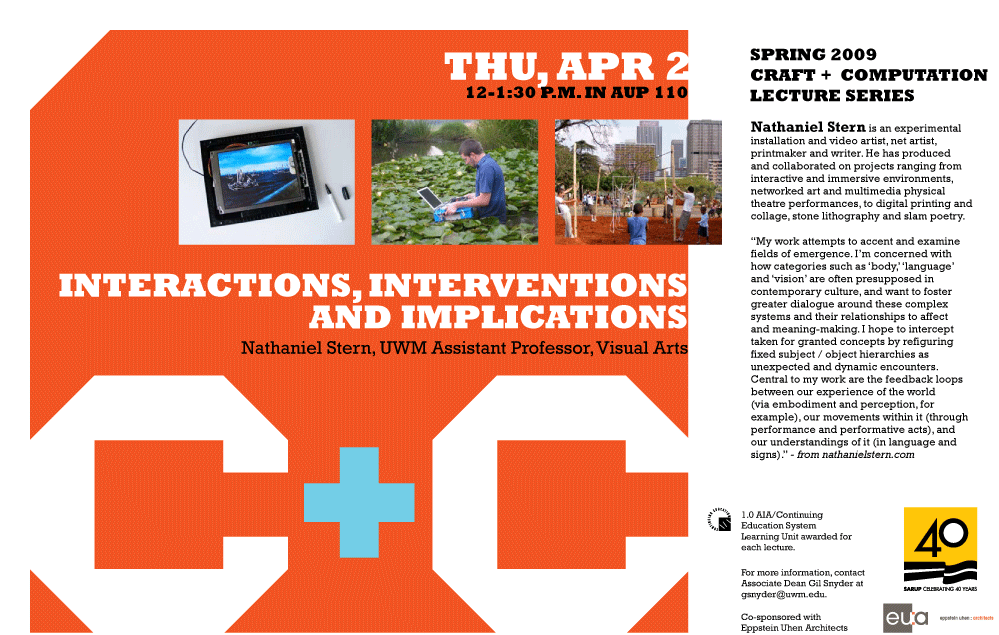
I’ll give an hour’s worth of overview of my practice, some works, and a couple of the trajectories I’m aware of in them. But if you can’t make that, don’t worry! The very next day I will be giving a very similar talk (pretty much the same one, with perhaps slightly more on the tech side, and with the general variability that comes with my “performances”) as part of the Computation and Craft lecture series in the School of Architecture & Urban Planning (SARUP) – Thursday, April 2nd at noon in AUP 110, also UWM. See the flyer below (click for larger).

interactions, interventions and implications: computation and craft lecture at UWM

interactions, interventions and implications: computation and craft lecture at UWM

Finally, I’ll kind of be all over the Johannesburg Art Fair, in South Africa – well, my art will. I personally can’t attend, but I am: (twice) in the Internet Art in the Global South net.art exhibition, curated by Tegan Bristow; on Bad Form, an interesting show over at Blank Projects, curated by Christian Nerf and Kathryn Smith; featured in a talk by Wilhelm van Rensburg on contemporary printmaking (Gallery AOP); and will mostly likely also feature at the David Krut table. Should be an awesome fair – sad to miss it.

Hope to see some of you around these great events!

Posted in art, art and tech, Compressionism, creative commons, kaganof, me, milwaukee art, research, south african art, stimulus, technology, theory ·

Archives

11 March 2009 by nathaniel

UW-Milwaukee Grad Student feature: Mairin Hartt

This is the second in a series of MFA student features from the graduate program I work in at Peck School of the Arts,  the University of Wisconsin – Milwaukee. These will be cross-posted on the MyArtSpace.com blog.

Creative Commons License
UW-Milwaukee Grad Student features are licensed under a
Creative Commons Attribution 3.0 Unported License

After graduating with a BFA 2006, Mairin worked as an Arts Educator at various institutions, including the Evanston Art Center, the Chicago Children’s Museum, and the Marwen Foundation. Her work explores the existence of emergence, entropy, and connection in organic forms and processes. Mairin has studied at Beloit College, the School of the Art Institute of Chicago, and at the Burren College of Art in Ireland. Mairin is currently working toward a Masters of Fine Arts in Visual Art at the University of Wisconsin in Milwaukee. To view images of Mairin’s work or information about upcoming exhibitions and events, please visit her blog, http://www.mairinhartt.blogspot.com, or her website, http://www.mairinhartt.com.

Talk about your current practice. What do you make and why is that important to you?

I combine various media on paper, using mostly automatic drawing methods. In 101 Cellplates, for example, I layered small sheets of rice paper on top one another, working on the utmost layer. Marks from the previous sheets – graphite pencil and ink – would seep through, creating impressions upon the sheets underneath. I interacted with the marks of each layer, simulating sedimentation and other processes of accumulation. I find it interesting how one layer builds upon and affects another, creating a dialogue, and becoming a document of time. You become a witness to that process.


#41, #55,
and #61 of 101 Cellplates, Sumi Ink, India Ink, and Graphite on Rice Paper, each 3″ x 5″, 2008

Drawing, to me, is the most elemental, the most direct act in visual art. It allows for different media to interact and co-exist. When I draw, the exposed paper often reminds me of exposed bone; the textures, raw and fragile, like skin. The residual spaces reveal the process of creation, of the piece itself. There is something about the tactile quality of paper and drawing that is extremely fulfilling. I feel more connected with each piece. I believe that establishing a connection with the image is important to create honest work. Art that is honest – both emotionally and intellectually – affects me the most.

What got you to this point? What were you doing or making before, and how did that lead you to this kind of production?

As a child my two favorite subjects were art and science. Both subjects were about curiosity and discovery, about observing the world around us. I studied natural forms a great deal. I would peel open seedpods in my backyard, sometimes creating drawings of dissected trees and plants. I once made a flipbook of a single flower growing from a seed, blooming, wilting, and then returning to the soil. I considered being a biologist, but I felt art allowed for a deeper exploration and study of all aspects of science as well as other subjects.

Up until college, I painted realistic portraits and landscapes. For me, realism represented a sign of discipline and the technical ability of a professional artist. In 2002 I finished a portrait that was the most successfully realistic painting I had made up to that point. I remember looking at it and feeling, surprisingly, dissatisfied. Realism could only scratch the surface of what I wanted to convey. It was strange. None of my favorite artists were Realists. They were Impressionists and Expressionists, and I asked myself, “Why am I painting this way?”

Afterwards, I began exploring other methods and techniques, moving toward abstraction, eventually utilizing intuitive and automatic drawing exercises akin to the Surrealists and Expressionists to explore the textural and emotional affects of numerous combinations of various mediums. I still use these methods today. I believe that everything is connected in this world. As such, I feel abstraction allows multiple contradictions to co-exist and connect.

Who inspires you that you know personally, as well as historically or in contemporary practice?

As I said previously, my initial inspirations were Impressionists, Post-Impressionists, and Expressionists: Claude Monet, Vincent Van Gogh, et cetera. I first saw their work in the flesh at age nine, and was in awe. Monet’s analytical approach, and Van Gogh’s emotional approach, to color revealed to me the emotional effect of color upon the viewer. As I got older I also became interested in the Romantics’ use of rich, saturated colors to convey the Sublime.

Contemporary artists I admire would include Vija Celmins. She creates intensely detailed graphite drawings of vast, natural spaces. I appreciate her treatment of the small and the grand on an equal terrain. Her work revealed the potential of gray to me. Ocean Surface Wood Engraving 2000 is a large, gray, woodblock print of the ocean that appears to recede into infinity.

I am also interested in work by Paul Nudd, specifically his drawings and collages. I saw some of his mixed media collages at the Evanston Art Center in 2007. They looked to consist of mucus, pubic hair, and other possible repulsive items on canvas. The materials were not listed, which left you wondering if the materials were actually what you feared. Yet, I could not help but stare. They were oddly alluring.

Tell us about your favorite and least favorite works of art from your entire repertoire – why they deserve those titles and what you learned from them.

My least favorite works would be those lacking imagination or discipline. It is a precarious balance. Part of what I enjoy about reactionary processes is the unexpected, the ‘mistakes,’ which provide potential for exploration and imagination. What I have discovered is my imagination is more vivid than I could have fathomed. However, work without any structure or focus also loses my interest.
My favorite pieces are ones that are unpredictable, where the image develops and progresses on its own. This is how I became interested in ideas of emergence – specifically how order can come from disorder, and how the universe is in constant flux.


Images from Cellular Repetition/Outdoor Installation, Chalk, 2008
In Cellular Repetition/Outdoor Installation, I wanted to engage with the urban environment directly and, symbolically, re-connect areas within that space to each other. I envisioned these circular marks representing microscopic cells, replicating, spreading, and connecting everything around us. It began as an exercise to continue freeing up my drawing practice, but it grew into a much larger project when I began drawing on my own skin to connect myself with the space.

Image from Cellular Repetition/Body
, Ink on Skin, 2008

What are you working on right now, and where do you see your work headed next?

I see my work continuing in this vein – combining various media on paper, creating abstract images. I enjoy the vagueness or unidentifiable aspect of my work. Despite the vagueness, the images often remind me of odd organic creatures and structures. The ambiguity allows the viewer to make their own connection with the work.


untitled 1, Sumi Ink, Watercolor, and Graphite on Paper, 8″ X 15″, 2008-2009


untitled 2, Sumi Ink, Watercolor, and Graphite on Paper, 8″ X 15″, 2009


untitled 3, Sumi Ink, Watercolor, and Graphite on Paper, 8″ X 15″, 2009

C

urrently I am exploring notions of emergence and connection through microscopic forms and cellular processes, highlighting the connection of the macro and the micro. I am fascinated with the theories of entropy and emergence. Specifically, to the idea that patterns and structures develop and organize from apparent disorder. According to the theory of entropy, organized systems should not exist. It would be more efficient for all of our atoms to float around the universe detached, instead of cooperating as complicated entities. It requires energy to become a planet, star, or living organism. Living is tension, a balance between existence and non-existence. I hope to remind people of how inter-related everything is and to gift a sense of some of the sublimity of existence.

Posted in art, art and tech, creative commons, milwaukee art, reviews, stimulus, theory ·

Archives

06 March 2009 by nathaniel

MA/MFA Thesis Exhibition

Some of my fantastic grad students have a show opening this afternoon / evening – and it’s going to be awesome. The show includes performance, installation, video, painting, sculpture, and more, across a broad range of political, social, theoretical and material concepts. If in the Milwaukee area, please come!

Maria Bolivar, InterMedia
Kristin Haas, Painting and Drawing
Richard Mutz, InterMedia
Leah Schreiber, Painting and Drawing

MA/MFA Thesis Exhibition I
Opening Reception: Friday, March 6, 5-7pm

Gallery Talk: Tuesday, March 10, 4pm
Inova/ Arts Center Gallery

MFA UWM

MFA UWM

Posted in art, art and tech, inbox, me, milwaukee art, stimulus, theory ·

Archives

19 February 2009 by nathaniel

Dennis Balk: Early work 1890-2090

Denis Balk

February 6-March 13, 2009
Inova/Kenilworth (Milwaukee)
2155 North Prospect Avenue
Artist reception: February 6, 6-9 pm

Really fascinating show – his first retrospective – at the INOVA gallery in Milwaukee. Very theatrical, lovely installations, precursors to relational art, some funny prints and drawings and time lines and maps. Definitely worth a visit. From the INOVA site:

“This exhibition surveys Balk’s work from the 1990s ‘napkin’ drawings project (historical timelines drawn in marker on cloth dining napkins) to his current “Planck State” particle interaction images and beyond. Through a complex, winding style of narrative exposition, built with photographs of Middle Eastern street life, fanciful subatomic depictions, and scraps of text, Balk investigates the constituent material of reality as it shapes and forms cultures that reshape and reform the world.”

Posted in art, milwaukee art, re-blog tidbits, theory ·

Archives

18 February 2009 by nathaniel

What is important

Although I’ve been keeping a low profile in the public debates about Wikipedia Art, I have had a few ongoing and private discussions with its critics and supporters. With his OK, the below is an excerpt from an email I wrote to Tom Moody yesterday.

—–

The main issue for me is not whether I (or others) like or dislike … the Wiki [(I actually think it an extremely valuable resource)], to game or not game the systems that contribute to it, and certainly not to canonize myself – you’ll note that other than our own page and my own blog, I have not at all participated in any of the discussions about the project (not on wikipedia, not on rhizome [another rhizome thread here], not on Paddy’s blog, etc). I care not about the rejection of the page, really; or even if you call it “art,” as Paddy suggests. I think the debates still have contextual value, even outside of the art space. People care about this: about art, about Wikipedia, about the blogosphere, about the conceptual frames and important people (whether of self-import or otherwise) that “control” these spaces through their online voices or backend deletions. The idea that this page got any less or more fairness or discussion than any other Wiki page is not my own – I’ve seen many debates just like this one spearheaded by just as many folks at the Wiki  – I feel lucky that [Wikipedia Art] got this much attention; a real failure would have been a speedy delete, and then nothing, which we always knew was a possible outcome. The point is, most people don’t see how arbitrarily many of these decisions are made, or where biases lie, despite the fact that, as you say, in the “post Gallery [post academy?] world Wikipedia is the new Academy, because it has the ability to control the discourse of who is an important artist (or art blogger)” [and more!]. A bunch of volunteers, of their own free will, cared enough to do all this, a bunch of artists and theorists care enough to carry on the debate. Paddy is right, perhaps “the discussion is my art” means I always “win” – but this project, art or not, is not about winning for me. And nor is Wikipedia, and nor is the art blogosphere.

I’m glad the [debate] carries on, because even if Wikipedia Art is not at all important, it has provoked a discussion around what is.

Posted in art, art and tech, creative commons, Links, me, milwaukee art, pop culture, re-blog tidbits, reviews, stimulus, technology, theory, uncategorical ·
← Older posts
Newer posts →

Categories

Tags

aesthetics alice wilds art artist feature avant-garde books briefiew coding comics concern culture digital studio drawing ecology engineering fantasy fiction goods for me google ilona andrews jon horvath kate daniels milwaukee mo gawdat nathaniel stern paduak philosophy public property reading review sean slemon self-enjoyment Steve Martin syllabus sharing teaching technology TED TEDx trees urban fantasy web-comics webcomics whitehead world after us writing

nathaniel’s books

Interactive Art and Embodiment book cover
Interactive Art and Embodiment: the implicit body as performance

from Amazon.com

Buy Interactive Art for $30 directly from the publisher

Ecological Aesthetics book cover
Ecological Aesthetics: artful tactics for humans, nature, and politics

from Amazon.com

All content © 2026 by implicit art. Base WordPress Theme by Graph Paper Press