implicit art

art and ecology, fiction and geek stuff, culture and philosophy, parenting and life, etc

implicit art

pop culture

Archives

18 May 2008 by nathaniel

ONE MORE DAY TO REGRET – a project by Douglas Gimberg & Christian Nerf

one more day to regret, a project by Douglas Gimberg & Christian Nerf

ESCAPE TO ROBBEN ISLAND (2008)

On the 21st of March in 2007 Douglas Gimberg and Christian Nerf began their collaborative project with the somewhat austere brief ‘Build a boat, grow a beard’. Various exhibitions, events, interventions and intercessions, such as planting an apple tree in Paradise, translating Anton Szandor La Vey’s Satanic Bible into Afrikaans and inviting viewers to engage in seemingly light hearted acts of desecration at their 2007 exhibition Carpentry 101 have formed part of their year-long collaboration, the climax of which is the enaction of their latest work, Escape to Robben Island (2008). On an undisclosed date the pair allegedly launched off the shores of mainland Cape Town in their recently completed, small, wooden boat, the angasi nkosi angasi nkosi and rowed their way to the former prison, insane asylum and leper colony.

Planned from the outset of the project, the annihilation of the angasi nkosi, angasi nkosi will re-enact the damage that over fifty previous viewers inflicted on the boat’s maquette one month earlier at Fuckup in Gugulethu.

Significantly, the exhibition at the AVA does not display any concrete evidence of the actual journey to Robben Island. One of the easier interpretive alternatives would be to simply deny a rationale altogether and frame Gimberg and Nerf’s undertakings as indulgent adventures, Scooby Doo type mysteries that dabble with the dark arts and the deep seas; playful pursuits that amicably expose the futility of art to those who take it all too seriously. Fortunately or unfortunately, depending on your personal predilection, this projective vision of two men showing off the evidence of their various maritime, horticultural, destructive and escapist fantasies for their viewers to actively enjoy is disrupted by the very obstruction that prompted its application in the first place. Gimberg and Nerf’s employment of a deliberate and strategic exchange that provides one piece of information while enshrouding another suggests that the lack of information, of reasoning and explanation is not the reactive product of a hostility towards explanation (or even over-explanation) but rather of an appreciation of obscurity that is allowed to remain obscured rather than be substituted by silliness. The indications of an approach that is sympathetic to futility within Gimberg and Nerf’s various projects are also, therefore, indicative of an ability to understand the importance of attempting to express the meaninglessness of meaning without feeling the need to giggle about it (whether nervously, sarcastically or in earnest). This is not to say that the work is without humour, the absurdity of the project, so enhanced by the insecure paranoia and obsession that its obscurity often provokes in the viewer, ensures that the benefits of self-irony are not lost with the rejection of frivolity.

The artists themselves do not motion to put the socially conscious viewer at ease, and it is perhaps the task of this projected viewer to grapple with their own questions of meaning, to interrogate the idea of the hierarchy between the blatantly meaningful (the things we are taught to care about) and the meaningless (the work of the devil).

Through their consistent refusal to spell out any sort of reasonable rationale for the project, leaving many things unsaid and others to chance Gimberg and Nerf have essentially created a construct that simultaneously proves and disputes itself through direct and indirect self-reference; a puzzling mystery, a complicated scheme, something completely pointless that one can spend hours thinking about. It allows meaning to be made from something that is completely meaningless in any reputably profound sense, provoking ridiculous discussions, agonizingly futile attempts to prove or disprove, idle banter and feeble debates; providing us, therefore, with indubitable proof of our simple minds.

The value and charm of the obscure is that it refuses to be resolved, the truthful answer, its true meaning, simply doesn’t exist. This does not mean however that it is meaningless; pointless and futile maybe, but not meaningless – when pointlessness is left bare it translates, through interpretation, into obscurity, prompting a radical void of uncertainty that forces further questioning. The obscure is not inaccessible, it is not afraid of or hostile towards understanding and meaning, pointlessness is not a full stop.

Excerpt from text by Ryan van Huyssteen and Francis Burger

@ AVA, 35 Church Street, Cape Town, South Africa til May 30
Hours: Mon – Fri 10am – 5pm, Sat 10am – 1pm
Event: (Buyer and Seller of Souls) May 20

More: onemoredaytoregret.blogspot.com

Posted in art, inbox, Links, pop culture, re-blog tidbits, south african art, stimulus, uncategorical ·

Archives

14 May 2008 by BradyDale

Interview: David Strattan White on SIMULATIONS

A few weeks ago, I watched a staged reading of David Strattan White’s play Simulations, at The Walking Fish Theater in Philadelphia. Simulations is a play inspired by the world of the computer game, The Sims. It imagines two people in the real world, two people in The Sims world and one person who might come from either.

David recently left Philadelphia for a teaching job in Indiana, but after we talked for a little bit after the reading we had a more thorough discussion about his work on-line.

Like the previous interview with David Kessler, this interview has a companion exterview (a talk about everything else) over at This Too Will Pass.
————————

BradyDale: From where I sit, we are only starting to see literature that deals with the new technology that surrounds us. Do you agree? Jonathan Lethem came to Philadelphia’s Free Library a little while back to talk about his latest book. I remember two things about that visit: first, that I didn’t think he’d be that boring and, second, that he said he just adamantly did not write about email or cell phones or the web in his books. It just didn’t feel right for him, and I empathize. Your play, Simulations, is all about a video game, though. Was that something you had to overcome or is it weird that I’d even bring it up as an issue?

DSW: I think that we are only starting to discover our technology – period. I remember eight years ago when I was moving to Philadelphia, my mom insisted that I get my first cell phone. That was eight years ago. Plays take a while to create. They are written, then they’re workshopped, then they’re marketed, then if, they’re chosen for production, there’s often eight to eighteen months between selection and production. I think the current technological lag is partly due to the fact that technology is moving so fast right now. It’s hard for artists to keep up. The difficult thing about writing for the current moment is that the current moment is often gone before you finish your first draft. I think that’s why a lot of writers avoid it. Because it’s hard to judge what will be an enduring sort of thing and what will become silly.

In Simulations I think I was just so fascinated by the idea of Betty creating her own fantasy happiness. And how easy it is for us to sort of surround ourselves in our own fictions. The most daunting task in tackling a video-game play (if that is a thing) was the question, ‘how do I portray a bridge between real world and Sim world.’ But that was never the point, so I just sort of decided that she’d just wish upon a star and be done with it. The video game just comes to life and the audience will deal with it.

I think that the Sims is as much a cultural phenomenon as it is a technological one. Our age is somehow both voyeuristic and escapist. We as a people seem to want technology to transport us away from our problems and on to identical problems. Somehow we relax from our mundane existence by creating an alternate mundane existence. And somehow we find love in our fantasy world, but we hide away from the exact same things we create. It’s a rabbit hole in an Escher painting.

I have read, seen and acted in other plays that deal with the moment in technology. Y2K by Arthur Kopit comes to mind. I participated in a developmental workshop at the Wilma for a play called Agency* by Ken Linn. which was about a pedophile Catholic priest who volunteered to be made into a cyborg assassin for the government in return for curing him of his urges. It was fantastic.

I think technology is something that always will color the landscape of art and literature. Shakespeare wrote about sea travel, Dickens wrote about the Industrial Revolution, Death of the Salesman is greatly influenced by automobiles and telephones, The Fountainhead is an epic story about progress in architecture and journalism. Changes in the world are the most fascinating subjects, and technology is a big fat harbinger of change.

BradyDale: I really liked your response about the bridge between the real world and the world of “The Sims.” Not going into it was a really good choice, though as an audience member I did think about it.

From what you said during the feedback session the other night, it sounds like you plan to revisit the script pretty seriously. How hardcore do you get about rewrites? I saw Chuck Palahniuk speak once and he said that he writes a complete new ending every time he revises a book. Just for fun. It sounded miserable to me because the end of the book is the most stressful part to write. All the stakes are on the end.

Where does the current version fit in your revision process and how much do things change over time with you? Will you put in whole new elements? Do you get re-inspired? Where do the biggest changes happen in the course of writing one of your scripts?

DSW: Personally, at this point in my life, I don’t have a set method. I sort of let the story dictate the process. Maybe I could write more if I did have a set process, but I feel like fitting the process to the story allows each story it’s own kind of form. So I’m always a little off-balance as far as what happens next. I can tell you for Simulations that I’m definitely not happy with the ending yet and that I think the play needs another layer – whatever that means. I’ve been trying to think about what that is, and experimented with some ideas that I’ve more or less thrown out. I think, except for the end, that every scene that is there will be there. And much of the end might be there. So in this circumstance it’s about writing more and finding a way to re-situate the new stuff so that the structure is still harmonious.

BradyDale:
You had one scene in particular where you said in your stage directions that maybe the walls would change color for a moment. We were all watching a staged reading, so that didn’t happen. There is also the issue of the hearts floating over the two characters heads when they fall for each other. Do you hope to incorporate new technology on stage? Would you, ideally, like to be a part of the first staging of “Simulations?” If so, what would be your top priority to see happen in a full staging of the play (at least as it’s written now)?

DSW: I think that directors like to find solutions. I know I do when I direct. I think that’s one of the fun things about creating theatre. A lot of times when I write, I’ll come up with an idea and then something in my brain will say, “Yeah. But how are you going to do it on stage?” Then a different voice says, “That would be really fun to figure out.” I really pride myself in not backing down from impossible things. I think that’s one thing that most really great theatre artists have in common.

That being said, I’ve seen lights really change the color of a room in an amazing way. And there could be new technology or really old technology. I see no reason hearts couldn’t simply be suspended from the ceiling. Ultimately, we don’t even have to see the hearts. But I do think it would be cool if we did. Also, why stop with hearts? there could be plusses, minusses, all other things that hover above Sims’ heads.

I will undoubtebly be a part of a staging. I won’t be the director. I like seeing what others bring to my writing way too much to do that. I’ll be the writer. I may be in rehearsals some or not at all. It depends.

As for the top priority, I’m really not sure. That depends on what the actors bring to it. This particular play, for all the talk I’m finding that it inspires, is really mostly a good time. I don’t think it’s ideas will change our lives, although it’s not without thought. I think for this one, success depends on how much fun it is. That simple. Get it? SIM – ple? Okay. That’s bad.

BradyDale: No, no! Don’t regret a pun! I’m tempted to request a pun in every answer! Your answer is just the opposite to one I once heard Kevin Smith give about his movies. He said he knew he was a bad director but just didn’t trust anyone else with his scripts. I thought, “But if you know you’re a bad director…” Some people have strange logic…

When I saw the staged reading of Simulations, there was a sort of talk-back at the end of the session. It seemed like most of the people in the room were involved in theater to some degree. I’m not, but I am a wannabe writer. As I remember, there was a lot of talk about the characterization of the Sims. Moments that confused people a little. The issue of the gobbledygook language the Sims spoke and how much the audience needed to be educated about The Sims in order to “get” your play. Overall, people were really positive and supportive of the play. I mention all this just to provide some context for folks who weren’t there.

What did you take away from the feedback you got? I could see everything people said churning hard through your head. You didn’t write much down but that seemed to be more because you were processing everything so intensely. What did you take away from that feedback? Did the things people said help or did the whole process help you to reveal even bigger questions about the script? I guess the real point of this question is to try and find out what was going on in your head during that discussion.

DSW: I got a lot from the discussion. Most importantly, that people followed it, even though they weren’t educated about The Sims(TM). That was good news. After that, I was kind of seeing the play fall together in a new way, and all of the specifics just sort of swirl into a new image of the play that was happening. When I wrote it, I’d just discovered Sara Ruhl’s plays. I love her simple, magical humor. I think that sort of aesthetic found its way into what ultimately became a farce in my play. I heard Tom Stoppard say that he doesn’t try to write a play until he has two or three ideas for a play, then he writes them all together. So I was thinking about the play being less direct. I almost think it’s too clear what it’s about. The talkback was great. And the reading was very informative. I don’t think I’m a comedic writer, so it was a little scarey wondering if people would be excited about this one. So it was cool to see the actors so attracted to the story.
__________________________
Now read the exterview with David.

Posted in art, art and tech, brady dale, pop culture ·

Archives

14 May 2008 by nathaniel

friend of the summit

For those of you who don’t know, I’m a huge supporter of Creative Commons (CC), and more specifically iCommons. The former is an organization dedicated to open source coding and content for creative technologists, designers, artists, musicians, scientists (and more!), and promotes access and re-mixing through distribution licenses that are alternatives to copyright worldwide. The latter (iCommons) is an international community of the same types, all of whom may use or promote CC, copyfight, pirated content/material for activism and/or art, remixing and reusing legally and illegally, or anything around “the commons” of content and community; this is mostly manifested as a yearly summit of amazing individuals talking about and furthering the state of the (communal) arts (and the community itself).

In 2006 and 2007, I participated as an artist in resident (AIR) for iCommons (in Brazil and Croatia, respectively), and in the latter year I ran a larger AIR programme, where there were 6 interdisciplinary artists (and one arts critic!) from 4 continents. Although I’m sitting out this year (Sapporo!), I’m still a friend, as evidenced by the logo/link below and in my sidebar.

I highly recommend checking it out and getting involved – my life, art, networks and activist tendencies are better having been involved, and I’m sure to be participating again in the future.

Posted in art, art and tech, Compressionism, creative commons, iSummit07, me, news and politics, pop culture, re-blog tidbits, south african art, stimulus, uncategorical ·

Archives

12 May 2008 by nathaniel

getaway experiment @ artthrob

Marcus Neustetter and my net.art project / turbulence commission circa 2005, getawayexperiment.net, has been written up on the project page for artthrob this month, by their newly appointed new media editor, Chad Rossouw. Link.

First, a congratulations to Chad on his new position – I’ve read some of his writings and know he can be very thoughtful and interesting, and I’m glad to have his expertise covering and furthering new media art in South Africa.

I was admittedly surprised to see getawayexperiment.net reviewed by artthrob (again). Not only is it a relatively older work – by net.art standards, anyhow… although, in fairness, it is currently on web exhibition at Greylock Arts in the states, so I can see why Chad came across it and may have wanted to give it some attention now – but it was also already written about, more extensively, on Artthrob’s project page in Feb 2005, by Carine Zaayman. I know Ed Young may have started this trend when he decided he needed to let SAartsEmerging know how much they now suck after a good first year (Ed maintains this original goodness before the suckiness, and this site was also first more positively covered by Zaayman on the same page as Ed’s review – and also a site I used to be involved with; Linda Stupart’s adjoining bloggy piece, around Art Heat’s conception time, is worth mentioning here, too…), but if it’s not a new work you want to write about – and especially because the work has not changed, as opposed to in Ed’s case – then at least a little nod and link to Carine’s original (and much longer and more positive) review by Chad could have been included (Ed fails here, too; and is less generous than either Chad or Carine; and also oddly claims the site is easy to ignore while simultaneously writing the third artthrob piece about it). They are all in the same publication after all, so an ongoing discussion would be appropriate. (Those are some long sentences there, with lots of parenthetical thoughts in both brackets and dashes. Sorry, that’s just how it goes some times….)

All that being said, I can’t deny that Chad’s criticism has merit. While I stand by the strength of both the concept and its resulting pages for getawayexperiment.net (and Chad seems to like this, too), I think that the lack of a large number of participating artists uploading their own images once the work was launched comes precisely from the fact that the world the piece creates is extremely idiosyncratic – his point. While I don’t generally think this necessarily a bad thing in the art world, this particular piece is meant to be both about participation and empowerment, and so while it represents those concepts well, as an interactive work, it does not initiate them, in the literal sense, as much as it could.

I think the piece, overall, is successful in creating various dialogues around these issues, as is evidenced by these two texts, and another by Eduardo Navas. But I appreciate Chad’s fair review and feedback when it comes to getawayexperiment.net‘s shortcomings, and am looking forward to more of the same from him – whether about my own work, or those of other South African artists.

Posted in art, art and tech, carine zaayman, creative commons, me, pop culture, re-blog tidbits, reviews, south african art, stimulus, technology, theory ·

Archives

01 May 2008 by nathaniel

DATA 30

Fantastic DATA on Tuesday with Alessandro Ludovico (Italy), Jaime Villarreal (Mexico), Ivan Twohig (Ireland).

Ivan showed several projects including his Falling Man, which turned free 3D graphics of a falling man into life-size paper sculptures throughout a gallery. Alessandro showed his Google Will Eat Itself and Amazon Noir, and Jaime did a live networked performance with junk and micro-controllers, making music in real-time with his friends in Mexico while here in Dublin.

Heaps of photos here. A few samples:

See more photos.

Posted in art, art and tech, flickr, Ireland Art, pop culture, stimulus, technology, theory ·

Archives

22 April 2008 by nathaniel

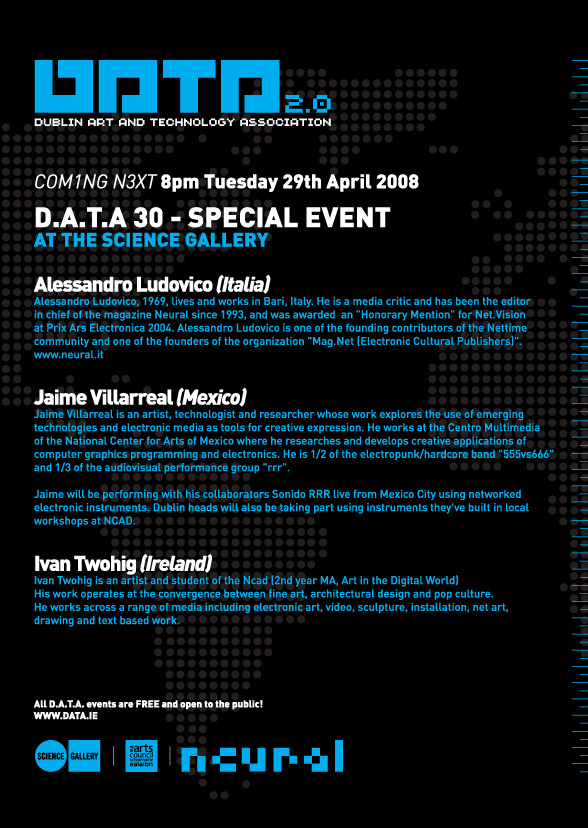
DATA 30: Alessandro Ludovico, Jaime Villarreal, Ivan Twohig

The Dublin Art and Technology Association is having a hot month!

8pm Tuesday 29 April
Science Gallery, Trinity College, Dublin
Guests: Alessandro Ludovico (Italia), Jaime Villarreal (Mexico), Ivan Twohig (Ireland)

See the flyer at full size.

DATA 30

DATA:EVENT:30 – * Special 30th Event Anniversary*

Alessandro Ludovico (Italia):
Alessandro Ludovico, 1969, lives and works in Bari, Italy. He is a media critic and the editor in chief of the magazine Neural from 1993 and was awarded with a “Honorary Mention” for Net.Vision at Prix Ars Electronica 2004. Alessandro Ludovico is one of the founding contributors of the Nettime community and one of the founders of the organization “Mag.Net (Electronic Cultural Publishers)”. www.neural.it

Jaime Villarreal (Mexico):
Jaime Villarreal is an artist, technologist and researcher whose work explores the use of emerging technologies and electronic media as tools for creative expression. He works at the Centro Multimedia of the National Center for Arts of Mexico where he researches and develops creative applications of computer graphics programming and electronics. He is 1/2 of the electropunk/hardcore band “555vs666” and 1/3 of the audiovisual performance group “rrr”. Jaime will be performing with his collaborators Sonida RRR live from Mexico City using networked electronic instruments. Dublin heads will also be taking part using instruments they’ve built in local workshops at NCAD and the Science Gallery.

Ivan Twohig (Ireland):
Ivan Twohig is an artist and student of the Ncad (2nd year MA, Art in the Digital World) His work operates at the convergence between fine art, architectural design and pop culture.� He works across a range of media including electronic art, video, sculpture, installation, net art, drawing and text based work.

All D.A.T.A. events are FREE and open to the public!

Posted in art, art and tech, Ireland Art, Links, pop culture, re-blog tidbits, stimulus, technology ·
← Older posts
Newer posts →

Categories

Tags

aesthetics alice wilds art artist feature avant-garde books briefiew coding comics concern culture digital studio drawing ecology engineering fantasy fiction goods for me google ilona andrews jon horvath kate daniels milwaukee mo gawdat nathaniel stern paduak philosophy public property reading review sean slemon self-enjoyment Steve Martin syllabus sharing teaching technology TED TEDx trees urban fantasy web-comics webcomics whitehead world after us writing

nathaniel’s books

Interactive Art and Embodiment book cover
Interactive Art and Embodiment: the implicit body as performance

from Amazon.com

Buy Interactive Art for $30 directly from the publisher

Ecological Aesthetics book cover
Ecological Aesthetics: artful tactics for humans, nature, and politics

from Amazon.com

All content © 2026 by implicit art. Base WordPress Theme by Graph Paper Press