implicit art

art and ecology, fiction and geek stuff, culture and philosophy, parenting and life, etc

implicit art

Links

Archives

18 May 2008 by nathaniel

ONE MORE DAY TO REGRET – a project by Douglas Gimberg & Christian Nerf

one more day to regret, a project by Douglas Gimberg & Christian Nerf

ESCAPE TO ROBBEN ISLAND (2008)

On the 21st of March in 2007 Douglas Gimberg and Christian Nerf began their collaborative project with the somewhat austere brief ‘Build a boat, grow a beard’. Various exhibitions, events, interventions and intercessions, such as planting an apple tree in Paradise, translating Anton Szandor La Vey’s Satanic Bible into Afrikaans and inviting viewers to engage in seemingly light hearted acts of desecration at their 2007 exhibition Carpentry 101 have formed part of their year-long collaboration, the climax of which is the enaction of their latest work, Escape to Robben Island (2008). On an undisclosed date the pair allegedly launched off the shores of mainland Cape Town in their recently completed, small, wooden boat, the angasi nkosi angasi nkosi and rowed their way to the former prison, insane asylum and leper colony.

Planned from the outset of the project, the annihilation of the angasi nkosi, angasi nkosi will re-enact the damage that over fifty previous viewers inflicted on the boat’s maquette one month earlier at Fuckup in Gugulethu.

Significantly, the exhibition at the AVA does not display any concrete evidence of the actual journey to Robben Island. One of the easier interpretive alternatives would be to simply deny a rationale altogether and frame Gimberg and Nerf’s undertakings as indulgent adventures, Scooby Doo type mysteries that dabble with the dark arts and the deep seas; playful pursuits that amicably expose the futility of art to those who take it all too seriously. Fortunately or unfortunately, depending on your personal predilection, this projective vision of two men showing off the evidence of their various maritime, horticultural, destructive and escapist fantasies for their viewers to actively enjoy is disrupted by the very obstruction that prompted its application in the first place. Gimberg and Nerf’s employment of a deliberate and strategic exchange that provides one piece of information while enshrouding another suggests that the lack of information, of reasoning and explanation is not the reactive product of a hostility towards explanation (or even over-explanation) but rather of an appreciation of obscurity that is allowed to remain obscured rather than be substituted by silliness. The indications of an approach that is sympathetic to futility within Gimberg and Nerf’s various projects are also, therefore, indicative of an ability to understand the importance of attempting to express the meaninglessness of meaning without feeling the need to giggle about it (whether nervously, sarcastically or in earnest). This is not to say that the work is without humour, the absurdity of the project, so enhanced by the insecure paranoia and obsession that its obscurity often provokes in the viewer, ensures that the benefits of self-irony are not lost with the rejection of frivolity.

The artists themselves do not motion to put the socially conscious viewer at ease, and it is perhaps the task of this projected viewer to grapple with their own questions of meaning, to interrogate the idea of the hierarchy between the blatantly meaningful (the things we are taught to care about) and the meaningless (the work of the devil).

Through their consistent refusal to spell out any sort of reasonable rationale for the project, leaving many things unsaid and others to chance Gimberg and Nerf have essentially created a construct that simultaneously proves and disputes itself through direct and indirect self-reference; a puzzling mystery, a complicated scheme, something completely pointless that one can spend hours thinking about. It allows meaning to be made from something that is completely meaningless in any reputably profound sense, provoking ridiculous discussions, agonizingly futile attempts to prove or disprove, idle banter and feeble debates; providing us, therefore, with indubitable proof of our simple minds.

The value and charm of the obscure is that it refuses to be resolved, the truthful answer, its true meaning, simply doesn’t exist. This does not mean however that it is meaningless; pointless and futile maybe, but not meaningless – when pointlessness is left bare it translates, through interpretation, into obscurity, prompting a radical void of uncertainty that forces further questioning. The obscure is not inaccessible, it is not afraid of or hostile towards understanding and meaning, pointlessness is not a full stop.

Excerpt from text by Ryan van Huyssteen and Francis Burger

@ AVA, 35 Church Street, Cape Town, South Africa til May 30
Hours: Mon – Fri 10am – 5pm, Sat 10am – 1pm
Event: (Buyer and Seller of Souls) May 20

More: onemoredaytoregret.blogspot.com

Posted in art, inbox, Links, pop culture, re-blog tidbits, south african art, stimulus, uncategorical ·

Archives

22 April 2008 by nathaniel

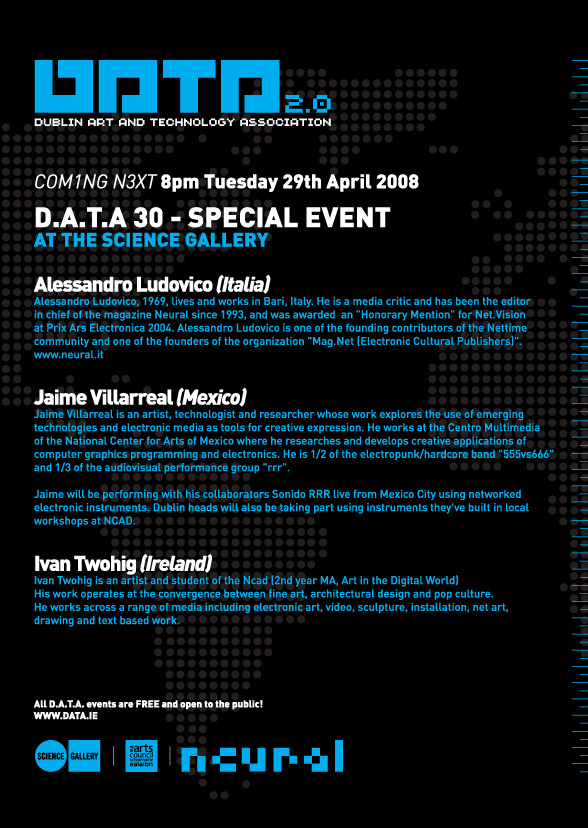
DATA 30: Alessandro Ludovico, Jaime Villarreal, Ivan Twohig

The Dublin Art and Technology Association is having a hot month!

8pm Tuesday 29 April
Science Gallery, Trinity College, Dublin
Guests: Alessandro Ludovico (Italia), Jaime Villarreal (Mexico), Ivan Twohig (Ireland)

See the flyer at full size.

DATA 30

DATA:EVENT:30 – * Special 30th Event Anniversary*

Alessandro Ludovico (Italia):
Alessandro Ludovico, 1969, lives and works in Bari, Italy. He is a media critic and the editor in chief of the magazine Neural from 1993 and was awarded with a “Honorary Mention” for Net.Vision at Prix Ars Electronica 2004. Alessandro Ludovico is one of the founding contributors of the Nettime community and one of the founders of the organization “Mag.Net (Electronic Cultural Publishers)”. www.neural.it

Jaime Villarreal (Mexico):
Jaime Villarreal is an artist, technologist and researcher whose work explores the use of emerging technologies and electronic media as tools for creative expression. He works at the Centro Multimedia of the National Center for Arts of Mexico where he researches and develops creative applications of computer graphics programming and electronics. He is 1/2 of the electropunk/hardcore band “555vs666” and 1/3 of the audiovisual performance group “rrr”. Jaime will be performing with his collaborators Sonida RRR live from Mexico City using networked electronic instruments. Dublin heads will also be taking part using instruments they’ve built in local workshops at NCAD and the Science Gallery.

Ivan Twohig (Ireland):
Ivan Twohig is an artist and student of the Ncad (2nd year MA, Art in the Digital World) His work operates at the convergence between fine art, architectural design and pop culture.� He works across a range of media including electronic art, video, sculpture, installation, net art, drawing and text based work.

All D.A.T.A. events are FREE and open to the public!

Posted in art, art and tech, Ireland Art, Links, pop culture, re-blog tidbits, stimulus, technology ·

Archives

17 April 2008 by nathaniel

Till Joseph flies to hide the biting tears, by Doron Golan

I had to post this beautifully understated new video work by Doron Golan.

joseph
Till Joseph flies to hide the biting tears (2008, 48MB, 5.20 min.)

Michael Szpakowski, also of DVblog, says (via rhizome):

…this is great & quite the strangest thing you’ve ever made. The tone is quite disturbing, made me quite nervous, but it’s also beautiful. In particular there’s one moment near to the end with lots of effects when there’s just some of the most beautiful shades of green *ever* on the screen.

Also I had an epiphany whilst watching – I realised one particular move I love in your editing ( and it lends it so much of its personal quality and power) -it’s like a sort of “half-jump-cut” – we move from one position of a person to another, sometimes with a slight zoom in or out or a slight change of angle but the continuity is both manifestly broken and somehow retained. It *is* a jump cut but in your hands it
doesn’t have the brashness that one might associate with that term. It’s amazingly potent.

Do you shoot with that sort of thing in mind, zooming in and out with a mind to removing some of the intervening footage?

I like the performance too, understated but effective…

The effects are the thing I find strangest – they are so in-your-face and contrast so markedly with that lovely B&W look you achieve. The little buzzing objects ( for want of a better description) put me in mind of the helicopter in the Tell Aviv portraits..

The symbolism (again for want of a better word) is so intensely personal, or at least hermetic that at this end of your work there’s a flavour of Blake. I couldn’t exactly logically justify that assertion but it *feels* true to me…

Posted in art, art and tech, Links, poetry, re-blog tidbits, reviews, stimulus, uncategorical ·

Archives

10 April 2008 by nathaniel

Printmaking Today (and a minor kvetch)

My hard drive died last week, which sucked. I didn’t lose anything important like art or my PhD (thank goodness), but it’s taken days just to get back to running, due to file and email jumbles on various drives, etc (still not quite there, and will have some crazy organizing to do in my spare time – files everywhere! – over the next few months…).

Anyhow, lost somewhere in the gambit was this 2-page feature on David Krut projects – featuring li’l ole me! – in Printmaking Today magazine…

Read it.

Posted in art, art and tech, inbox, Links, me, reviews, south african art, stimulus, technology, theory ·

Archives

10 April 2008 by nathaniel

Paddy Johnson interviews Aron Namenwirth of artMovingProjects

Fantastic interview here. Snippet:

Two years ago Caitlin Jones observed in NYFA Current that net artists working in multiple formats were increasingly finding venues to show. Today, the art world is still figuring out how to manage the practicalities of dealer and artist relationships. I spoke with Aron Namenwirth, of artMovingProjects, in an effort to better understand the challenges, and solutions, digital media presents to contemporary galleries with a focus on New Media. – Paddy Johnson

One topic that’s come up on Rhizome’s blog is the rematerialization of art (the idea, according to Ed Halter, “that innovations such as the flat-screen monitor, the digital print, and the editioned DVD, have helped transform immaterial forms like video and net.art into a new generation of physical, sellable objects”), so I wanted to talk to you about this a little. Is it critical to display new media art in the gallery?

I think new media art, like old media, needs a physical place for critical and social discourse. On the computer screen in the privacy of your home, you can do research, and email other professionals on the merits of a piece, but it’s not the same as looking at it in a real space, walking around it, and experiencing it. A lot of new media work requires interaction, and that interaction is mediated by the spectator and the user together.

optidisc.jpg

Tom Moody, OptiDisc, 2007 (Installation at artMovingProjects)

It seems to me that there’s a lot to be said for going into a space, and experiencing that work with someone else too. A dialog can occur, that, as you mention, is more spontaneous. Which I think can be important for new media, particularly because the bias of the medium is “cold.”

Of course, the beauty of some new media art projects is that you can view it anytime you want online.

Right, which presumably has its pluses and minuses for dealers. I know you have been working on a contract between the artist and gallery. I thought maybe we could discuss some of these details a little, because I imagine they’re really important to both artists and dealers.

Sure. The contract I’ve drawn up is an agreement between the artist and artMovingProjects. It’s binding for the life of the working relationship between artist and the gallery, and that’s actually how the document starts. The stipulation is for one piece of the artist’s oeuvre — and that’s what’s so different about it than other gallery contracts. Typically, the contract between the artist and the gallery represents all the artist’s work, and ties the artist to the gallery. In this case, the artist is free to work for many different venues simultaneously, which is a real plus.

Well, there are examples of independently working artists in traditional mediums that seem to do okay, but it is very rare.

Yes, and this is very specifically tied to the intellectual content. It stipulates that the artwork will only be sold with permission of the gallery at the agreed piece in perpetuity….With editions, and video, the dealers typically increase the price of the edition as it is sold, and I feel that that’s not such a great idea in the short term because it creates undue pressure on the collector. Also, part of the contract stipulates that any deals the artist makes outside the agreement involving others will not be supported by the gallery without authorization in writing. Further, should the artwork be sold without permission in writing this will end the relationship between the artist and the gallery.

To read the full piece click here.

Posted in art, art and tech, creative commons, Links, pop culture, re-blog tidbits, research, stimulus, technology, theory, uncategorical ·

Archives

04 March 2008 by nathaniel

openframeworks: i am adopted

joel and dave playing with openframeworks and arduino

Joel and Dave playing with openframeworks and arduino

This weekend I went and took a 2-day workshop on openframeworks with Zach Lieberman and Theo Watson – the class was mostly a bunch of cool designers and artists from London – orgnanized by tinker.it at the Paddington Arts Center.

These are two great guys, trying to make Computer Vision and interactive art programming (and C++ more generally) easier to start with and use for everyday folks. openframeworks’ speed and open-source-ness make it an invaluable tool, potentially far superior to its non-free competitors. Zach and Theo are wonderful artists, astute thinkers and generous teachers and coders, and I consider the workshop to be a huge success – I will definitely be using openframeworks in the future, and I hope to be teaching it, too. I may even steal their line from the beginning of the class: “you are all officially adopted; we take teaching very seriously, and promise to help you in your work from here on out.”

Thanks everybody! Check out the openframeworks wiki if you want to read a bit more about it.

Posted in art, art and tech, creative commons, Links, me, stimulus, technology ·
← Older posts
Newer posts →

Categories

Tags

aesthetics alice wilds art artist feature avant-garde books briefiew coding comics concern culture digital studio drawing ecology engineering fantasy fiction goods for me google ilona andrews jon horvath kate daniels milwaukee mo gawdat nathaniel stern paduak philosophy public property reading review sean slemon self-enjoyment Steve Martin syllabus sharing teaching technology TED TEDx trees urban fantasy web-comics webcomics whitehead world after us writing

nathaniel’s books

Interactive Art and Embodiment book cover
Interactive Art and Embodiment: the implicit body as performance

from Amazon.com

Buy Interactive Art for $30 directly from the publisher

Ecological Aesthetics book cover
Ecological Aesthetics: artful tactics for humans, nature, and politics

from Amazon.com

All content © 2026 by implicit art. Base WordPress Theme by Graph Paper Press