
about | artist statement | contact
I make art that amplifies how we relate to things, ourselves, and each other. I present what these relationships do, and mean for us, and are.
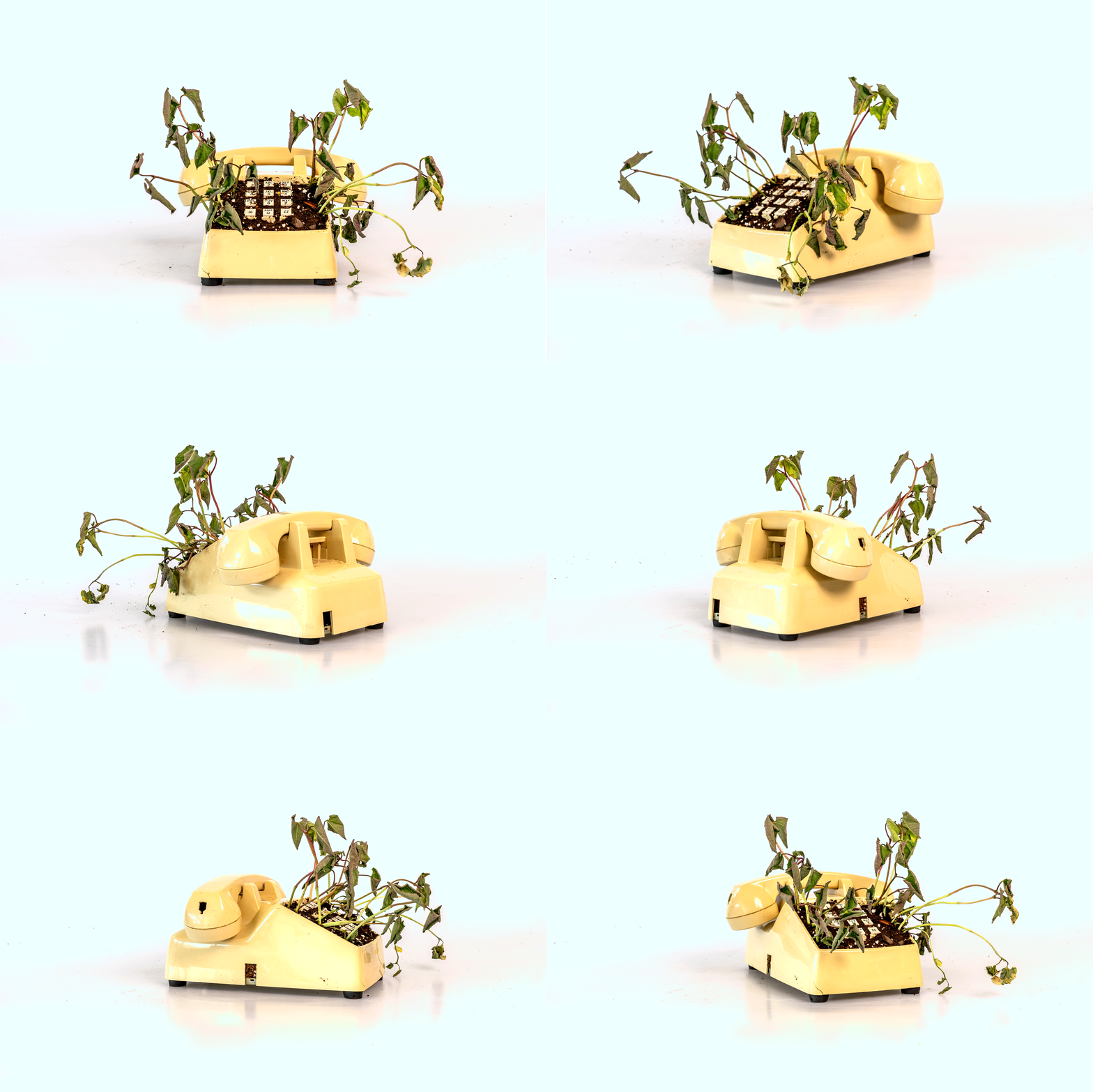
Simple, awkward, funny, beautiful, generous, mean, and more. And not just human relationships. While I, myself, am fairly simple (ba-dum-cha), I’ve had an awkward backpack, a funny phone, a beautiful bow tie, a generous shower, a mean cup of coffee. And each impacts me, and those around me; relationships are ecological.
An ecological approach takes account of, and speculates on, materials, processes, and thoughts, together. It is concerned with how humans and non-humans, matter and concepts, things and not-yet things, politics, economics, language, and industry, past, present, and future, for example, are all actively shaped in, and as, their interrelations. There are, according to Erich Horl, ecologies in the thousands, including “ecologies of sensation, perception, cognition, desire, attention, power, values, information, participation, media, the mind, relations, practices, behavior, belonging, the social, [and] the political” to name a fraction of those already called into action.

Art has the ability to highlight and magnify such ecologies – to ask us how we might better perform our relationships – through humor, discomfort, movement, perception, wonder, or other means. I combine new and traditional media in installations and objects, prints, videos, sculptures, and public works that suspend and intensify our ecological relationships: with the humans, nature, and politics therein. My work foregrounds taken for granted categories – such as technology or nature, body or space, language or culture – and works to remember each as a dynamic encounter. Here we engage with and feel the world around us. We experience and practice how concepts and matter cooperatively and continuously emerge.
This is both an ethical and aesthetic practice. It is an action, and a call to action.
 For example, my exhibition, catalog, and documentary, The World After Us: Imaging techno-aesthetic futures, combines plant life with electronic waste and scientific experimentation with artistic exploration to ask: What will digital media be and do, after us? What will my laptop, phone, or tablet look like in a million years? How will our devices weather or grow over time? What else might our techno-waste be, and how might we sense and feel this? Where might electronics lead our environmental and economic politics? Can we plan and act toward new and different futures? Its installation takes the forms of a wall-hung jungle of computer detritus and biological reclamation, fossilized and reconfigured phones and laptops, and reimagined electronics.
 Server Farms are computers and other technological equipment repurposed as planters. A gutted iMac, face up, where the screen and motherboard are replaced with wheat grass. A Dell filled with house plants, aloe sprawling from a tower, a mushroom and moss rooted in an Apple Watch. I root trees in laptops, grow molds and fungi in and around tablets, inject watches, phones, and cameras with spores and microscopic life – then let each flower, flourish, incubate, and spread.
 Or with Phossils, I subject media devices to extreme heat and cold, artificial pressure and geological time, or other intense conditions that weather and turn these materials into… something else. Through research, experimentation, and craft – including collaborations with geothermal scientists at Cornell University – I have tried to transform phones into crude oil, coal, or other fossil fuels, into synthetic archives and simulated relics for a future time. Cook, freeze, burn, smash, blend, and more… and put the results on exhibit, in beakers and tubes, on pedestals and stands, and/or as archaeological finds.
 And utilities see e-waste re-thought as a raw material, and transmuted into other (somewhat) usable forms. I turn ground phones into ink for the printing of fine art prints (Phonēy Prints). I melt down iMacs and recast them as a hammer, wrench, and screwdriver, cut circuit boards into a saw, axe, and trowel (Circuitous Tools and Applecations).
It is impossible for humans to truly fathom our planet on its own terms and at its own size, or conversely from the perspective of bacteria. But we can feel such things, through art and storytelling – making our aesthetic encounters both conceptually and ethically vital toward new futures. The World After Us questions how we move, think, feel, and act with the Earth and its inhabitants, both living and otherwise. It asks us to rethink our everyday interactions on a much larger scale, to change how we move, digitally and otherwise, as humans in the natural world on the one hand, between politics and commerce on the other.

 With web-based documentation and a companion hardcover book coming after the opening, Generation to Generation is my next large-scale exhibition (premiering at the Krasl Art Center, in Michigan, in late April 2025). All collaborations with AI poet and researcher, Sasha Stiles, Generation to Generation is a series of Artificial Intelligence (AI)-powered poems, installations, and writings that experiment with and exhibit how humans and technology have always evolved together. It asks how non-humans might sense, think, and create along with us, toward more fruitful futures. Centered around an AI-developed font – with language-letters the “smallest bit” of human technology – we ask,
– How does technology nurture human nature, and vice versa?
– Can human-AI collaboration yield truly creative and innovative offspring?
– In a world of human-made cyborgs, AI bots, and intelligent systems – alongside a spectrum of natural intelligences, from plant to animal – who or what do we consider kin?
– What does our emerging transhuman mother tongue look, feel, taste, smell and sound like? What other senses does it speak to?
– How can we leverage technologies to help shape meaningful legacies and better futures?
Asking and answering these questions has seen the production of: a monumental, poetic landscape of reclaimed electronic waste; an interactive mirror that “reads” human movement and translates it into dynamic code; a print- and image-based installation, featuring a custom AI font that evolves past human understanding, beyond the limits of the screen or page; play-based installation of stencils, coloring books, and paint; concrete poetry made of precious metals recovered from mining slag and computer waste — alchemized artifacts of digital communication; and, media-rich (generative/oral/aural/digital) performances of AI-powered poetry, updating an ancient art form for the approaching posthuman age.

 Generation to Generation: conversing with kindred technologies began with some metaverse drops between AI and generative art NFTs, such as our sold out reference to my last exhibition, THE WORD AFTER US (2022) and our Art Blocks Curated Still Moving, and continued with ongoing plays between poetic materials as sculpture and installation, and affective digital poetry on and off the Blockchain. Neural Networks, as well as novel understandings of natural networks – from forests and mycelium to ant farms and earthworms – are enabling and enhancing unique forms of creative exploration in and with various matter and materials, life and non-life. Generation to Generation hopes to open up those spaces for even greater exploration, both in academic circles and in the everyday.
At stake are not only the relationships between humans and the natural and technological worlds they inhabit and make, but the ongoing evolution and future of those worlds, together.
 In Body Language (2000-2013), my suite of four interactive installations, participants perform some of the complex relationships between materiality and text. With stuttering – developed and shown in dialogue with people who stutter – they use their entire bodies to touch and trigger activation points laid out in a Mondrian-styled grid. Each rectangle in the work’s projected image is not filled with primary colors, but animated text and spoken word. The saturation of these virtual buttons creates an inverse relationship: move quickly, and the piece will itself stutter in a barrage of audiovisual verbiage; move carefully, even cautiously – stutter with your body – and both meaning and bodies are substantiated. We must navigate our arms and hands, legs and feet, or neck and head, laboriously back and forth, on and off, each individual button. We slowly and carefully explore bodies, language, and space, together: like Butoh, or Thai Chi. It is an embodied listening. The piece asks, What if we performed our bodies, media, concepts, and materials with this level of care all the time? In Congress or business meetings, with our families or in nature? What could that be and do? Body Language invites an investigation of, and accountability for, how we rehearse speaking and listening, acting and writing, bodies and language. It coincides with my first book, Interactive Art and Embodiment: The Implicit Body as Performance (2013, Gylphi), which takes a close look at the stakes for interactive and digital art, and their implications.
Central to my work are the feedback loops between sensation, experience, movement, and understanding. What do we sense, and how does that make sense? Where do we move, and when are we moved? What do we value, and how does that change our values? Materiality and embodiment, affect and perception, transformation and time. I want to foster greater dialogue around these complex and relational ecologies.
 In my Compressionism series of prints (2006 and ongoing), I strap a desktop scanner, computing device, and custom-made battery pack to my body, and perform images into existence. I might scan in straight, long lines across tables, tie the scanner around my neck and swing over flowers, do pogo-like gestures over bricks, or just follow the wind over water lilies in a pond. The dynamism between my body, technology, and the landscape is transformed into beautiful and quirky renderings, which are then produced as archival prints. In mid-2014, I built a sub-aqueous imaging system, and produced Rippling Images: 18 prints while scuba diving on a live coral reef. Here I folded not only time and space into the work, but also the impacts of water and land, life and non-life, that we perform with every day: as individuals, as bodies, and as a people. Each image enfolds breathing and air, plastic and gravity, scratching and breakage, water, bubbles, fish, and more, as movement, change, and relation: frozen, and full of force.
Both Compressionism and my interactive works are ‘per-formed’ to challenge notions of a ‘pre-formed’ world, or sense, or meaning. By engaging the potentials of process and external influence into my art, I bring to the fore some of the many ecological agencies that play a role in continuing to make what is. ‘We’ are a always a part of intricate, interacting, and ongoing materials, processes, and thoughts; we are always more than the boundaries of what we know, or feel, or make.
Given Time (2010) stages two permanently logged-in Second Life avatars, each forever and only seen by and through the other. These lovers are hand-drawn in subtly animated charcoal, graphite, and pastel, and hover in mid-air, gazing into one another’s interface. Viewers encounter their partnership as large-scale and facing video projections in a real world gallery. They are invited to physically walk between them, able to hear and see them breathing, witness their hair blowing in the wind, pick up faint sounds such as rushing water or birds crying out from the surrounding simulated environment. Here, an intimate exchange between dual, virtual bodies is transformed into a public meditation on human relationships, bodily mortality, and time’s inevitable flow. Love, reciprocity, and generosity are potent forces for creation and change.

Wikipedia Art, with Scott Kildall (2009), questions structures of power and knowledge in the Age of the Internet. Here we wrote about, and then initiated, an art work composed on Wikipedia, and thus art that anyone can edit. Through a social and creative feedback loop of publish-cite-transform that I call ‘performative citations,’ the piece began as an intervention, turned into an object, and was killed and resurrected on the Wikipedia site several times over. Wikipedians, artists, critics, bloggers, geeks, and journalists debated fact, theory, and opinion via hundreds of sites and publications worldwide, each community continuously transforming what the work was and did and meant simply through their writing and talking about it. Our more recent Tweets in Space (2012) sent messages from participants worldwide towards a habitable exoplanet 22 light years away. This project appeals to wonder and curiosity, while accenting the potency of social media dialog: the shallowness of 140 characters at a time, and the depth created by thousands of users conversing all at once.
 Writing and lecturing are also integral parts of my practice as an artist. In addition to an undergraduate degree in design and terminal Masters in studio art, I hold a hybrid humanities and engineering PhD in art and technology, and continue to write articles, books, chapters, reviews, and artist viewpoints for various mainstream and academic publications. My second book, Ecological Aesthetics: artful tactics for humans, nature, and politics (2018, Dartmouth College Press) is a creative and scholarly collection of stories about art, artists, and their materials, which argues that ecology, aesthetics, and ethics are inherently interconnected, and together act as the cornerstone for all contemporary arts practices.
I am fundamentally a researcher, who thrives on teaching, learning, and making work as an academic, as a part of my city’s vibrant arts and community organizations, and through the various online and translocal collectives I am a part of. My writing, community efforts (ie Eco Labs DAO, ABLE, MARN mentorship, and more), and teaching, like my art, combine traditional art historical trajectories with contemporary understandings of affect, ecology, relationality, and media, in order to bring new insight to arts and cultural production and criticism. My work seeks to infold our unfolding relationships with the world, and with one another. I invite us to explore, to embody, to re-imagine, and to re-make not only what is, but what could be. In short, an ecological and generous approach is at the center of my practice as an artist, as a teacher, and as a professional. I encourage, and attempt to model, both curiosity and dialog in the studio, in the classroom, around campus, and in the (art) world at large.
Just think about the kinds of relationships and environments we’d have if we thought more about the relationships and environments we have.